Questions
- What is the GOR Method?
- The GOR (Garnier-Osguthorpe-Robson) method is a method for predicting protein secondary structure from amino acid sequence.
It was developed in the early 1980s by Philippe Garnier, David Osguthorpe, and Robson Barlow. - The GOR method uses a statistical approach to predict the secondary structure of a protein.
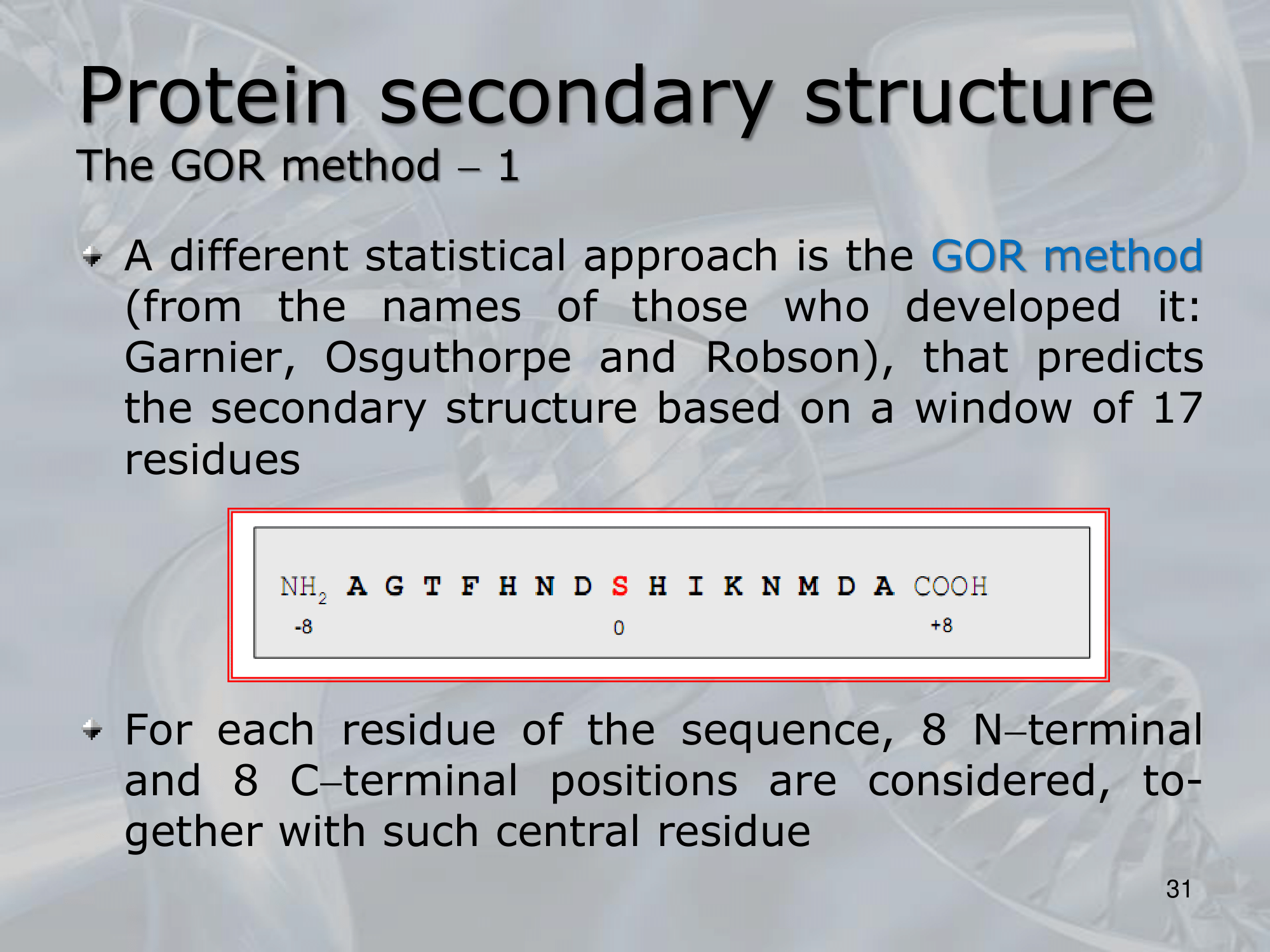
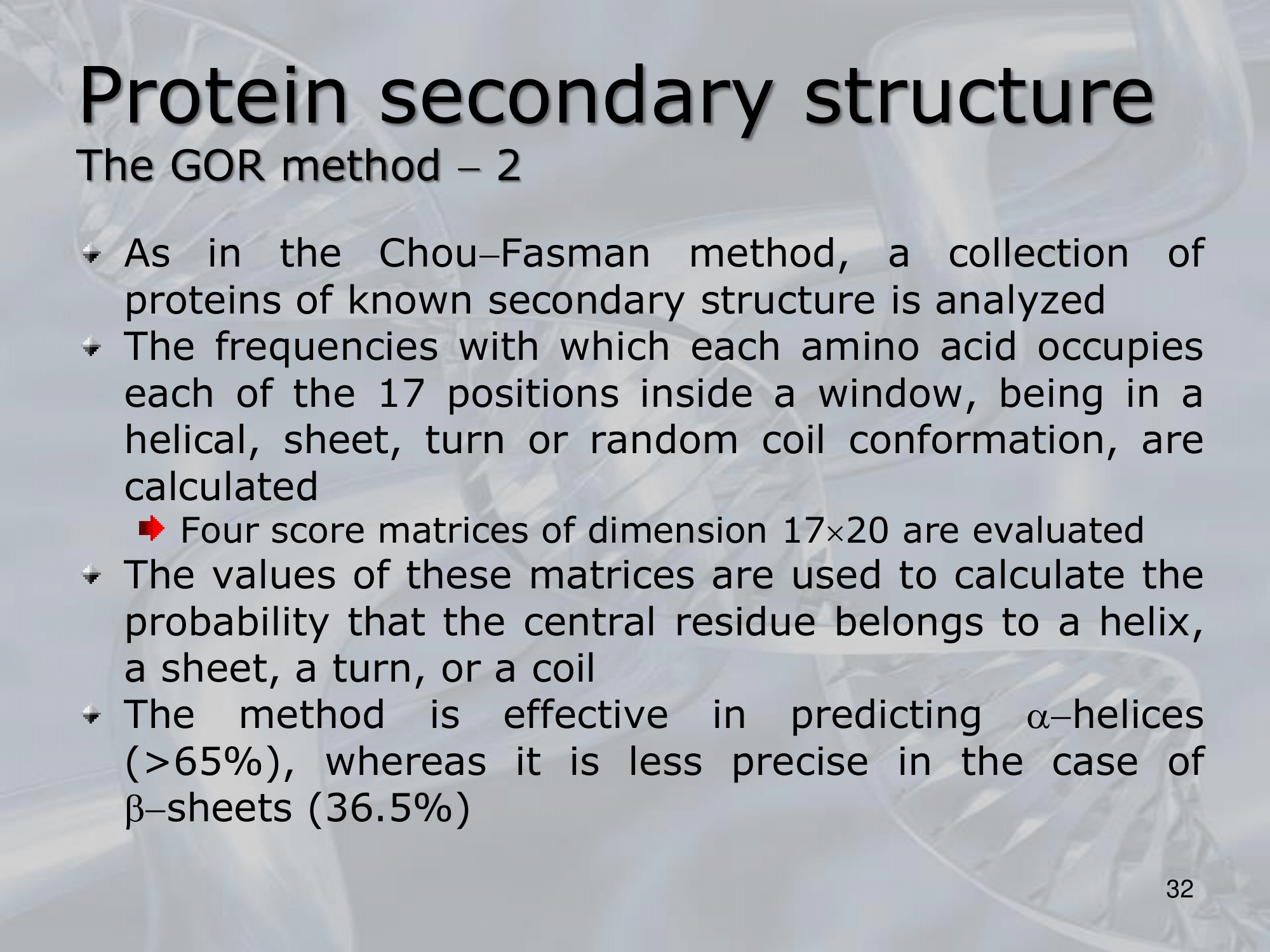
It involves analyzing the frequency of each type of secondary structure element (alpha helix, beta sheet, or coil) in a training set of known protein structures, and then using this information to predict the secondary structure of a new protein based on its amino acid sequence. - ==The GOR method uses a sliding window of typically 17 amino acids to make the prediction.
At each position in the protein sequence, the method calculates the probability of each type of secondary structure based on the frequencies observed in the training set==.
The probabilities are calculated using a log-odds scoring scheme, which takes into account the likelihood of observing a particular amino acid in each type of secondary structure. - The GOR method was one of the first methods to achieve a high level of accuracy in secondary structure prediction, and it was widely used in the 1980s and 1990s.
However, its accuracy has since been surpassed by more sophisticated machine learning methods, such as neural networks and support vector machines.
- The GOR (Garnier-Osguthorpe-Robson) method is a method for predicting protein secondary structure from amino acid sequence.
—————————————————————
IMPORTANTE
IMPORTANTE The GOR Method: We take a 17-residues window:
Using score matrices we calculate a score for the central residue, and we determine if it belongs to a helic, a sheet, a turn or a random coil. This method is more effective on -helics (> 65% accuracy), but less precise on -sheets (36.5% accuracy)
—————————————————————
Slides with Notes