Questions
- What are Terminator Sequences?
- Terminator sequences, also known as stop codons, are short DNA or RNA sequences that signal the end of a genetic sequence.
In DNA, the three stop codons are TAA, TAG, and TGA, while in RNA, the corresponding stop codons are UAA, UAG, and UGA. - When a stop codon is encountered during the process of transcription or translation, it signals the termination of the genetic sequence and the release of the resulting RNA or protein molecule.
Stop codons do not code for any amino acids, and their presence in a genetic sequence ensures that the resulting protein is of the correct length and terminates in the appropriate location. - Terminator sequences are important for the proper functioning of genetic systems, as they ensure that the correct protein is produced in the correct location and in the correct amount.
Mutations or errors in the termination codon can result in the production of truncated or nonfunctional proteins, which can lead to genetic disorders or disease.
- Terminator sequences, also known as stop codons, are short DNA or RNA sequences that signal the end of a genetic sequence.
- What is there to say about the RNA Secondary Structure?
- RNA secondary structure refers to the 3-dimensional conformation that a single-stranded RNA molecule adopts due to the formation of hydrogen bonds between complementary base pairs within the same RNA molecule.
This structure is important for the function of many RNA molecules, including transfer RNA (tRNA), ribosomal RNA (rRNA), and messenger RNA (mRNA). - The RNA secondary structure is stabilized by the formation of base pairs between complementary nucleotides, with adenine (A) always pairing with uracil (U), and guanine (G) always pairing with cytosine (C).
This results in a variety of different structural motifs, including stem-loop structures, bulges, internal loops, and multi-branch loops.- ==Stem-loop structures are the most common structural motif in RNA secondary structure, and are formed when a single-stranded RNA molecule folds back on itself to form a double-stranded stem connected by a single-stranded loop==.
These structures can be important for regulating gene expression and protein synthesis, as they can affect the stability of mRNA and the accessibility of ribosomes to the coding sequence.
- ==Stem-loop structures are the most common structural motif in RNA secondary structure, and are formed when a single-stranded RNA molecule folds back on itself to form a double-stranded stem connected by a single-stranded loop==.
- RNA secondary structure can be predicted using computational tools, which use algorithms to identify regions of complementary base pairing within an RNA molecule.
These predictions can then be used to study the structure and function of different RNA molecules, and can provide insight into their role in cellular processes such as translation, splicing, and gene regulation. - Overall, RNA secondary structure is an important aspect of RNA biology, and can play a key role in determining the function and regulation of RNA molecules in the cell.
- RNA secondary structure refers to the 3-dimensional conformation that a single-stranded RNA molecule adopts due to the formation of hydrogen bonds between complementary base pairs within the same RNA molecule.
—————————————————————
IMPORTANTE
IMPORTANTE Instrisic Terminators: Nucleotide sequence that include an inverted repeated sequence (~ex.: -CGGAUGC | GCAUCCG) immidiately followd by a sequence composed by (about) six uracils Similirarly to the easily recognizable sites placed immeadiately down-stream of the promoters, the great majority of prokaryotes genes also contain this specific signals, the intrinsic terminatror, that is a specific signal for the termination of transcription
IMPORTANTE RNA secondary structure Although usually RNA molecules are described as single-strand, they can actually adopt secondary structures, due to the formation of the intra-molecular base pairs, within the inverted repeats: ~Ex.:
The stability of the RNA secondary structure is directly connected to the length of the inverted repeats (often imperfect) and to the number of C/G and A/U inside these repetition. Remember that G-C forms hydrogen bonds, while A-U only .
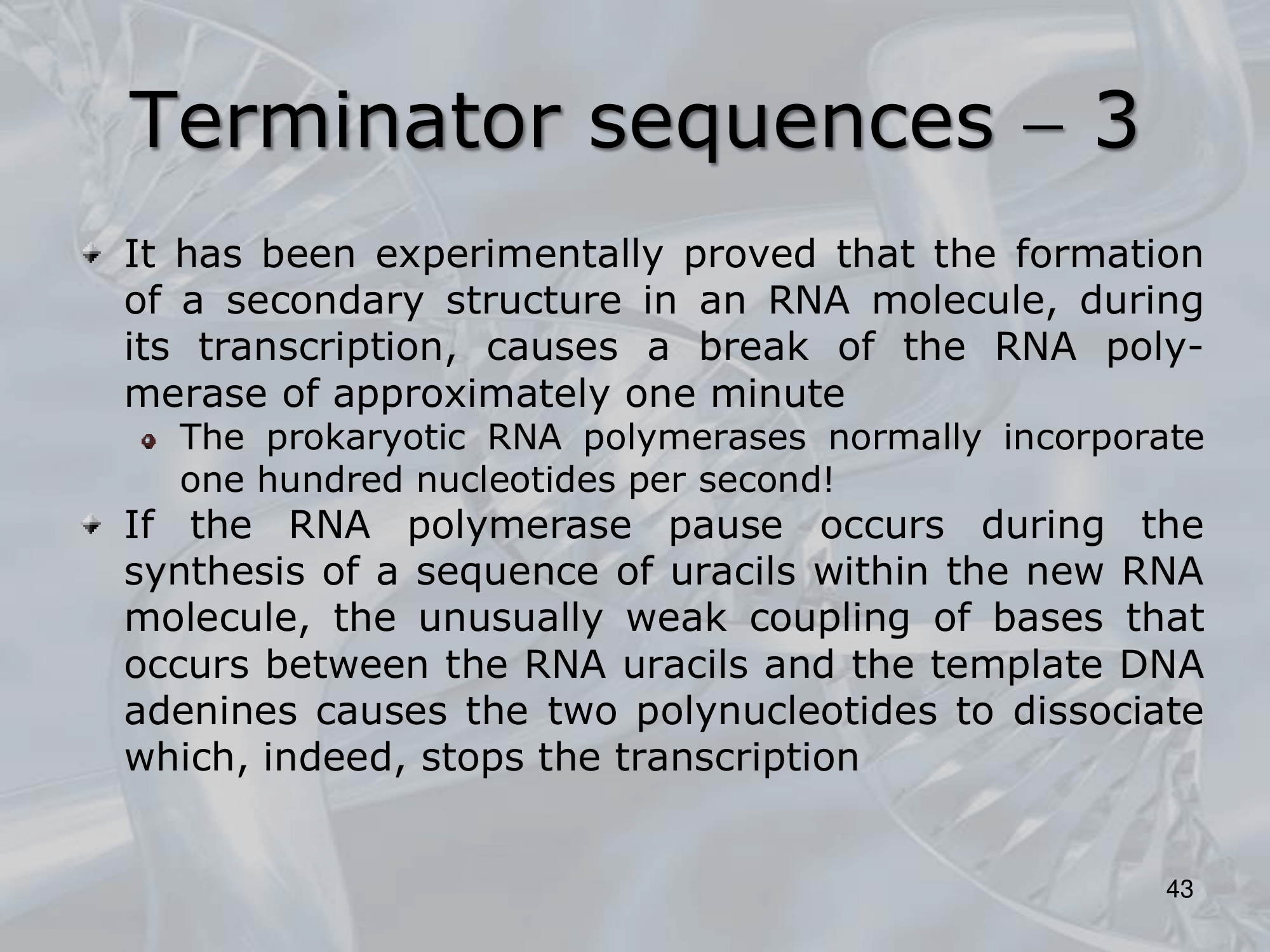
IMPORTANTE If the RNA forms a secondary structure it is good to note that transcription will take a brake more minute or so (for scale, the RNA polymerase transcribe 100 nucletides per second), because of the weak coupling that forms (hydrogen bonds) due to the inverted repeats.
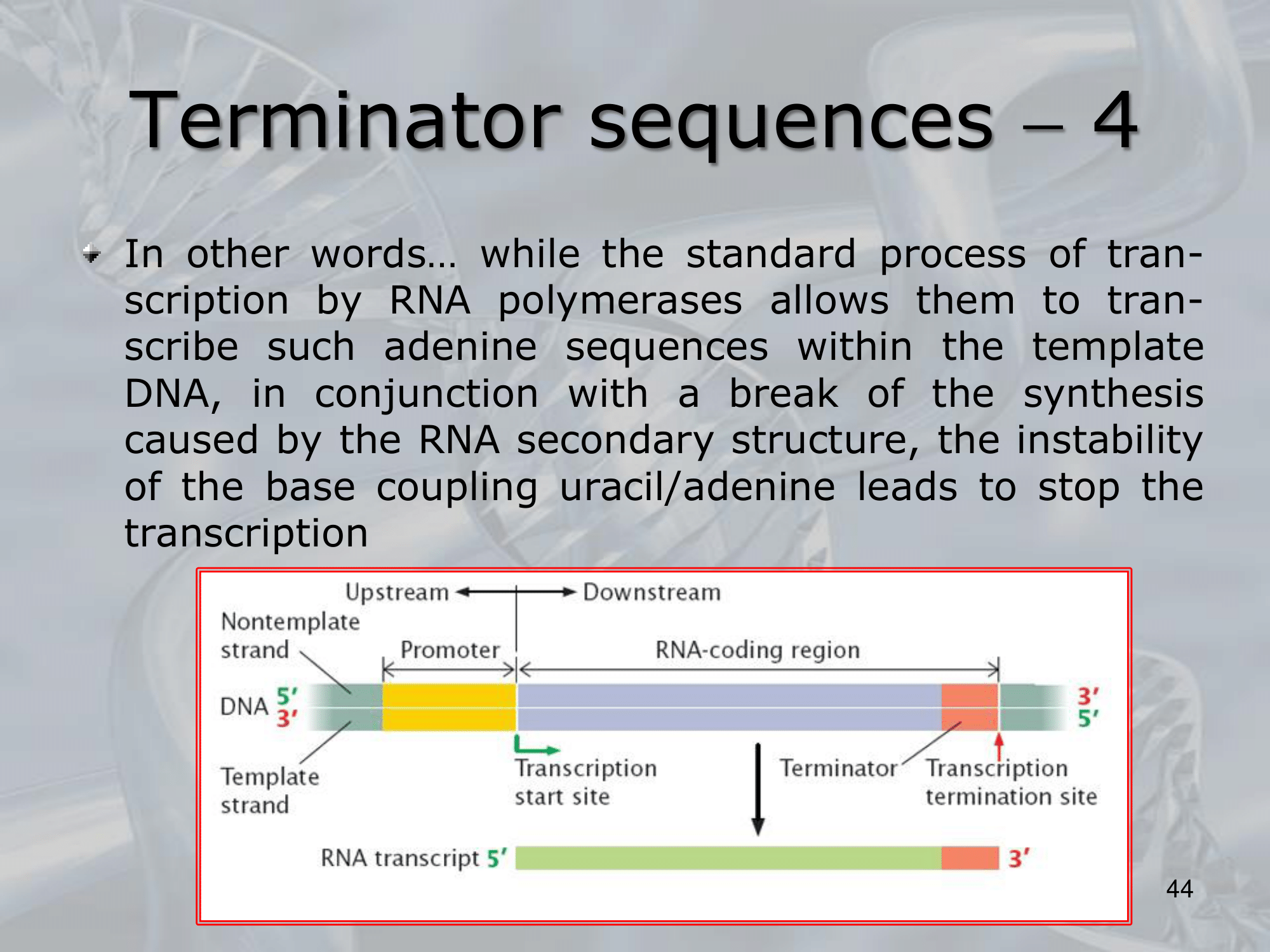
IMPORTANTE How is the Transcription process stopped? The RNA polymerase due to the unusual weak coupling that occurs when it find the terminator sequence of all uracils, will dissociate the RNA polymerase with the DNA sequence, stopping the transcription
—————————————————————
Slides with Notes
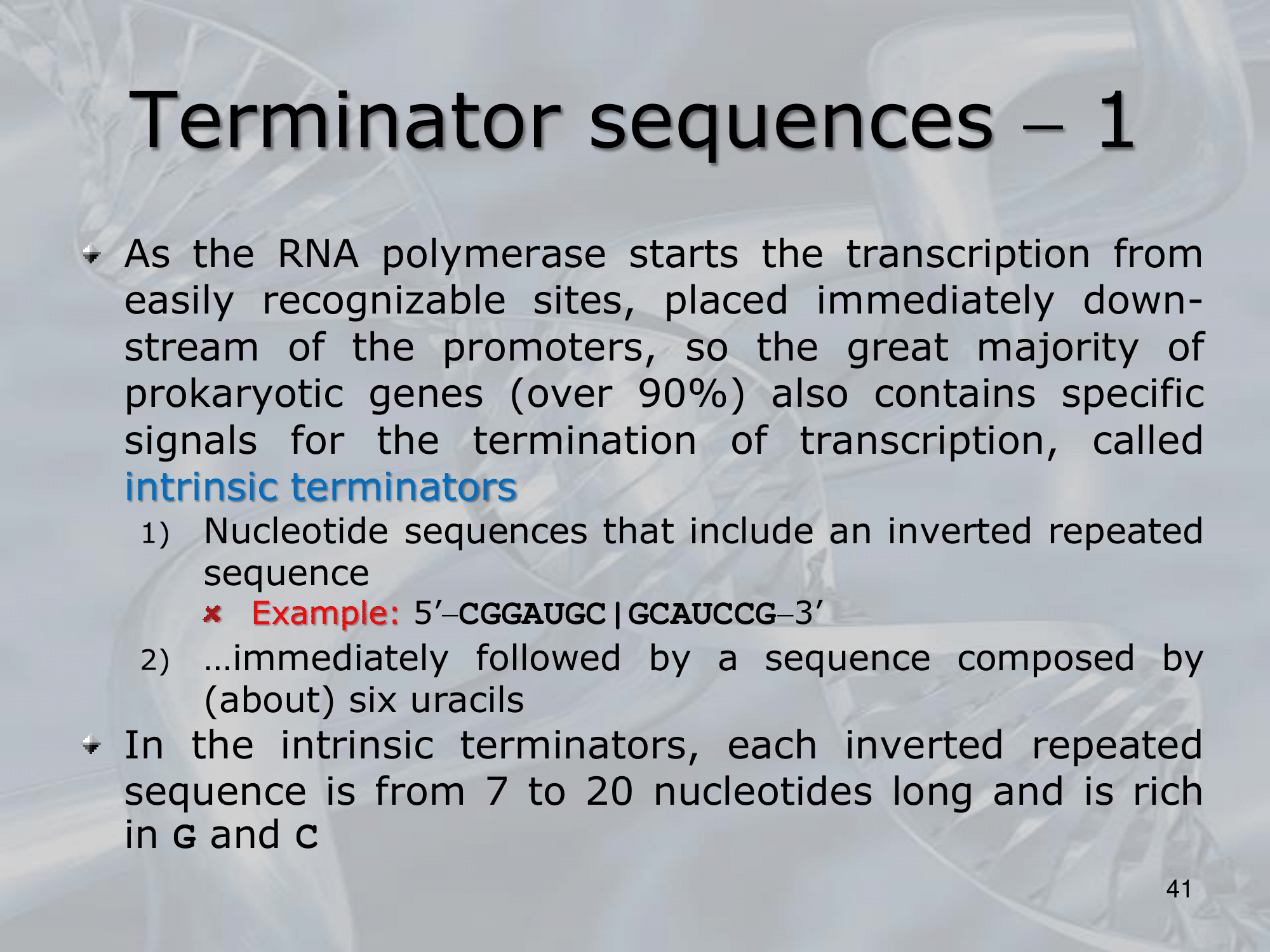
IMPORTANTE Instrisic Terminators: Nucleotide sequence that include an inverted repeated sequence (~ex.: -CGGAUGC | GCAUCCG) immidiately followd by a sequence composed by (about) six uracils Similirarly to the easily recognizable sites placed immeadiately down-stream of the promoters, the great majority of prokaryotes genes also contain this specific signals, the intrinsic terminatror, that is a specific signal for the termination of transcription
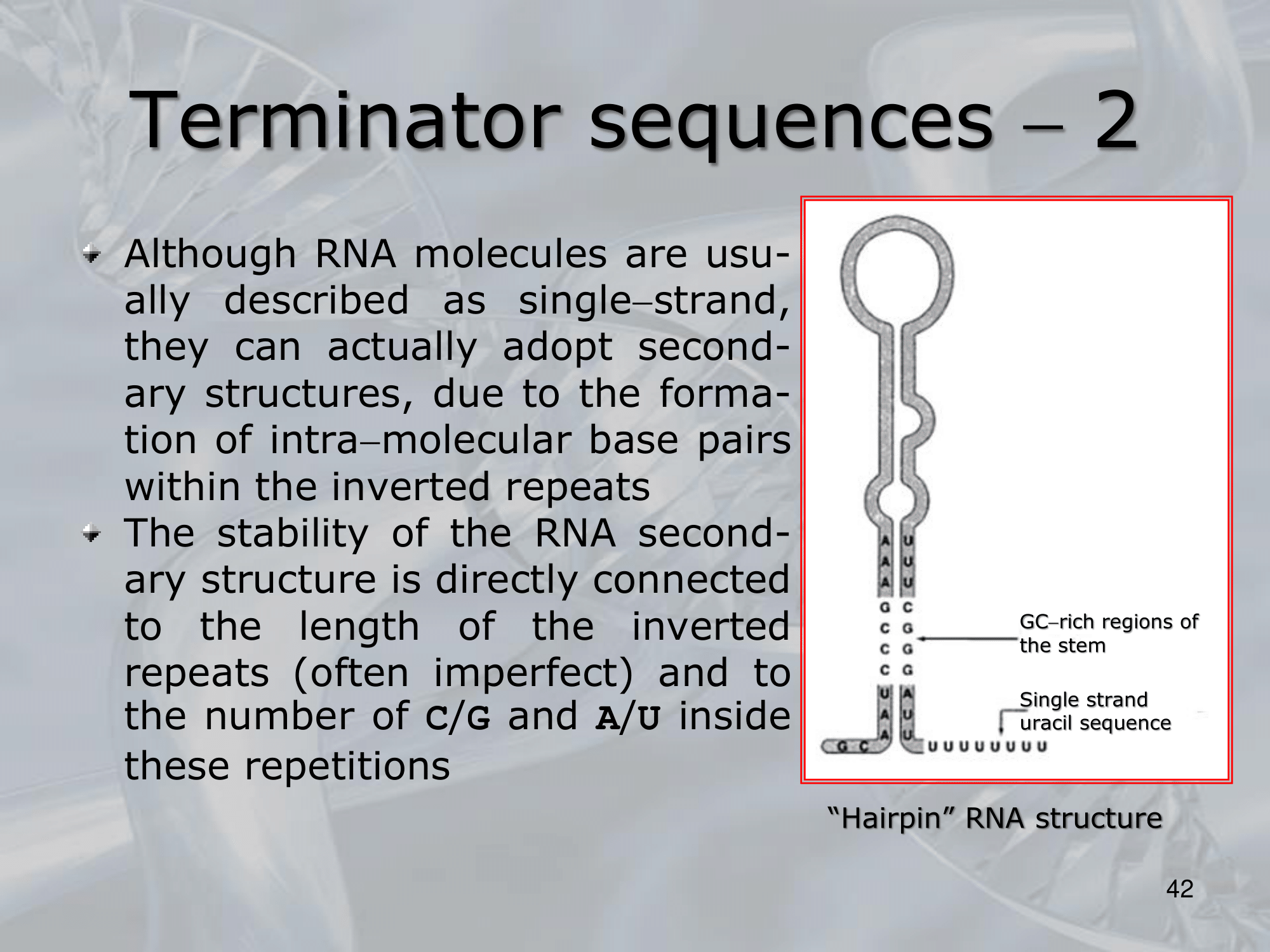
IMPORTANTE RNA secondary structure Although usually RNA molecules are described as single-strand, they can actually adopt secondary structures, due to the formation of the intra-molecular base pairs, within the inverted repeats: ~Ex.:
IMPORTANTE If the RNA forms a secondary structure it is good to note that transcription will take a brake more minute or so (for scale, the RNA polymerase transcribe 100 nucletides per second), because of the weak coupling that forms (hydrogen bonds) due to the inverted repeats.
IMPORTANTE How is the Transcription process stopped? The RNA polymerase due to the unusual weak coupling that occurs when it find the terminator sequence of all uracils, will dissociate the RNA polymerase with the DNA sequence, stopping the transcription