Questions
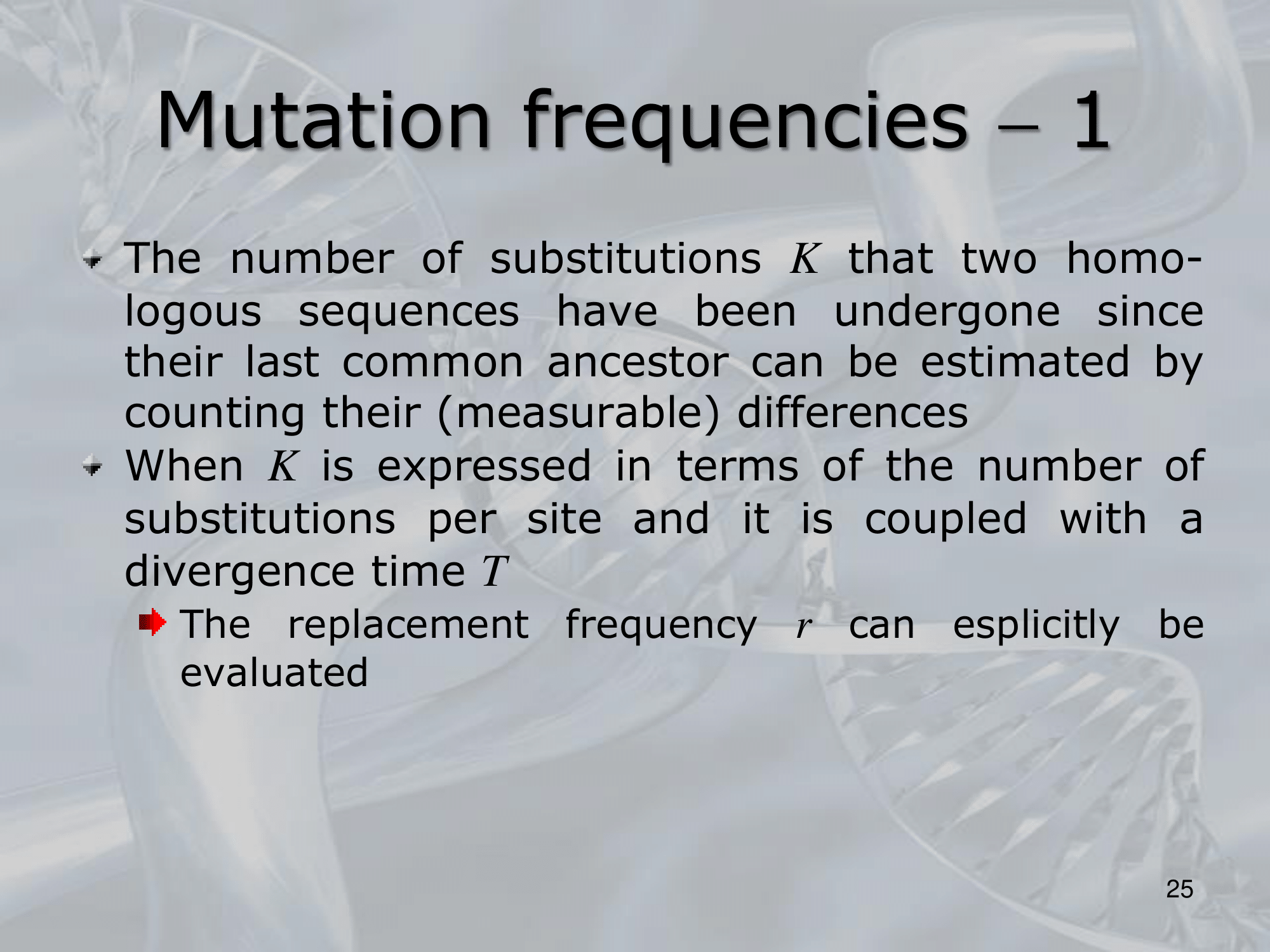
- What is the Divergence Time?
- ==Divergence time is the estimated time at which two or more lineages diverged from a common ancestor==.
In molecular evolution, divergence time is usually estimated based on the differences in genetic sequences between the lineages.
By comparing the sequences of orthologous genes or proteins in different organisms, scientists can reconstruct the evolutionary history of these organisms and estimate the time at which their common ancestors existed.
Divergence time can be affected by various factors such as mutation rates, generation times, and natural selection, and accurate estimation of divergence time requires careful consideration of these factors.
Divergence time estimation is a fundamental tool in evolutionary biology and can provide insights into the origin and diversification of different organisms and the processes that have shaped their evolutionary history.
- ==Divergence time is the estimated time at which two or more lineages diverged from a common ancestor==.
- What is the Number of Substitutions, how can we Evaluate it?
- The number of substitutions is a measure of the evolutionary distance between two DNA or protein sequences.
It refers to the number of nucleotide or amino acid differences between the sequences, indicating the number of times that a base or amino acid has been replaced by another over the course of evolution. - There are various methods to evaluate the number of substitutions, such as pairwise sequence alignment, multiple sequence alignment, and phylogenetic analysis.
- Pairwise sequence alignment compares two sequences and identifies the positions where substitutions have occurred.
The number of substitutions can be estimated by counting the differences in the aligned positions. - Multiple sequence alignment is a more sophisticated method that aligns three or more sequences and identifies the positions where substitutions have occurred in all sequences.
This approach allows for a more accurate estimation of the number of substitutions and can also identify conserved regions and domains in the sequences. - Phylogenetic analysis is a method that uses the number of substitutions to reconstruct the evolutionary history of the sequences and the organisms that carry them.
By building a tree of relationships between the sequences, phylogenetic analysis can estimate the divergence time and the rate of evolution for different lineages.
- Pairwise sequence alignment compares two sequences and identifies the positions where substitutions have occurred.
- Overall, the number of substitutions is a key measure in molecular evolution and provides insights into the evolutionary relationships, divergence times, and functional changes of different genes and proteins.
- The number of substitutions is a measure of the evolutionary distance between two DNA or protein sequences.
- What is the Replacement Frequency, how can we Evaluate it?
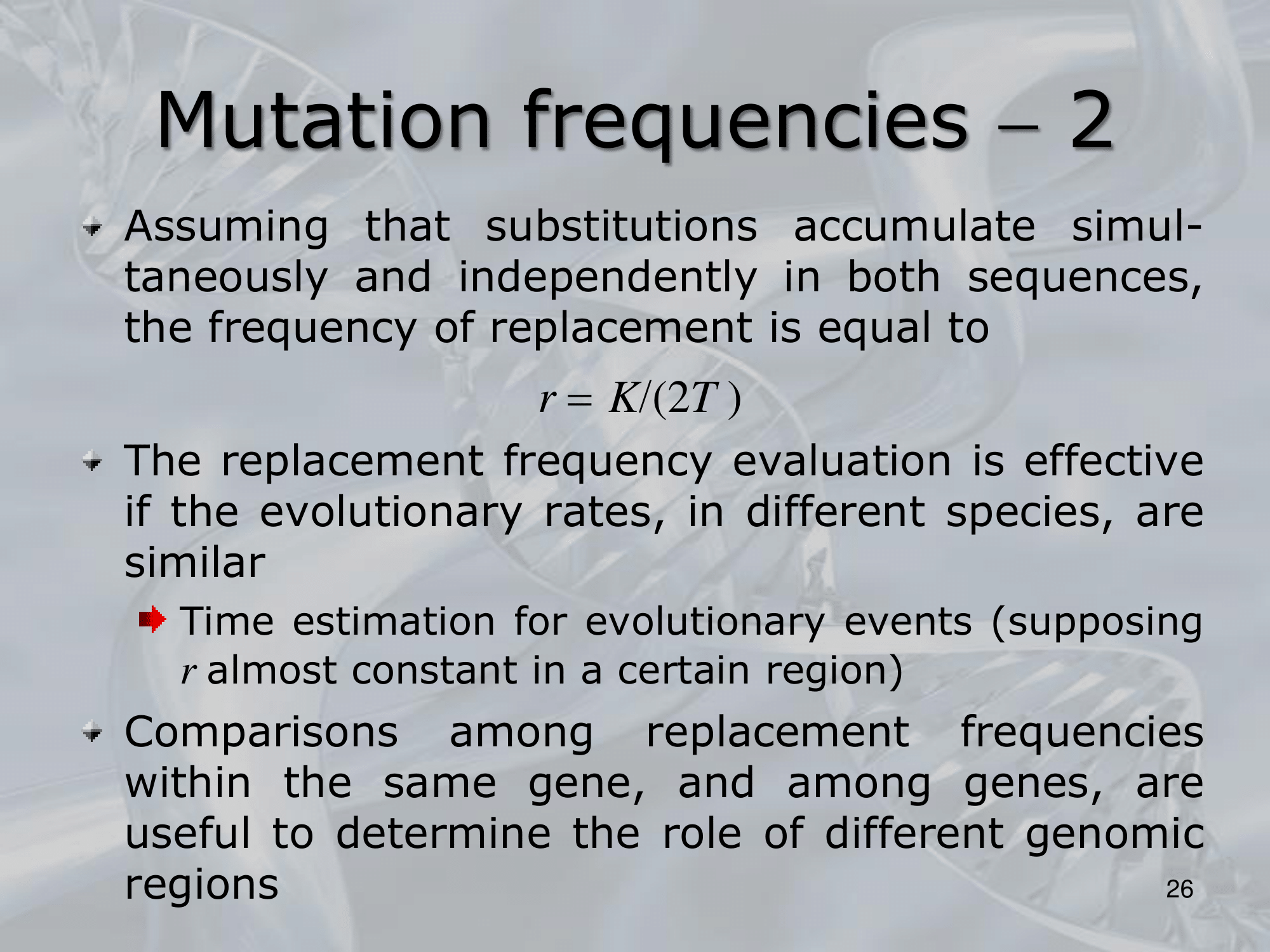
- ==The replacement frequency, also known as the replacement rate, is a measure of how often an amino acid substitution occurs per unit time during protein evolution==.
It is typically estimated as the number of non-synonymous substitutions (amino acid changes) per non-synonymous site per unit time. - There are several methods to estimate the replacement frequency, including maximum likelihood and Bayesian methods.
These methods use a model of molecular evolution that takes into account the different rates of substitutions, the effects of selection and genetic drift, and other factors that influence the evolution of protein sequences. - One common method to estimate the replacement frequency is the Ka/Ks ratio, which compares the rate of non-synonymous substitutions (Ka) to the rate of synonymous substitutions (Ks).
- A Ka/Ks ratio of 1 indicates that non-synonymous substitutions occur at the same rate as synonymous substitutions, suggesting that the gene or protein is evolving neutrally. A
- Ka/Ks ratio greater than 1 suggests positive selection, where amino acid substitutions are being favored because they confer a selective advantage, while a ratio less than 1 suggests negative selection, where amino acid substitutions are being selected against because they are deleterious.
- Overall, the replacement frequency is an important measure in molecular evolution that provides insights into the functional changes and selective pressures acting on different genes and proteins.
- ==The replacement frequency, also known as the replacement rate, is a measure of how often an amino acid substitution occurs per unit time during protein evolution==.
- What is the Mutation Frequency, how can we Evaluate it?
- The mutation frequency is the rate at which new mutations occur in a given population or organism.
It can be measured in different ways depending on the type of mutation and the organism being studied. - For example, the mutation frequency for a particular nucleotide can be estimated by sequencing a large number of copies of the same DNA region from different individuals and counting the number of times the mutation is observed.
The frequency of different types of mutations, such as single nucleotide polymorphisms (SNPs), insertions, and deletions, can also be estimated using this approach. - Another way to estimate mutation frequency is to measure the rate at which mutations accumulate over time in a population.
This can be done by comparing the DNA sequences of related organisms or populations that have diverged over different periods of time.
By calculating the number of differences between the sequences and the time since the organisms diverged, the mutation rate can be estimated. - In addition to these direct methods, the mutation frequency can also be estimated indirectly by measuring other molecular markers, such as changes in the frequency of neutral alleles or the amount of genetic diversity within a population.
- Overall, the mutation frequency is an important parameter in genetics and evolutionary biology, as it influences the rate of genetic diversity and the potential for adaptation in a population.
- The mutation frequency is the rate at which new mutations occur in a given population or organism.
—————————————————————
IMPORTANTE
IMPORTANTE Divergence time : quanto tempo fa le due specie si sono “divise/create”. #IMPORTANTE Number of substitution . #IMPORTANTE Replacement Frequency : frequenza di sostituzione di basi all’interno del DNA di due specie Comparare le replacements frequencies di geni diversi, può aiutarci a determinare il loro ruolo.
—————————————————————
Slides with Notes
IMPORTANTE Divergence time : quanto tempo fa le due specie si sono “divise/create”. #IMPORTANTE Number of substitution . #IMPORTANTE Replacement Frequency : frequenza di sostituzione di basi all’interno del DNA di due specie Comparare le replacements frequencies di geni diversi, può aiutarci a determinare il loro ruolo.