-
Most Enzymes are Proteins
-
Enzymes have a specifically shaped area called an active site where they can bind with a specific substrate.
-
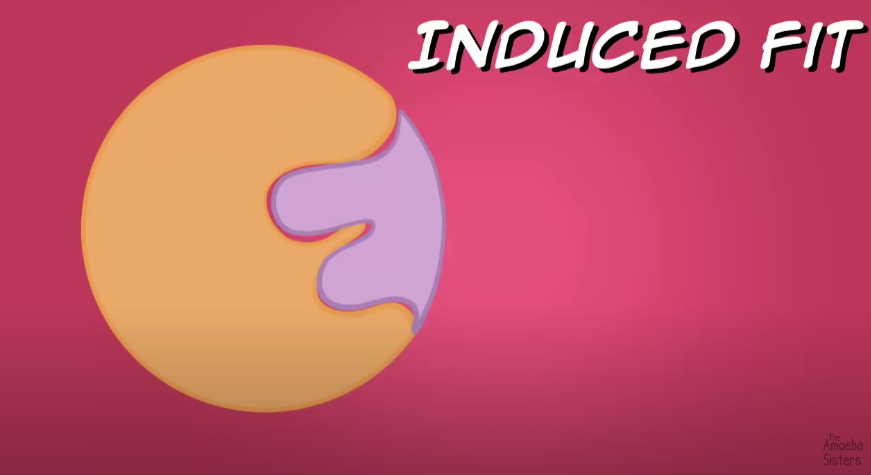
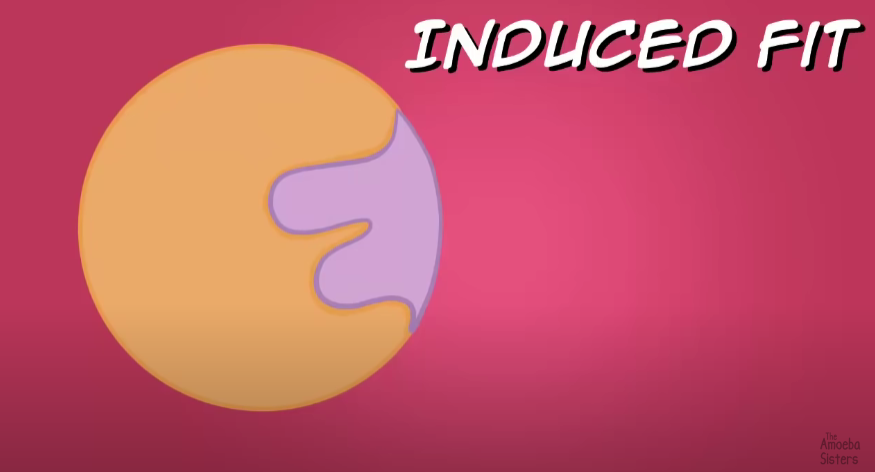
When a substrate bind with an enzymes it starts a process called induced fit, where the enzymes changes its shape even more to fit the substrate:
-
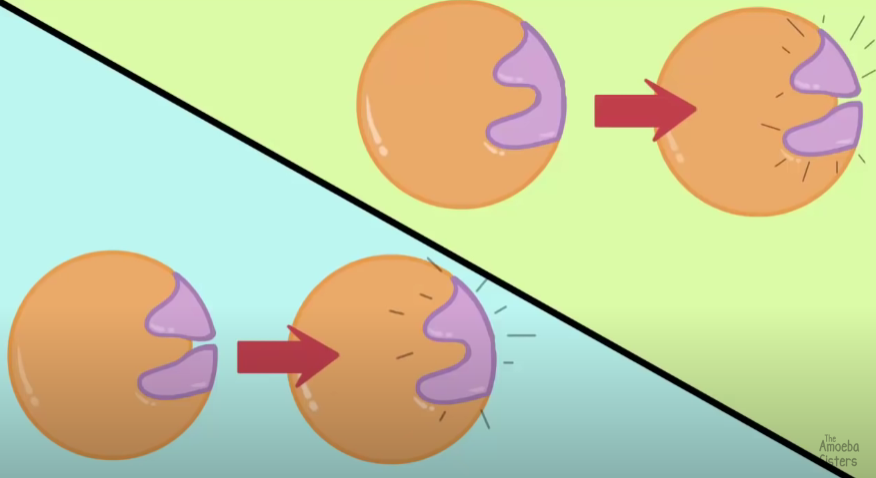
The enzyme will change the substrate, either it will brake it down or build it up, we call the results formed “products”
-
Enzymes have the ability to speed up reactions. For example the enzyme lactase has the ability to brake the bond formed by the sugar lactose, without enough of these enzymes we would have a hard time naturally digesting lactose.
NOTE: Enzymes usually end in -ase. While sugars usually end in -ose
-
Enzymes are catalysts and once a product is made, they can be reused for other reactions.
-
Enzymes can be found all around the human body, also can be found in plants, bacteria, fungi, and even in some viruses
~Ex.: Examples of Enzymes:
- Lipase (to brake down lipids) It brakes down lipids. One usual location of lipase is in our small intestin
- Amylase It brakes down carbohydrates, for example starch. One usual location of amylase is in our mouth
- Protéase
- Pepsin
- Trypsin To brake down proteins. One usual location of Pepsin is in the stomach One usual location of Trypsin in the small intestine
- Nucléases Brake down nucleic acids (DNA and RNA), specifically it brakes down their phosphodiester bonds, breaking them into nucleotides
Cofactors & Coenzymes
-
Enzymes not always work alone, they can also be helped by cofactors and coenzymes, they may bind to the active site and help the enzyme do its job
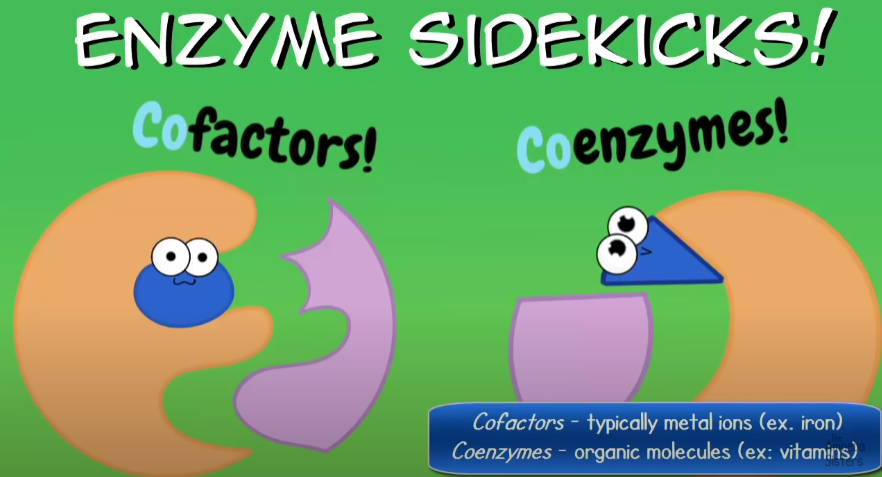
- Cofactors: typically metal ions (~ex.: iron)
- Coenzymes: organic molecules (~ex.: vitamins)
-
Enzymes have ideal condition to work (live) in, each enzyme has a different ideal pH and Temperature range, if the environment the enzymes lives in changes, the enzymes becomes denatured, that means its shape becomes distorted and it can no longer bind to its substrate.
-
An enzyme and cofactor/coenzyme bond can be permanent or temporary, it depends on how they are bonded
~Ex.: During the duplication of DNA, the enzyme DNA Polymérase is helped by the zinc-ion (a cofactor).
Inhibitors
Inhibitors can be either competitive or anti-competitive, their function is the same, changing the active site to stop the enzyme from doing its job.
-
Competitive Inhibitors sit in the active site blocking a substrate from being able to bind, the substrate are competing with the inhibitor.
-
Anti-Competitive Inhibitors instead bind to some other areas, and once they are bond they change the active site shape, again substrate can no longer bind to the enzyme.
-
Feedback Inhibition, a good use for inhibitor is to stop enzymes from producing too much of a specific product. Let’s see an example, we have a productio chain composed of three enzymes, that take a substrate A and change it into the product D:
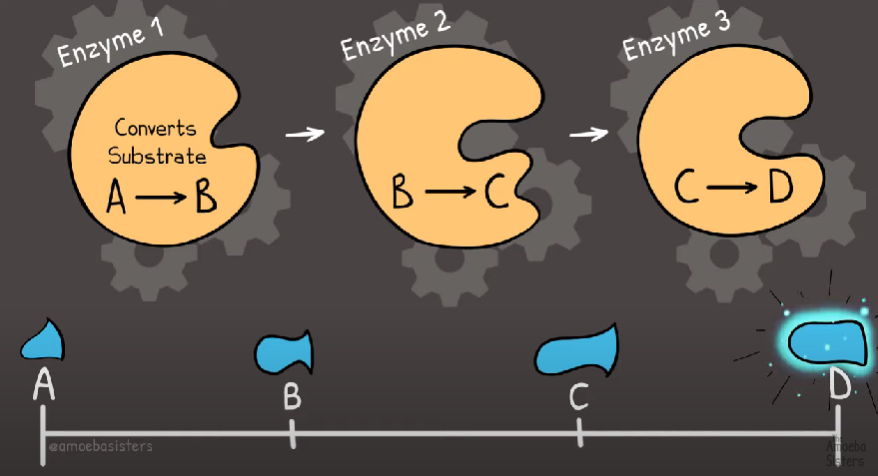 Once we have enough D product we would like to stop this chain, to do this the enzyme 1 might have aa an inhibitor the product D, once enough D product are done, some will be used to stop the chain inhibiting the first enzyme.
How are Enzymes Created:
Enzymes are proteins, ie made up of amino acids.. Synthesis of enzymes can be explained by Central Dogma of biology.
The Central Dogma Central Dogma of biology provides the basic framework for how the genetic information flows from genetic material (DNA) to Protein products inside the cell.
- DNA to RNA to Proteins

Deoxyribose nucleic acid (DNA) is the genetic material of life, all genetic informations are stored in DNA.. As we all know DNA is made up of Adenine (A), Thymine (T), Guanine (G) and Cytosine (C).
Well Genetic information is stored using these nucleic acids only.
DNA is composed of ATGC, RNA is composed of UTGC (Uracil(U) instead of Adenine) and proteins are made up of Amino acids (20 of proteinogenic amino acids). In order to get a fully active enzyme we need the DNA containing the information about that enzyme to be properly transcripted into RNA and then translated into Protein.
What is genetic information ?? Let’s say certain enzyme is made up of 100 amino acids (aa) MTPHYICR…….REQADPL (amino acid sequence with one letter code of aa) Now information of each aa is stored in DNA as a 3 letter codon
Methionine M is stored as - TAC (DNA) - AUG (RNA) (Adenine, Uracil and Guanine)

- Different codons of amino acids

- Codons in RNA, each codon represent an amino acid
Now there are some large machine like proteins in body called Ribosomes which can recognize the AUG in RNA and Insert a méthionine and start the protein or enzyme synthesis.. Similarly it happens for second amino acid and 2nd aa is attached to the end of 1zt aa, likewise 100 aa are attached in a sequence by Ribosomes by reading the RNA.. Later these large aa sequence folds and form as active protein or enzymes..

Light Green - RNA
Dark green -tRNA (helper in Ribosomes to bring amino acids by recognizing the codons)
Violet - Growing protein sequence
This is how , not only enzymes all proteins in our body is synthesized.. The central Dogma of biology