Questions
- What is Phylogenetic Analysis?
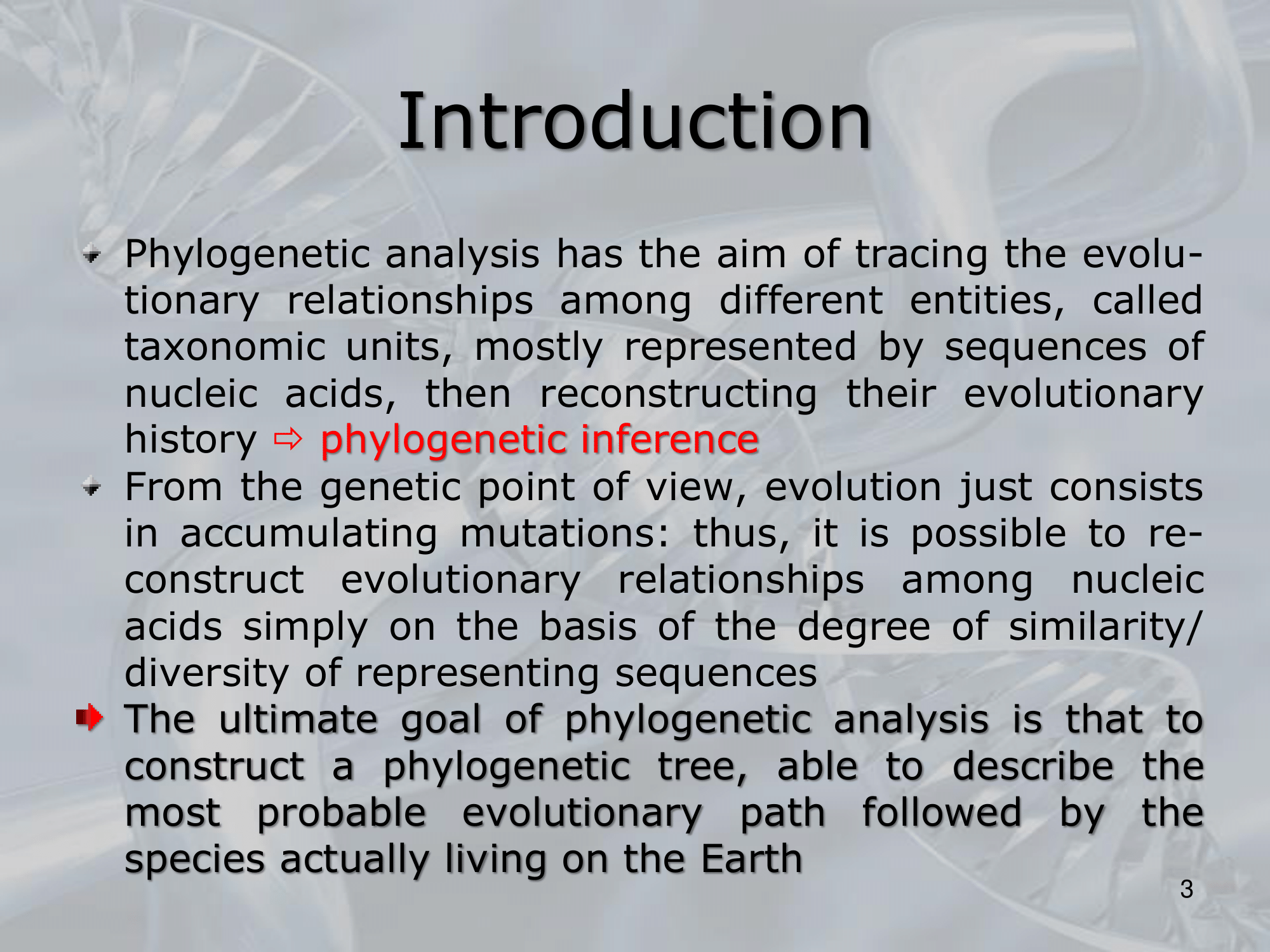
- Phylogenetic analysis is the study of evolutionary relationships among organisms, using molecular, genetic, and morphological data.
The goal of phylogenetic analysis is to reconstruct the evolutionary history, or phylogeny, of a group of organisms, which is typically represented as a branching tree diagram called a phylogenetic tree or cladogram. - Phylogenetic analysis is based on the principle of common descent, which suggests that all living organisms are related to each other through a shared evolutionary history.
By comparing the similarities and differences among genetic sequences or other traits of different organisms, phylogenetic analysis can reveal patterns of evolutionary relatedness and help us understand how different species are related to each other. - Phylogenetic analysis has many applications in biology, including in the study of evolutionary biology, biogeography, and systematics.
It can be used to classify organisms into different groups, to infer the timing and pattern of evolutionary events, and to predict the likely evolutionary trajectory of a group of organisms in the future.
- Phylogenetic analysis is the study of evolutionary relationships among organisms, using molecular, genetic, and morphological data.
- What is Phylogenetic Inference?
- Phylogenetic inference is the process of reconstructing the evolutionary relationships among a group of organisms based on their shared characteristics, such as DNA sequences, morphological features, or behavioral traits.
The goal of phylogenetic inference is to generate a phylogenetic tree or cladogram that represents the evolutionary history of the group of organisms being studied. - Phylogenetic inference involves several steps, including data collection, alignment, model selection, and tree building.
- In the data collection step, genetic or other trait data is collected from the organisms being studied.
- In the alignment step, the data is organized and arranged so that similarities and differences can be compared across different organisms.
- In the model selection step, a mathematical model is selected to describe the evolutionary processes that produced the observed data.
- Finally, in the tree building step, a phylogenetic tree or cladogram is constructed based on the selected model and the observed data.
- Phylogenetic inference is a powerful tool for studying the evolutionary history of different organisms and can be used to answer a wide range of biological questions.
For example, it can be used to understand the evolutionary relationships among different species, to investigate the timing and pattern of evolutionary events, and to identify the genetic basis for different traits or diseases.
- Phylogenetic inference is the process of reconstructing the evolutionary relationships among a group of organisms based on their shared characteristics, such as DNA sequences, morphological features, or behavioral traits.
- What is the Ultimate Goal of Phylogenetic Analysis?
- The ultimate goal of phylogenetic analysis is to reconstruct the evolutionary relationships among a group of organisms and to understand their shared evolutionary history.
This can help us answer fundamental questions about the origins and diversification of life on Earth, and can also have practical applications in fields such as medicine, agriculture, and conservation. - By reconstructing a phylogenetic tree or cladogram, we can understand the relationships among different species and how they evolved over time.
This can help us identify common ancestors and the timing of important evolutionary events, such as the origin of new groups of organisms, the diversification of lineages, or the emergence of new traits. - Phylogenetic analysis can also have practical applications in fields such as medicine, where it can be used to understand the evolutionary relationships among different strains of pathogens and to design effective treatments or vaccines.
It can also be used in conservation biology to identify species that are closely related and may require similar conservation strategies. - Overall, the ultimate goal of phylogenetic analysis is to understand the evolutionary history of life on Earth and to use that knowledge to advance our understanding of biology and solve real-world problems.
- The ultimate goal of phylogenetic analysis is to reconstruct the evolutionary relationships among a group of organisms and to understand their shared evolutionary history.
- What is the Ockham’s Razor?
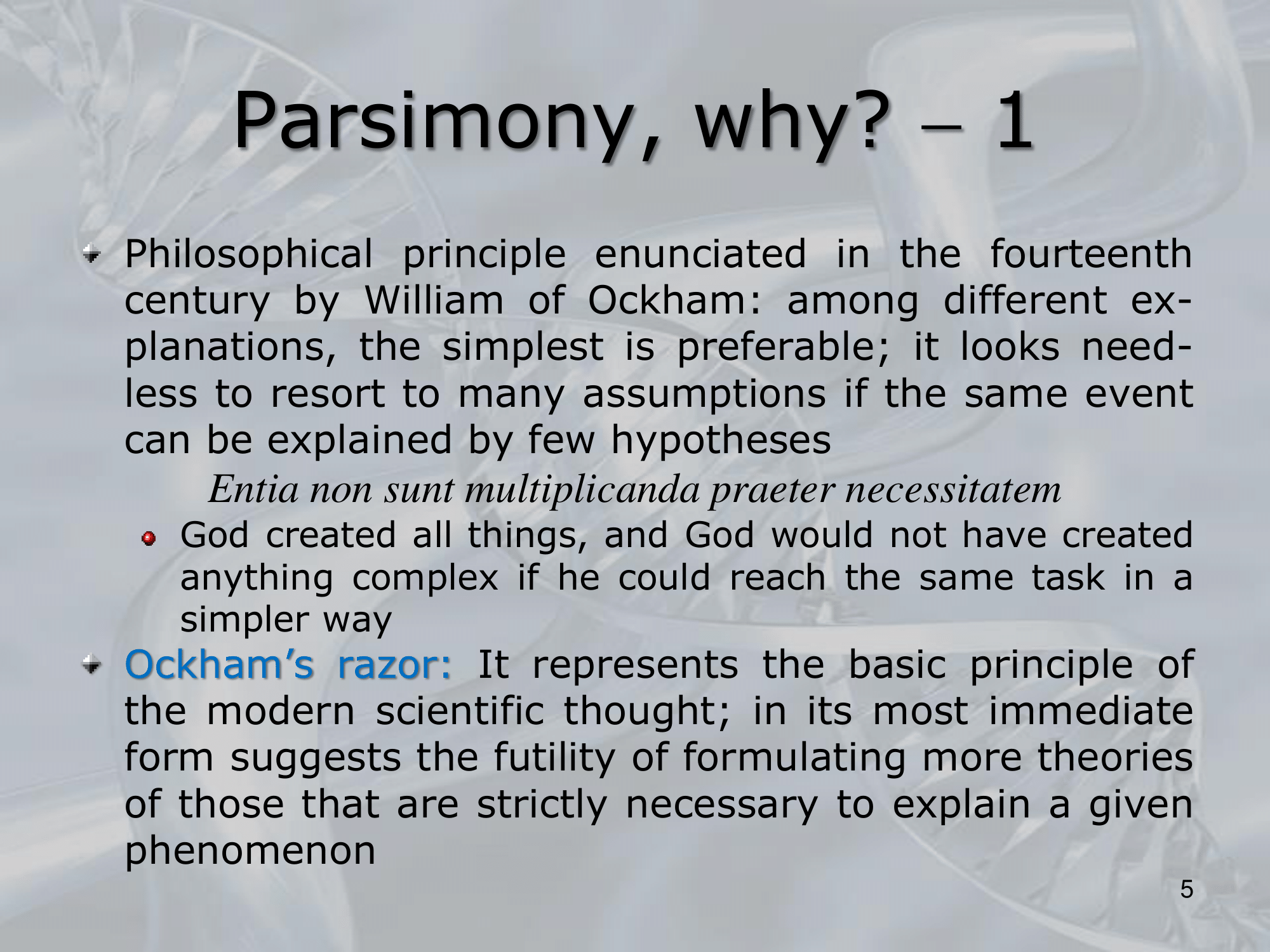
- ==Ockham’s Razor, also known as the principle of parsimony, is a principle in philosophy and science that states that when multiple explanations or hypotheses are available to account for a phenomenon, the simplest one is usually the correct one==.
In other words, the explanation that requires the fewest assumptions or entities is usually the most likely to be true. - The principle is named after the 14th-century English logician and Franciscan friar William of Ockham, who is credited with developing it.
Ockham’s Razor is often used as a guiding principle in scientific research, where the goal is to develop explanations for observed phenomena that are as simple and elegant as possible. - However, it is important to note that Ockham’s Razor is not an absolute rule and there may be situations where a more complex explanation is warranted.
In some cases, a more complex explanation may be necessary to account for all the available evidence or to make accurate predictions about future observations. - Overall, Ockham’s Razor is a useful principle for guiding scientific inquiry and promoting simplicity and clarity in explanations, but it should always be applied judiciously and with careful consideration of all available evidence.
- ==Ockham’s Razor, also known as the principle of parsimony, is a principle in philosophy and science that states that when multiple explanations or hypotheses are available to account for a phenomenon, the simplest one is usually the correct one==.
- What we mean when talking about Parsimony in Bioinformatics?
- In bioinformatics, parsimony refers to the principle of parsimony or Occam’s Razor applied to phylogenetic analysis.
The principle of parsimony states that, all other things being equal, the simplest explanation or hypothesis is usually the correct one.
In the context of phylogenetic analysis, parsimony refers to the principle that the best phylogenetic tree or cladogram is the one that requires the fewest evolutionary events or changes to explain the observed data. - In bioinformatics, parsimony is often used as a method for inferring phylogenetic trees from molecular or morphological data.
The idea is that the phylogenetic tree that requires the fewest evolutionary changes or mutations to explain the observed data is the most likely to be correct. - Parsimony-based methods for inferring phylogenetic trees involve constructing multiple possible trees and then evaluating them based on their parsimony score, which is the number of evolutionary events or changes required to explain the observed data.
The tree with the lowest parsimony score is considered the best explanation of the observed data. - Parsimony-based methods have some advantages, including their simplicity and ease of use, but they can also have limitations. In some cases, the true phylogenetic tree may not be the simplest one, and more complex explanations may be required to account for the observed data. As such, parsimony-based methods are just one of many approaches that can be used to infer phylogenetic trees, and it is important to consider multiple lines of evidence when evaluating the evolutionary history of different organisms.
- In bioinformatics, parsimony refers to the principle of parsimony or Occam’s Razor applied to phylogenetic analysis.
- What is the Concept of Maximum Parsimony?
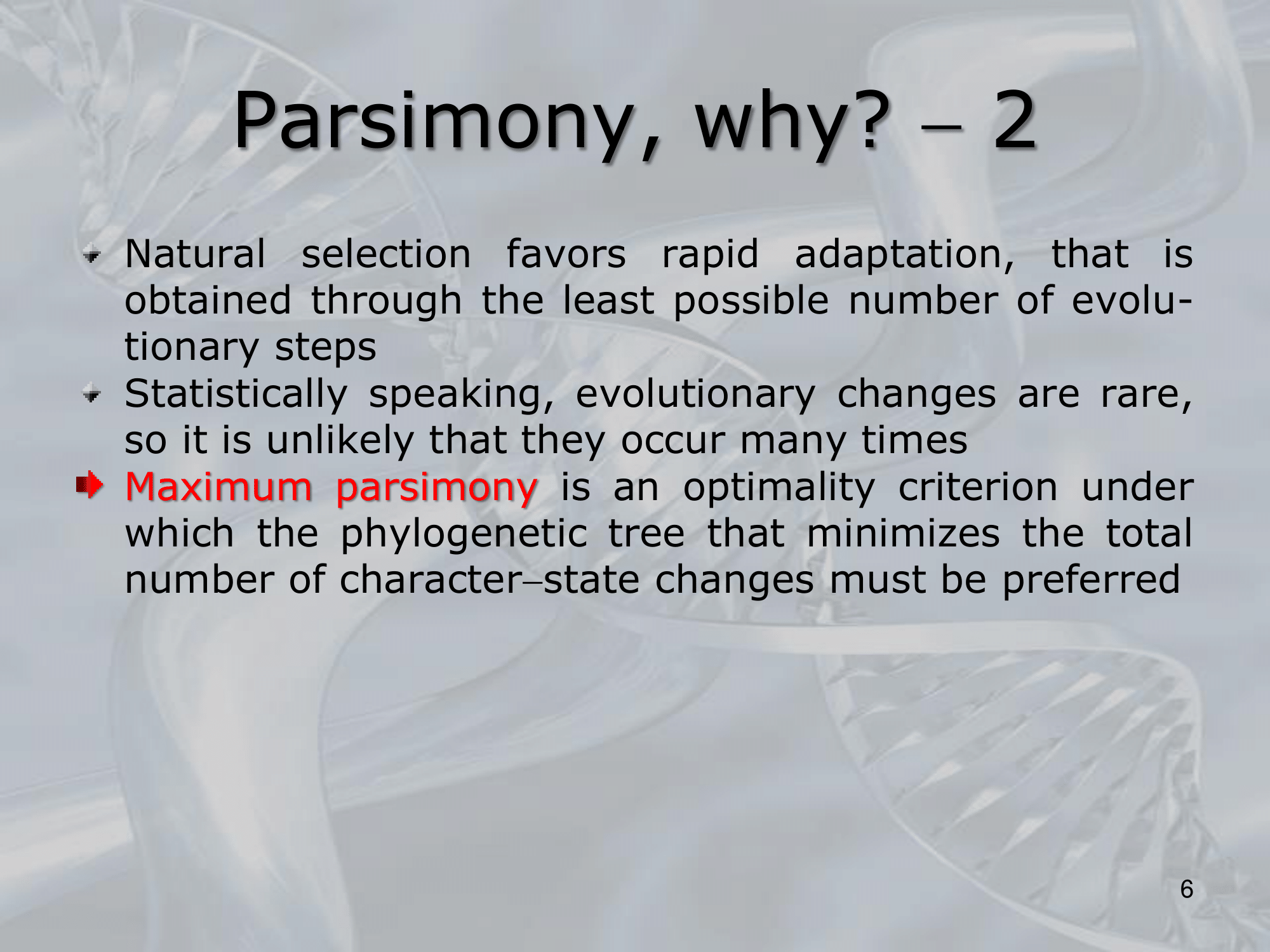
- The concept of maximum parsimony is a method for inferring phylogenetic trees in which the best tree is the one that requires the fewest evolutionary events or changes to explain the observed data.
This approach is based on the principle of parsimony or Occam’s Razor, which states that the simplest explanation is usually the correct one. - Maximum parsimony is a widely used method for inferring phylogenetic trees from molecular or morphological data in bioinformatics.
The idea is to construct multiple possible trees and then evaluate them based on their parsimony score, which is the number of evolutionary events or changes required to explain the observed data. - The tree with the lowest parsimony score is considered the most likely to be the correct phylogenetic tree.
The underlying assumption of this approach is that the true phylogenetic tree is the one that requires the fewest evolutionary events or changes to explain the observed data. - Maximum parsimony has some advantages, including its simplicity and ease of use, and it can be an effective approach when the data is relatively simple and the evolutionary relationships are well established.
However, it can also have limitations, particularly when the data is complex or when the evolutionary relationships are uncertain. - Despite its limitations, maximum parsimony remains a popular method for inferring phylogenetic trees in bioinformatics, and it is often used in combination with other methods, such as maximum likelihood and Bayesian inference, to generate more robust phylogenetic trees.
- The concept of maximum parsimony is a method for inferring phylogenetic trees in which the best tree is the one that requires the fewest evolutionary events or changes to explain the observed data.
- Can you make an Example on how we can evaluate a Parsimony Score of a Phylogenetic Tree?
- To construct a phylogenetic tree using maximum parsimony, we first need to generate all possible trees that connect the four species. Here are the four possible unrooted trees for these four species:
- To evaluate the parsimony score of each tree, we need to count the number of evolutionary events or changes that are required to explain the observed DNA sequence data.
Each change corresponds to a mutation that has occurred in the DNA sequence over time.
For example, if species A and B have a different nucleotide at a particular position in the DNA sequence, we assume that a mutation has occurred at some point in the evolutionary history of these two species. - To determine the parsimony score of each tree, we count the total number of evolutionary events or changes that are required to explain the observed data, assuming that each mutation has occurred only once in the evolutionary history of the four species.
—————————————————————
IMPORTANTE
—————————————————————
Slides with Notes