Information transfer refers to the process of transmitting information from one system or entity to another. In the context of information theory, information transfer is often measured in terms of the amount of information that is conveyed or the rate at which it is transmitted.
Information transfer can occur through various channels, such as verbal or written communication, digital or analog signals, or physical interactions between systems. The efficiency and reliability of information transfer depend on various factors, such as the bandwidth of the channel, the noise or interference in the channel, the encoding or modulation scheme used, and the decoding or demodulation process at the receiving end.
Information transfer is a fundamental concept in many fields, such as computer networking, telecommunications, signal processing, and cognitive science. In these fields, information transfer is often studied in terms of communication protocols, data transmission rates, error correction codes, and information processing algorithms.
In biological systems, information transfer is also a critical process for communication between cells and organisms. For example, in neural networks, information transfer occurs through the transmission of electrical or chemical signals between neurons, which allows for complex information processing and decision-making. The study of information transfer in biological systems is known as information biology or bioinformatics.
What is Supervised Learning?
Supervised learning is a type of machine learning in which an algorithm is trained using labeled data, meaning that the data has already been categorized or classified with correct answers. The goal of supervised learning is to learn a mapping from inputs to outputs based on the training data, so that the algorithm can accurately predict the output for new, unseen inputs.
In supervised learning, the labeled data is typically split into two sets: a training set, which is used to train the model, and a validation or test set, which is used to evaluate the performance of the model on unseen data. The algorithm uses the training set to learn the relationship between the input and output variables, which can then be used to make predictions on the validation or test set.
Supervised learning can be used for a variety of tasks, including classification, regression, and sequence prediction. In classification tasks, the goal is to assign a label or category to a given input, such as determining whether an image contains a cat or a dog. In regression tasks, the goal is to predict a numerical value, such as the price of a house based on its features. In sequence prediction tasks, the goal is to predict the next element in a sequence, such as predicting the next word in a sentence.
Supervised learning algorithms include decision trees, k-nearest neighbors, linear regression, logistic regression, support vector machines, and neural networks. The choice of algorithm depends on the specific task and the characteristics of the data. The performance of the algorithm can also be improved through techniques such as feature engineering, regularization, and ensemble methods.
What is Unsupervised Learning?
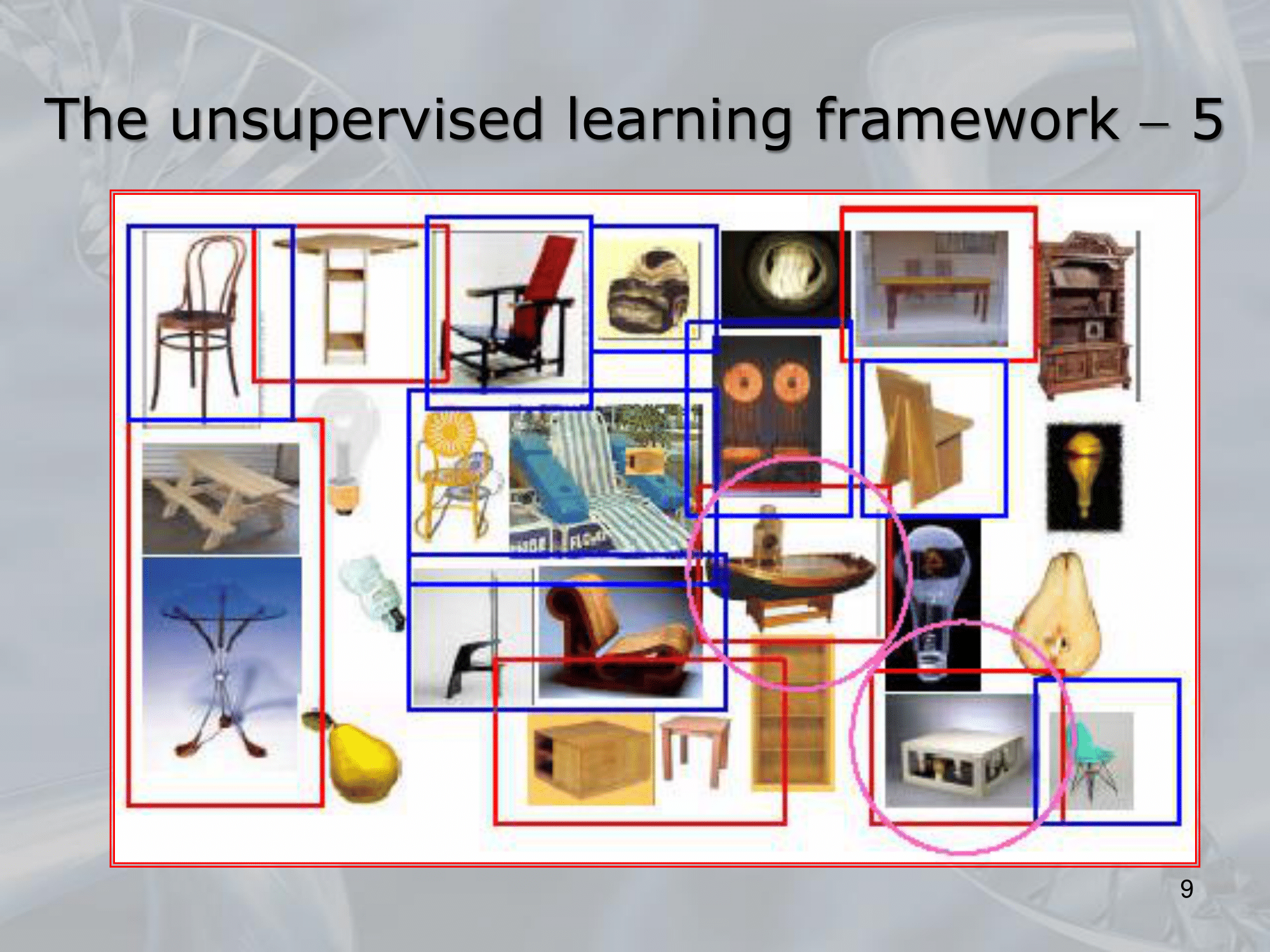
==Unsupervised learning is a type of machine learning algorithm in which the computer is given a set of unlabeled data and is tasked with finding patterns or relationships within the data without any prior knowledge of what those patterns or relationships might be. In other words, the algorithm is left to discover the underlying structure or distribution of the data on its own, without any explicit guidance or supervision from a human expert==.
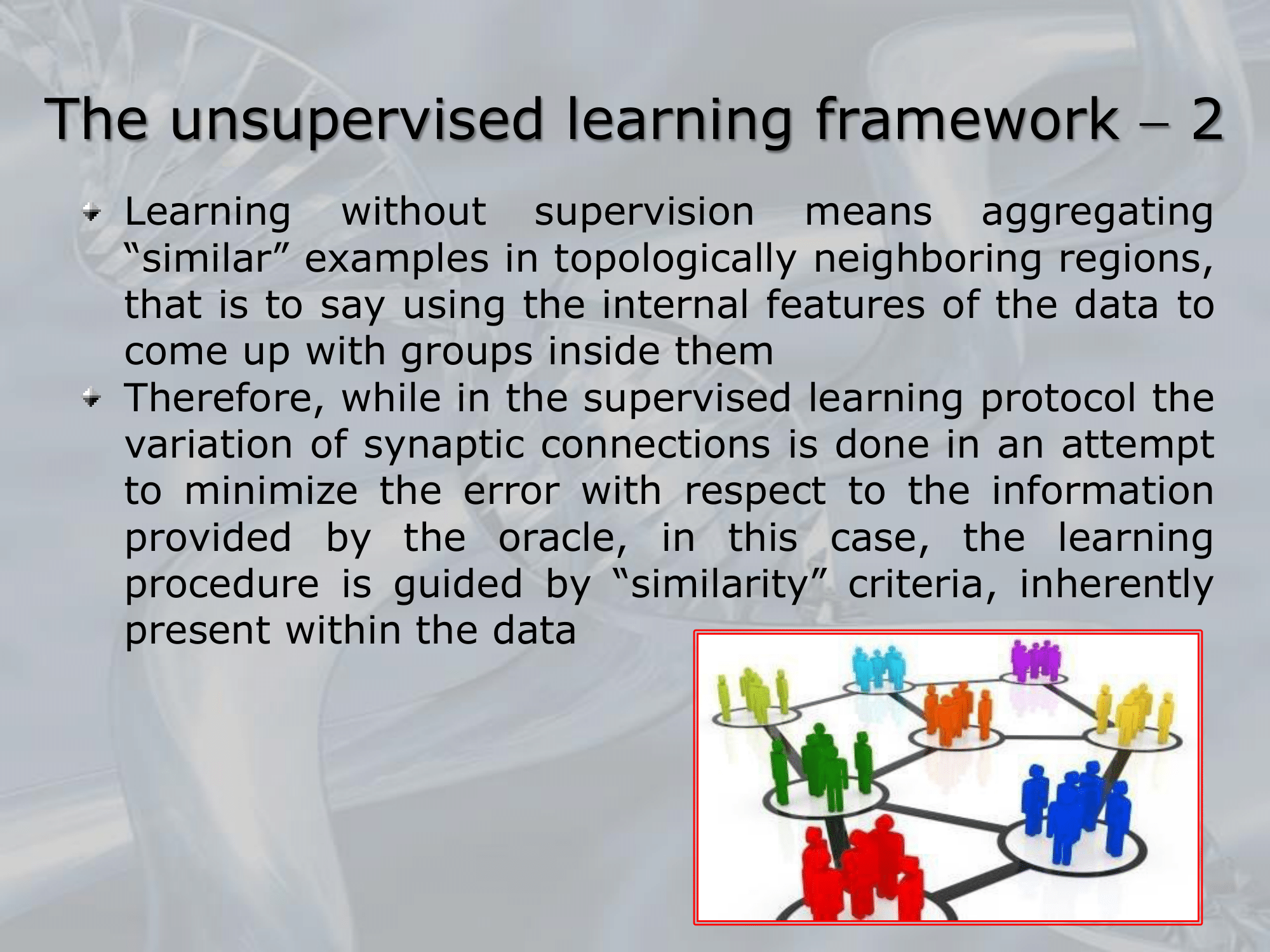
Unlike supervised learning, where the computer is given a set of labeled examples and learns to predict outcomes based on those labels, unsupervised learning is more exploratory in nature and is often used in data mining and clustering applications, where the goal is to group similar data points together based on their features or characteristics. Some common examples of unsupervised learning algorithms include k-means clustering, principal component analysis (PCA), and generative models like autoencoders and Gaussian mixture models.
What are Self-Orgnanizing Neural Networks?
==Self-Organizing Neural Networks (SONN), also known as Self-Organizing Maps (SOM) or Kohonen maps, are a type of unsupervised learning algorithm in which a neural network is trained to create a low-dimensional representation of a high-dimensional input space==.
In a SONN, the network is organized into a two-dimensional grid of neurons, each of which corresponds to a particular region of the input space. During training, the network adjusts the weights of each neuron to respond to different patterns in the input data, such that nearby neurons respond to similar patterns and distant neurons respond to dissimilar patterns. This process of weight adjustment leads to the formation of clusters or regions in the input space, which can be used for data visualization, clustering, and feature extraction.
SONN has been used in a wide range of applications, including image recognition, speech processing, and natural language processing. It is particularly useful when the input data has a high dimensionality and there is a need to reduce the complexity of the data and identify underlying patterns or structures.
What is the Hebb Rule?
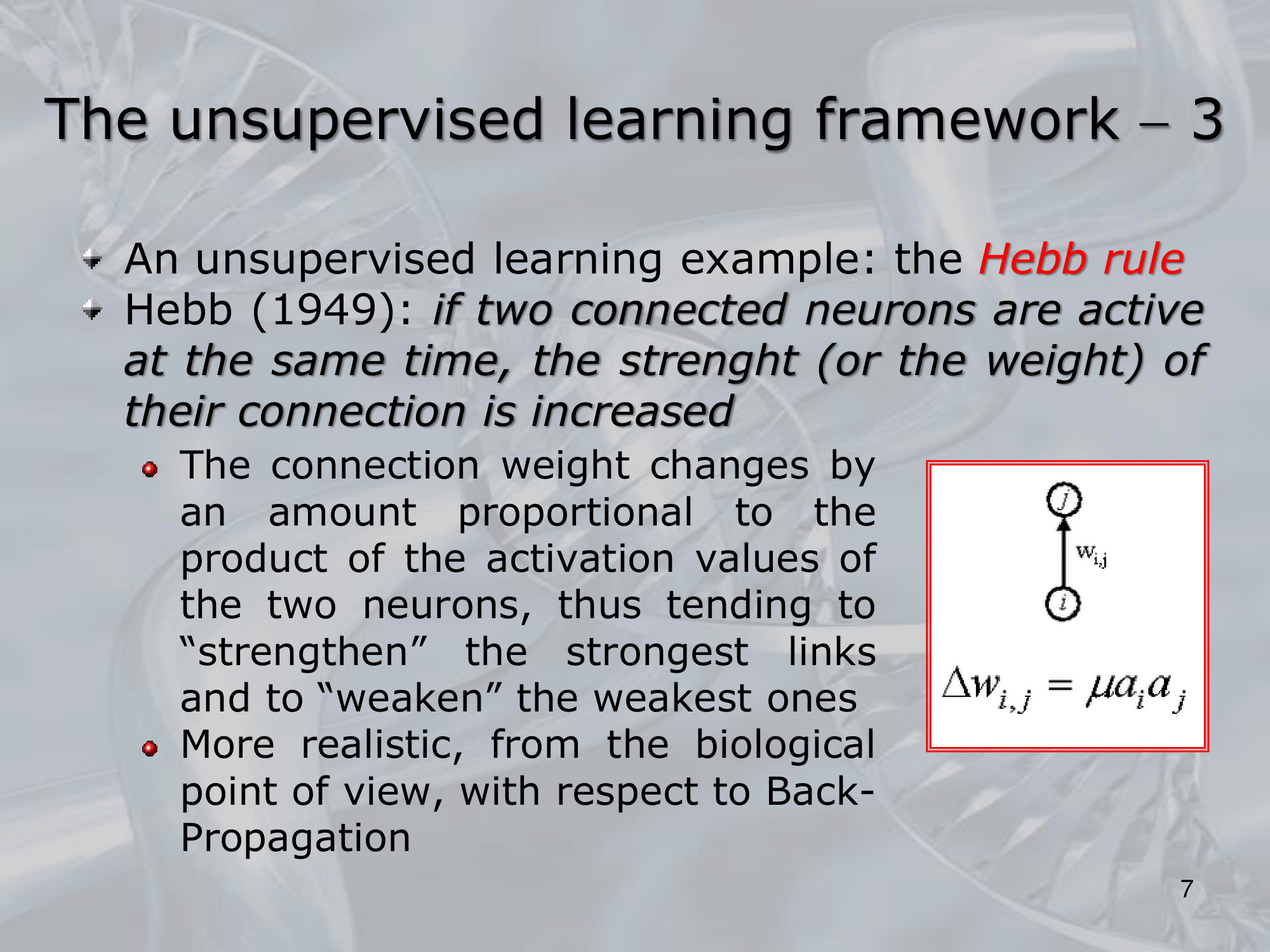
The Hebb rule is a simple learning rule proposed by Canadian psychologist Donald Hebb in 1949, which describes how neural connections between neurons can be strengthened or weakened based on their correlation with each other. The rule is often paraphrased as ==“cells that fire together, wire together”==.
In its simplest form, the Hebb rule states that if two neurons are activated simultaneously, the strength of the connection between them is increased. Conversely, if two neurons are not activated simultaneously, the strength of the connection between them is decreased. This process is known as Hebbian learning, and it is thought to be one of the key mechanisms underlying learning and memory in the brain.
The Hebb rule has been used to explain a variety of phenomena in neuroscience and psychology, including synaptic plasticity, long-term potentiation, and associative learning. It has also been applied in artificial neural networks, where it is used as a basic learning rule to adjust the weights between neurons during training. However, it should be noted that the Hebb rule is a simplified model of the complex processes that occur in the brain, and more sophisticated learning rules have been developed that take into account additional factors such as inhibitory connections and feedback.