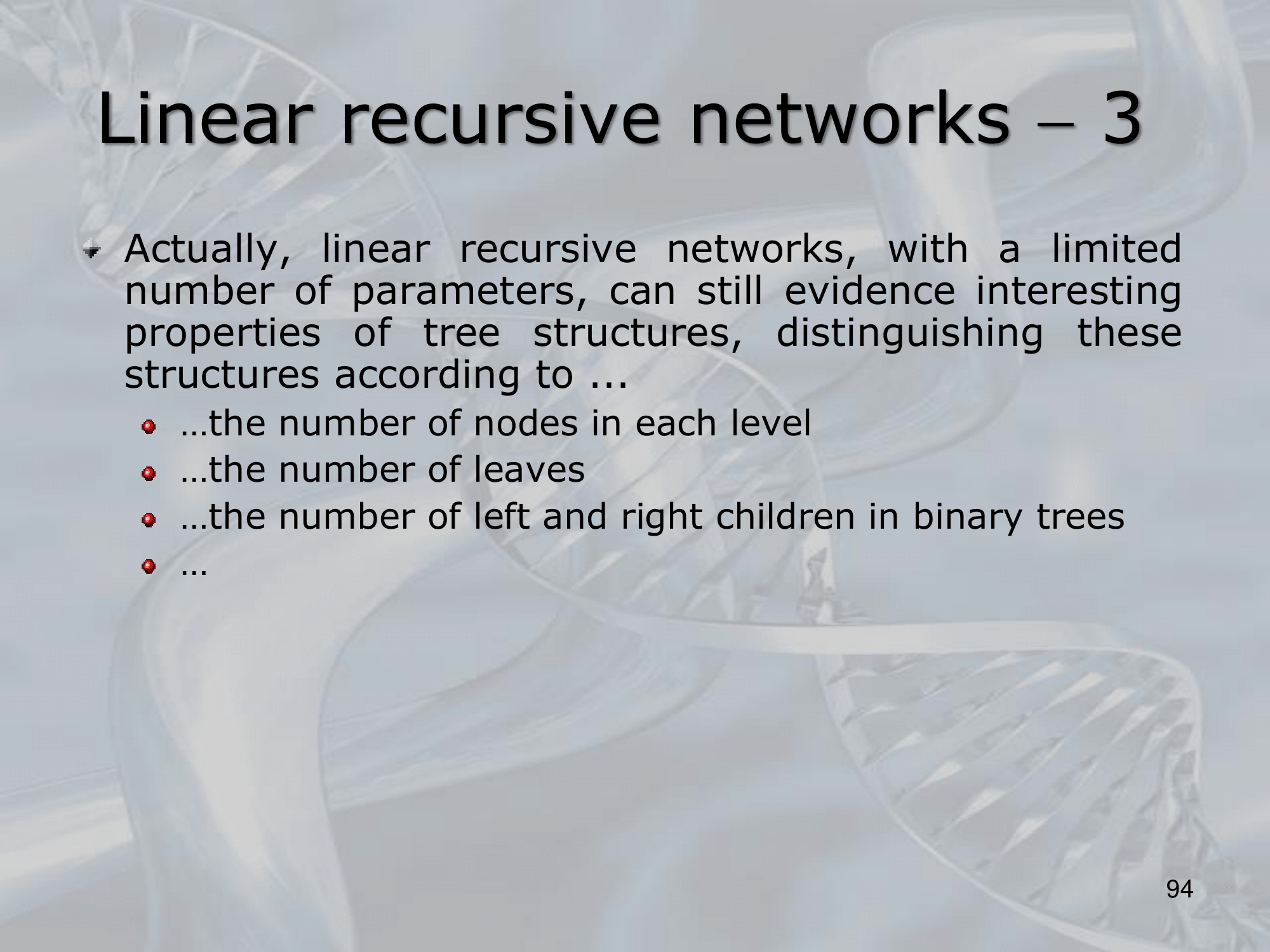
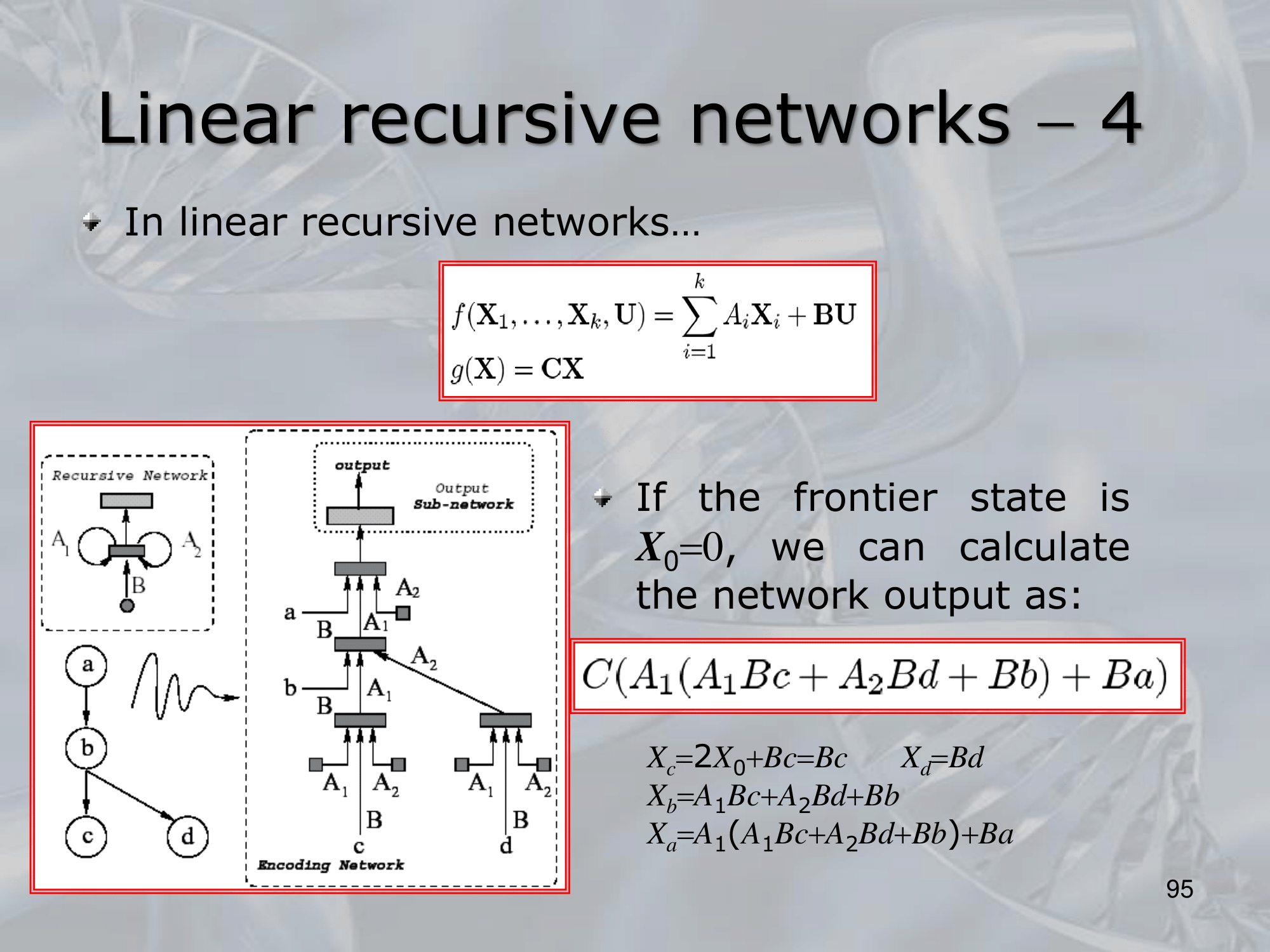
Linear Recursive Networks (LRNs) are a type of recurrent neural network architecture that is used for modeling time series data. Unlike other recurrent neural networks, such as LSTMs and Elman networks, which use non-linear activation functions, LRNs use linear functions to compute the network’s output.
==The key idea behind LRNs is to recursively apply a linear transformation to the network’s input over time, using a weight matrix that is shared across all time steps. This weight matrix represents the network’s memory of past inputs, and can be trained using backpropagation through time to optimize the network’s performance on a given task==.
One advantage of LRNs is that they are relatively simple and computationally efficient, making them well-suited to problems that require fast and efficient processing of time series data. However, their linear activation functions can also limit their ability to model complex and non-linear patterns in the data, and they may be less effective for tasks that require long-term memory or the ability to capture non-linear dependencies between inputs.
Despite these limitations, LRNs have been used successfully in a variety of applications, including speech recognition, time series prediction, and financial forecasting. Their simplicity and efficiency make them a useful tool for modeling time series data, particularly in situations where computational resources are limited.