Questions
- What are Family and Superfamilies of Protiens?
- Proteins that share a significant degree of sequence and structural similarity are grouped into families and superfamilies.
These groups are used to classify proteins based on their evolutionary relationships and functional similarities.- Protein family: A protein family is a group of proteins that share a common ancestor and have a high degree of sequence and structural similarity.
Members of a protein family typically have similar functions and catalytic activities, and may also have similar three-dimensional structures.
Examples of protein families include the globins, which are a family of heme-containing proteins involved in oxygen transport, and the serine proteases, which are a family of enzymes that catalyze the hydrolysis of peptide bonds. - Protein superfamily: ==A protein superfamily is a group of protein families that share a common ancestor and have lower levels of sequence and structural similarity than members of a family==.
Proteins in a superfamily may have different functions and catalytic activities, but they share a common structural motif or fold.
Examples of protein superfamilies include the TIM barrel superfamily, which includes a diverse group of enzymes with different catalytic activities, but all share a conserved barrel-shaped fold, and the immunoglobulin superfamily, which includes a large group of proteins with diverse functions that all contain immunoglobulin-like domains.
- Protein family: A protein family is a group of proteins that share a common ancestor and have a high degree of sequence and structural similarity.
- Protein families and superfamilies are useful for predicting the function of newly discovered proteins based on their sequence and structural similarity to known proteins.
They can also provide insights into the evolutionary relationships between proteins and the mechanisms by which new protein functions arise.
- Proteins that share a significant degree of sequence and structural similarity are grouped into families and superfamilies.
- What are Fold and Classies of Proteins?
- Protein folds and classes are ways of categorizing proteins based on their three-dimensional structure.
The fold of a protein refers to the way in which the linear sequence of amino acids is folded into a specific three-dimensional shape.
The class of a protein refers to the larger group of proteins that share similar structural features, including the overall fold and arrangement of secondary structures.- Protein fold: A protein fold is a particular arrangement of secondary structural elements, including alpha helices, beta sheets, and loops or coils, that results in a specific three-dimensional structure.
Protein folds are defined by the arrangement and connectivity of these secondary structural elements. Some common protein folds include the alpha helix bundle, beta barrel, and alpha/beta sandwich. - Protein class: Proteins are also categorized into classes based on their overall structure and functional properties.
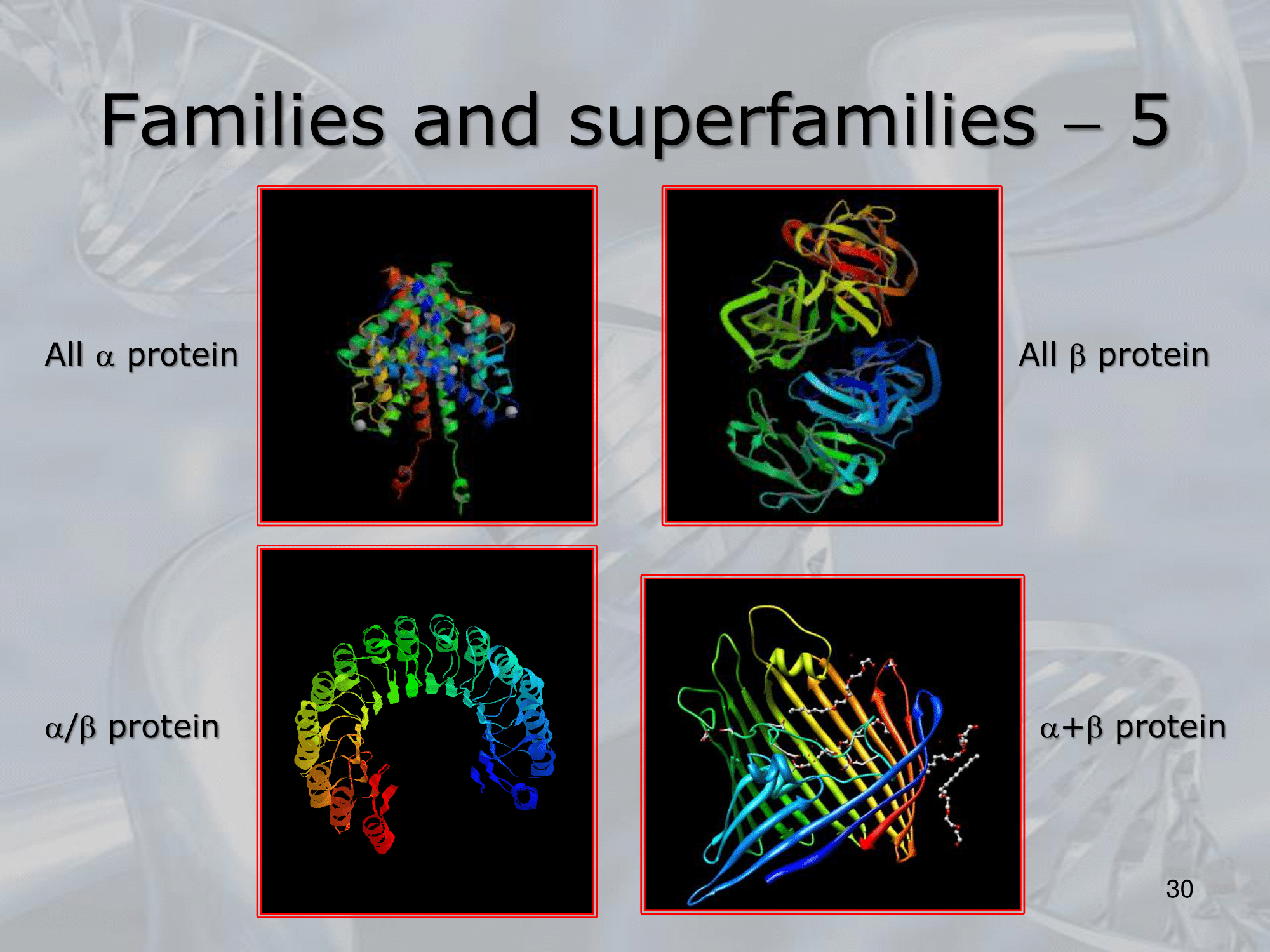
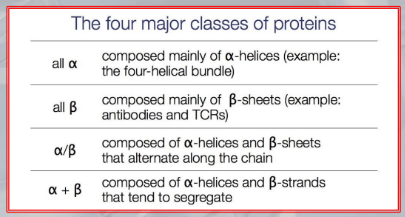
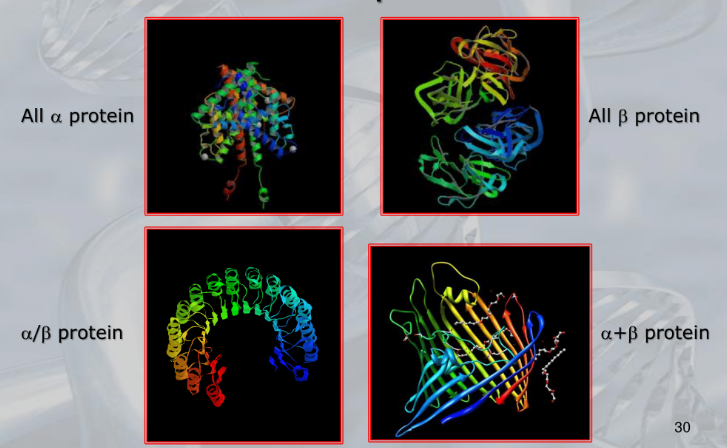
There are four major protein classes: all-alpha proteins, all-beta proteins, alpha/beta proteins, and alpha+beta proteins.- ==All-alpha proteins are dominated by alpha helices, with relatively few beta strands==.
- ==All-beta proteins are dominated by beta strands, with relatively few alpha helices==.
- ==Alpha/beta proteins contain both alpha helices and beta strands, often arranged in alternating layers==.
- ==Alpha+beta proteins contain regions of alpha helices and beta strands, but the two are not as distinctly separated as in alpha/beta proteins==.
- Protein fold: A protein fold is a particular arrangement of secondary structural elements, including alpha helices, beta sheets, and loops or coils, that results in a specific three-dimensional structure.
- Protein fold and class classification schemes are useful for predicting the function of unknown proteins based on their structural features, as proteins with similar folds and classes often have similar functions.
They can also provide insights into the evolution of protein structure and function.
- Protein folds and classes are ways of categorizing proteins based on their three-dimensional structure.
—————————————————————
IMPORTANTE
IMPORTANTE We know that all proteins existing today may derive from original proteins.
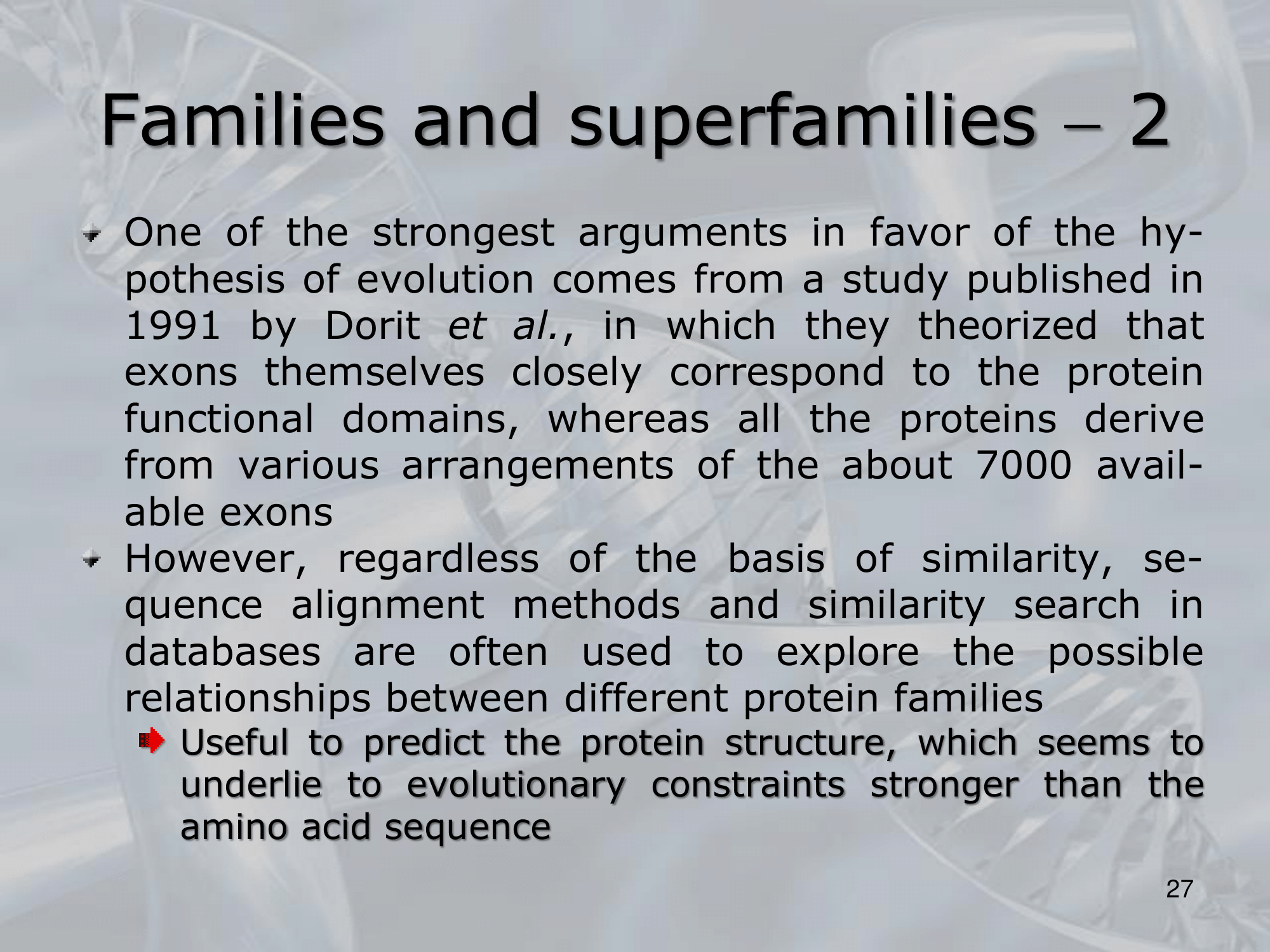
IMPORTANTE Families and Superfamilies: Sequence allignmetns methods and similarity search in databases are often used to explore the possible relationshis between different protein families. ==Knowing a protein family is useful to predict the protein structure==
IMPORTANTE Family of Proteins: ==by definition proteins that have a sequence identity grater than are members of the same family== #IMPORTANTE Superfamilies, instead are groups of proteins with a level similarity above #IMPORTANTE Fold and Classes: are groups of protein, with respect to their secondary structure: membrane proteins, mainly proteins, mainly proteins, proteins, proteins, ,
IMPORTANTE Protein Hierarchical Databases: SCOP: Structural Classificatio Of Proteins. CATH: Class, Architetcure, Topology, and Homologous superfamilies. FSSP: Fold classification based on Structure-Structure alignment of Proteins.
—————————————————————
Slides with Notes
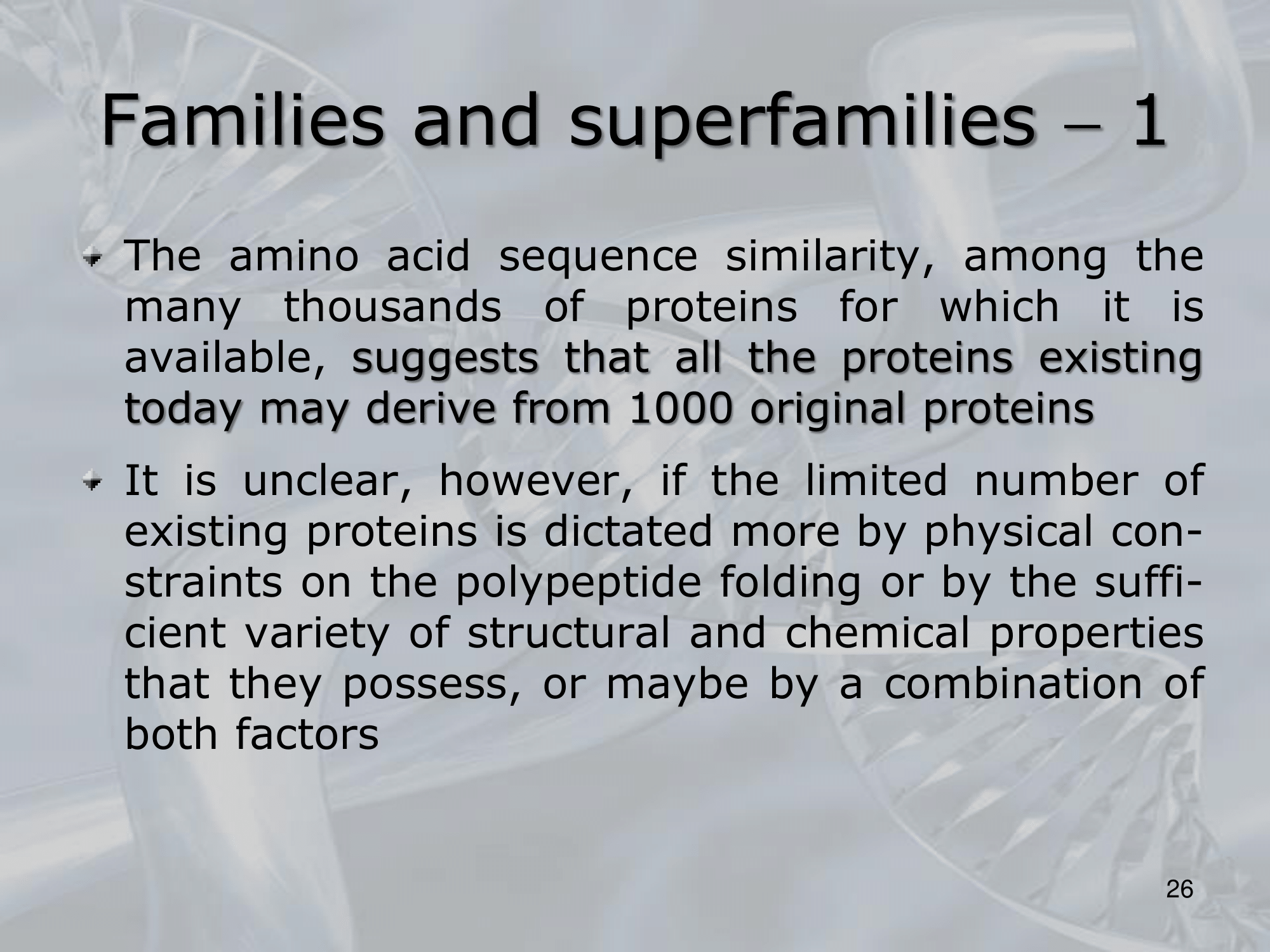
IMPORTANTE We know that all proteins existing today may derive from original proteins.
IMPORTANTE Families and Superfamilies: Sequence allignmetns methods and similarity search in databases are often used to explore the possible relationshis between different protein families. ==Knowing a protein family is useful to predict the protein structure==
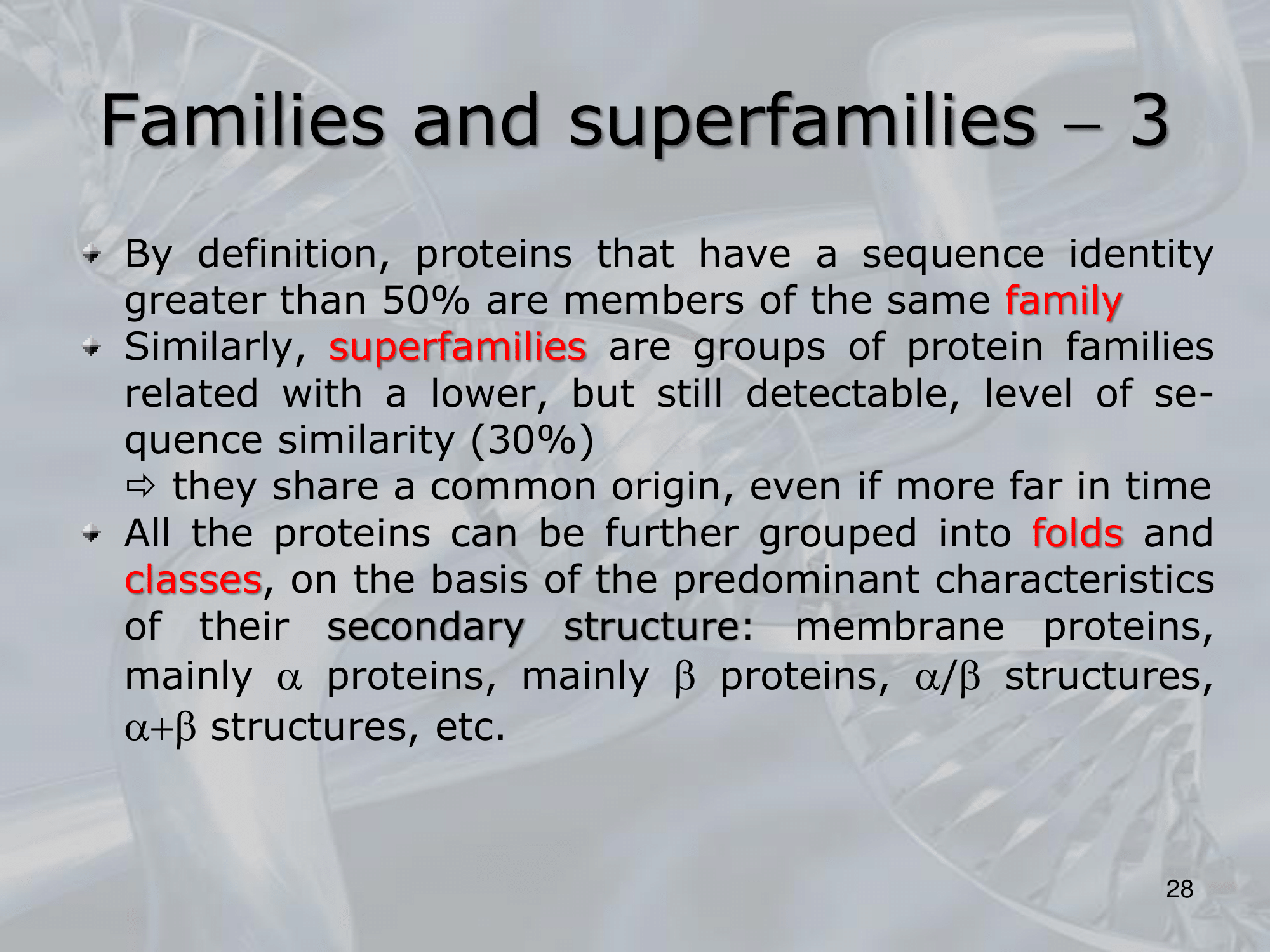
IMPORTANTE Family of Proteins: ==by definition proteins that have a sequence identity grater than are members of the same family== #IMPORTANTE Superfamilies, instead are groups of proteins with a level similarity above #IMPORTANTE Fold and Classes: are groups of protein, with respect to their secondary structure: membrane proteins, mainly proteins, mainly proteins, proteins, proteins, ,
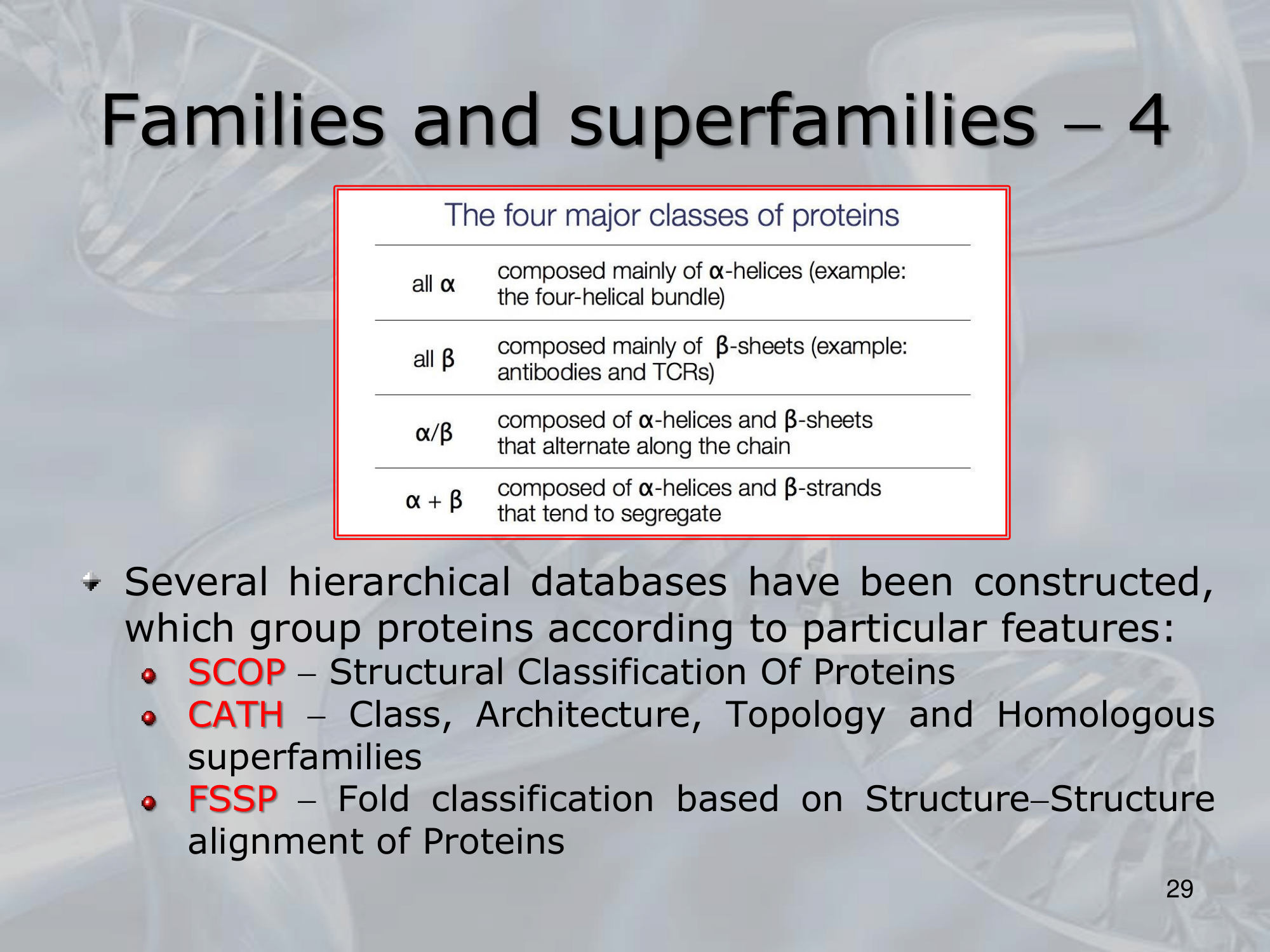
IMPORTANTE Protein Hierarchical Databases: SCOP: Structural Classificatio Of Proteins. CATH: Class, Architetcure, Topology, and Homologous superfamilies. FSSP: Fold classification based on Structure-Structure alignment of Proteins.