Questions
- What are SAGE?
- ==SAGE stands for “Serial Analysis of Gene Expression,” which is a technique used to measure the abundance of mRNA molecules in a sample of cells or tissues==.
SAGE involves the generation of short DNA tags that represent the mRNA sequences in the sample, which can then be used to identify and quantify the expression levels of individual genes. - The process of SAGE involves the extraction of mRNA molecules from cells or tissues, followed by their conversion into short DNA tags using a series of enzymatic reactions.
==These DNA tags are then amplified using PCR and sequenced using high-throughput sequencing technologies.
The resulting sequence data can be analyzed to identify and quantify the expression levels of individual genes in the sample.== - SAGE has several advantages over other methods of gene expression analysis, including its ability to detect low levels of gene expression and its capacity for multiplexing, which allows the analysis of multiple samples in parallel.
SAGE has been used extensively in the study of gene expression patterns in development, disease, and evolution, and has contributed significantly to our understanding of the regulation of gene expression in many organisms. - Overall, SAGE is a valuable tool in molecular biology and genetics research, and its use has led to numerous advances in our understanding of gene expression and regulation.
- ==SAGE stands for “Serial Analysis of Gene Expression,” which is a technique used to measure the abundance of mRNA molecules in a sample of cells or tissues==.
—————————————————————
IMPORTANTE
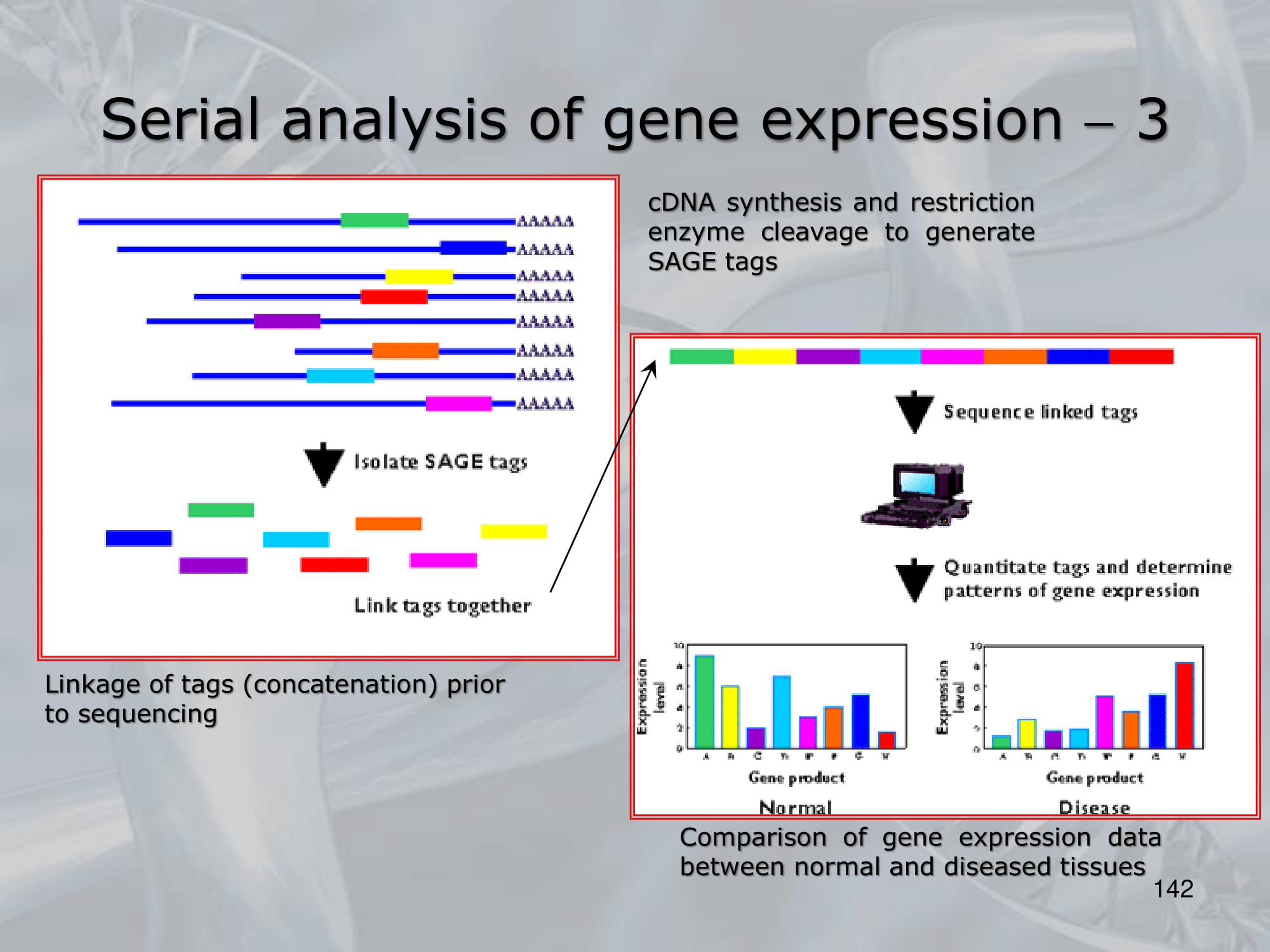
IMPORTANTE SAGE (Serial Analysis of Gene Expression) SAGE is an experimental method designed to use the advantages of large-scale sequencing with the aim to obtain quantitative information of gene expression It consist in “tagging” the genome, short sequence of a gene are used as tags, allowing the estimation of the expression level of each gene, by counting how many times the corrispondin “tag” appears in a large enough sample of “tags”
These “tags”, formarly called ESTs (Expressed Sequence Tags), are for example taken from the cDNA library,
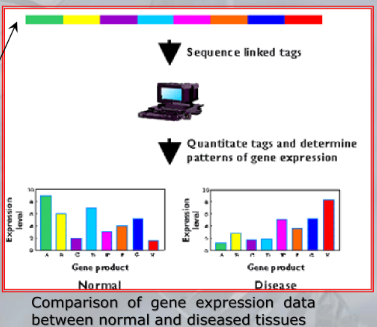
Studing the tags on normal tissue and the tags on a diseased one we can maybe see some differences, useful for recognizing the absence and abbundance of some genes.
—————————————————————
Slides with Notes