Questions
- What is Glycosylation?
- ==Glycosylation is a biological process in which sugar molecules, called glycans, are covalently attached to proteins, lipids, or other biomolecules==.
This process is important for the proper function and stability of many proteins, and it can also affect their interactions with other molecules in the cell. - ==Glycosylation occurs in several stages, starting with the synthesis of the sugar molecules in the cytoplasm or endoplasmic reticulum of the cell.
These sugar molecules are then transported to the Golgi apparatus, where they are modified and attached to proteins or lipids.
The resulting glycoproteins or glycolipids can have a variety of functions, including cell signaling, cell adhesion, and immunity==. - There are several types of glycosylation, including N-linked glycosylation, O-linked glycosylation, and glycosylphosphatidylinositol (GPI) anchoring.
Each type of glycosylation involves different enzymes and pathways, and can lead to different modifications of the target molecule.
- ==Glycosylation is a biological process in which sugar molecules, called glycans, are covalently attached to proteins, lipids, or other biomolecules==.
—————————————————————
IMPORTANTE
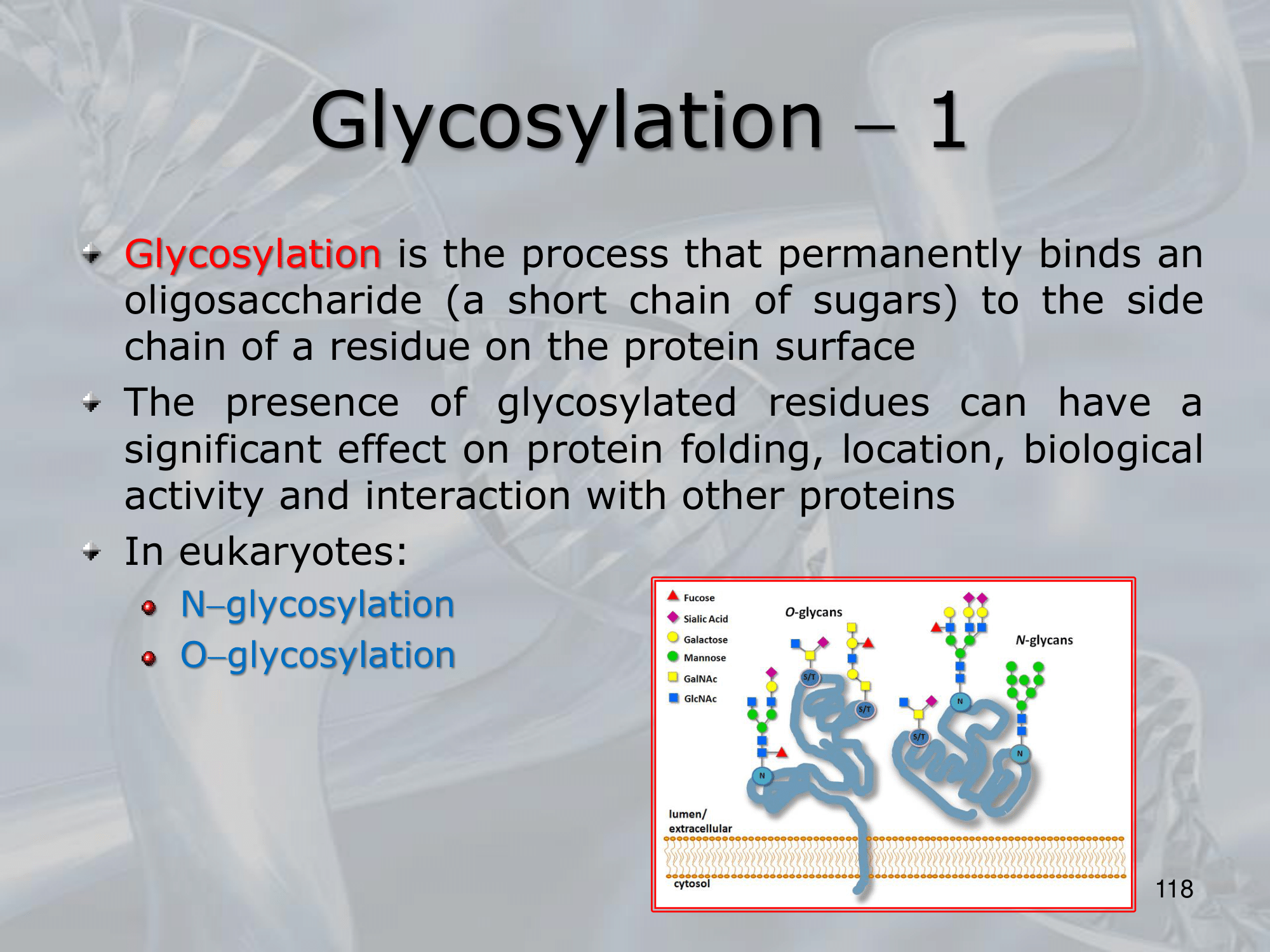
IMPORTANTE Glycosylation: The process that permanently binds an oligosaccaride (a short chain of sugars) to the side chain of a residue on the protein surface The presence of glycosylated residues can have a significan effect on protein folding, location, biological activity and interaction with other protein.
In eukaryotes there are two types of glycosylation:
- N-glycosylation
- O-glycosylation
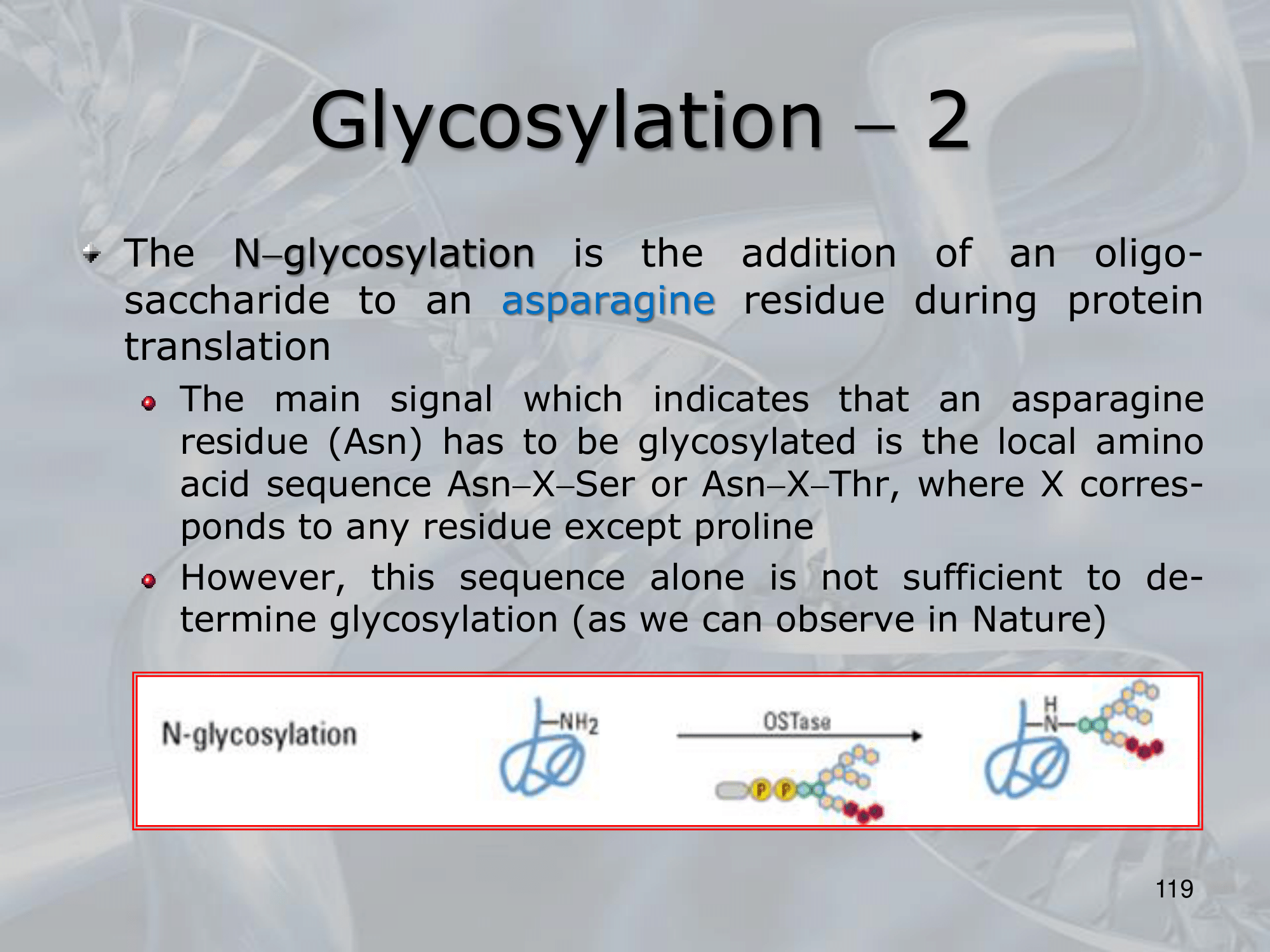
==The N-glycosylation is the addition of an oligosaccaride to an asparagine residue during protein translation==.
The main signal which indecate that an asparagine residue (Asn) has to be glycosylated is the local amino acid sequence Asn-X-Ser or Asn-X-Thr. (Where X corresponds to any residue, except proline) Tho, this siquence alone is not sufficient to determine glycosylation.
~Ex.: N-glycosylation
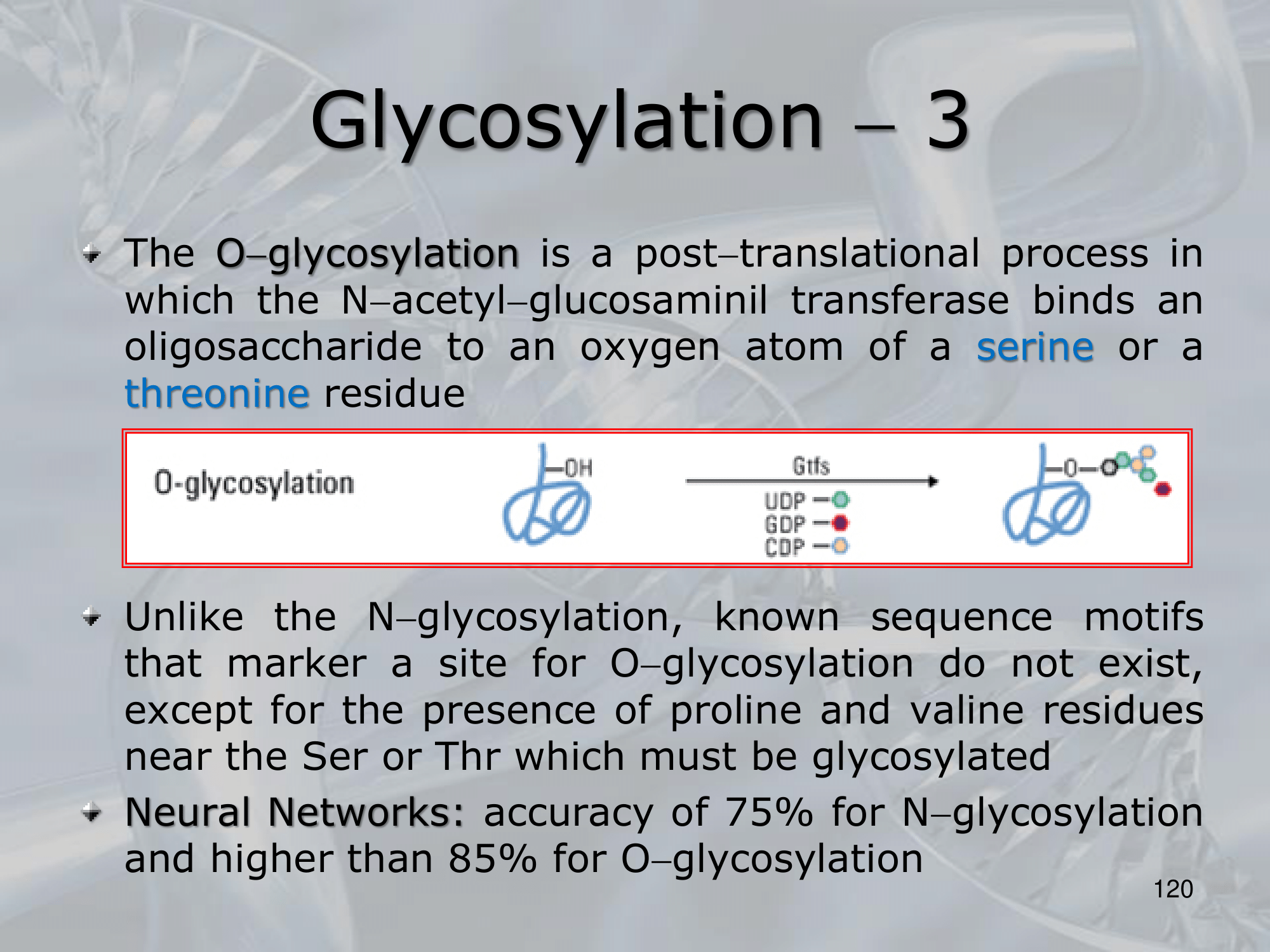
==The O-glycosylation is a post-translational process in which the N-acetyl-glucosaminil tranfersase binds an oligosaccaride to an oxygen atom of a serine or a theronine reside==.
Unlike the N-glycosylation there are no known sequence that mark a site for O-glycosylation. Except for the presence of proline and valine residues near the Ser or Thr which must be glycosalyted.
~Ex.: O-glycosylation
==NN accuracy for N-glycosylation:== ==NN accuracy for O-glycosylation==: (higher even if almost none known sequence)


—————————————————————
Slides with Notes