Questions
- What is an Active and Stable Structure?
- ==An active and stable structure in the context of proteins refers to a three-dimensional conformation that is necessary for the protein to perform its biological function, and that is also robust enough to resist unfolding or denaturation under normal physiological conditions==.
- In order for a protein to function properly, it must adopt a specific conformation or shape that allows it to interact with other molecules in a specific way.
This conformation is often called the “native state” or “active state” of the protein.
A protein’s native state is stabilized by a variety of interactions, including hydrogen bonds, electrostatic interactions, and hydrophobic interactions, as well as disulfide bonds and other covalent bonds in some cases. - In addition to being active, a protein’s native state must also be stable under normal physiological conditions.
This means that it must resist unfolding or denaturation due to changes in temperature, pH, or other environmental factors.
If a protein becomes denatured or unfolded, it may lose its biological activity, aggregate, or form insoluble clumps, which can lead to disease. - The active and stable structure of a protein is determined by its amino acid sequence and the interactions that occur between its amino acid side chains. Mutations or changes in the protein’s environment can disrupt these interactions, leading to misfolding, denaturation, or aggregation.
Understanding the factors that contribute to protein stability and activity is important for designing new drugs and therapies that target specific proteins or protein-protein interactions.
- What is the Lavinthal Paradox?
- The Lattice model of protein folding, developed by Charles Lavinthal in 1969, is a simplified model of protein folding that assumes that the energy landscape of a protein is relatively smooth and that the folding process is a random search for the lowest energy state.
However, this model leads to a paradox known as the “Lavinthal Paradox.” - The Lavinthal Paradox arises from the fact that there are an enormous number of possible conformations that a protein can adopt as it folds.
Even for small proteins, there are more possible conformations than there are atoms in the observable universe.
If a protein had to explore all of these conformations in a random search, it would take an impossibly long time for it to find the lowest energy state.
However, proteins typically fold rapidly, on the order of microseconds to milliseconds.
This suggests that the folding process is not a random search but is instead guided by some sort of folding pathway. - ==The Lavinthal Paradox highlights the fact that protein folding is a complex and non-random process==, and that other factors, such as the presence of folding intermediates, cooperative folding interactions, and chaperone proteins, must be involved in guiding the protein to its native state.
- The Lattice model of protein folding, developed by Charles Lavinthal in 1969, is a simplified model of protein folding that assumes that the energy landscape of a protein is relatively smooth and that the folding process is a random search for the lowest energy state.
—————————————————————
IMPORTANTE
IMPORTANTE Is it most stable and/or enrgetically most favorable? The Levinthal Paradox says that the number of possible folds for a polypeptide chain (even for a small one) is so vast that performing an exhaustive search for all possible configuration would take years, the paradox suggest that at each intermediate step of the folding process the protein becomes progressively more stable. So we can’t know if once compleately folded the protein will be in an absolute minimum configuration for the energy or not. Tho we know that natural selection favors those proteins that are active and robust.
—————————————————————
Slides with Notes
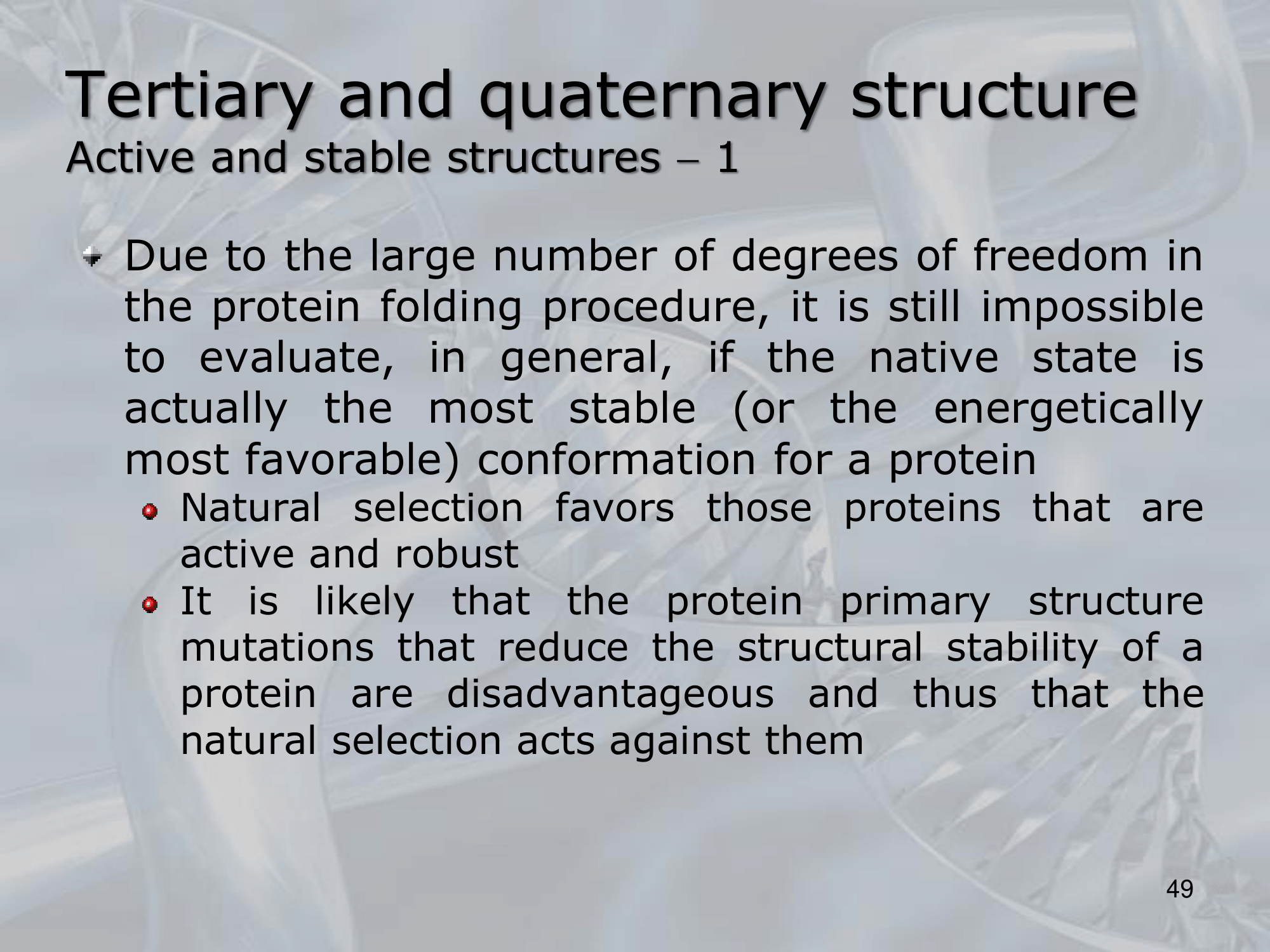
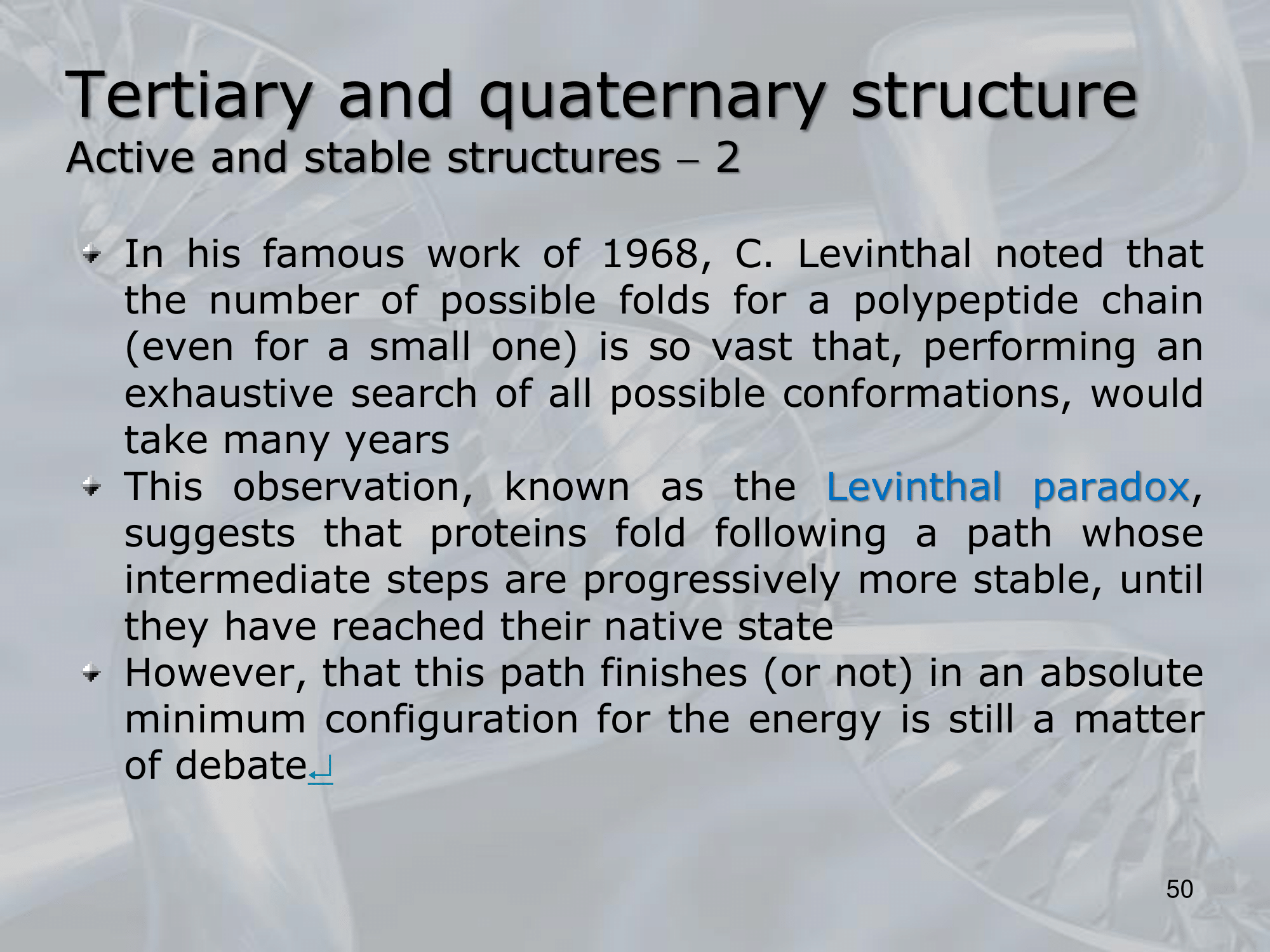
IMPORTANTE Is it most stable and/or enrgetically most favorable? The Levinthal Paradox says that the number of possible folds for a polypeptide chain (even for a small one) is so vast that performing an exhaustive search for all possible configuration would take years, the paradox suggest that at each intermediate step of the folding process the protein becomes progressively more stable. So we can’t know if once compleately folded the protein will be in an absolute minimum configuration for the energy or not. Tho we know that natural selection favors those proteins that are active and robust.