Question
- Why organisms have Preferences in the use of Codons?
- ==Organisms have preferences in the use of codons because the genetic code is degenerate, meaning that there are multiple codons that can code for the same amino acid.
For example, the amino acid leucine can be coded for by six different codons: UUA, UUG, CUU, CUC, CUA, and CUG==. - However, different organisms tend to use different codons with different frequencies.
This is known as codon usage bias, and it is thought to be a result of a combination of factors, including mutation, genetic drift, and natural selection.- One factor that can influence codon usage is mutation.
Mutations can occur randomly in the genome, and some codons may be more susceptible to mutation than others.
Over time, this can lead to differences in the frequency of different codons within a genome. - Another factor that can influence codon usage is genetic drift.
Genetic drift refers to random fluctuations in the frequency of alleles within a population, and it can be particularly important in small populations.
If a particular codon happens to be more common in a small population, it may become fixed simply as a result of chance. - However, the most important factor influencing codon usage is thought to be natural selection.
Different codons can be translated more efficiently by the ribosome, and some codons may be more energetically or metabolically favorable than others.
In addition, some codons may be more susceptible to error during translation, leading to a higher rate of misincorporation of incorrect amino acids.
Natural selection can therefore favor the use of codons that are more efficient, favorable, or less error-prone, leading to differences in codon usage between different organisms.
- One factor that can influence codon usage is mutation.
- Overall, codon usage bias is a complex phenomenon that is influenced by a range of factors, including mutation, genetic drift, and natural selection. The study of codon usage can provide important insights into the biology and evolution of different organisms.
- ==Organisms have preferences in the use of codons because the genetic code is degenerate, meaning that there are multiple codons that can code for the same amino acid.
—————————————————————
IMPORTANTE
IMPORTANTE Codons Preferences: Remember that the possible combination of 3 letters taken from (A, T, C, G) is equal to 64. ==There exist 64 codons but only 20 amminoacids==. So many codons map for the same amminoacids. From experiments it has been proved that each organism has a preference for which codon maps which amminacids. ~Ex.: The codons that code for Argenine are 4: CGT, CGC, CGG, AGG, the yeast uses 48% the codon AGA, and only 10% the others.
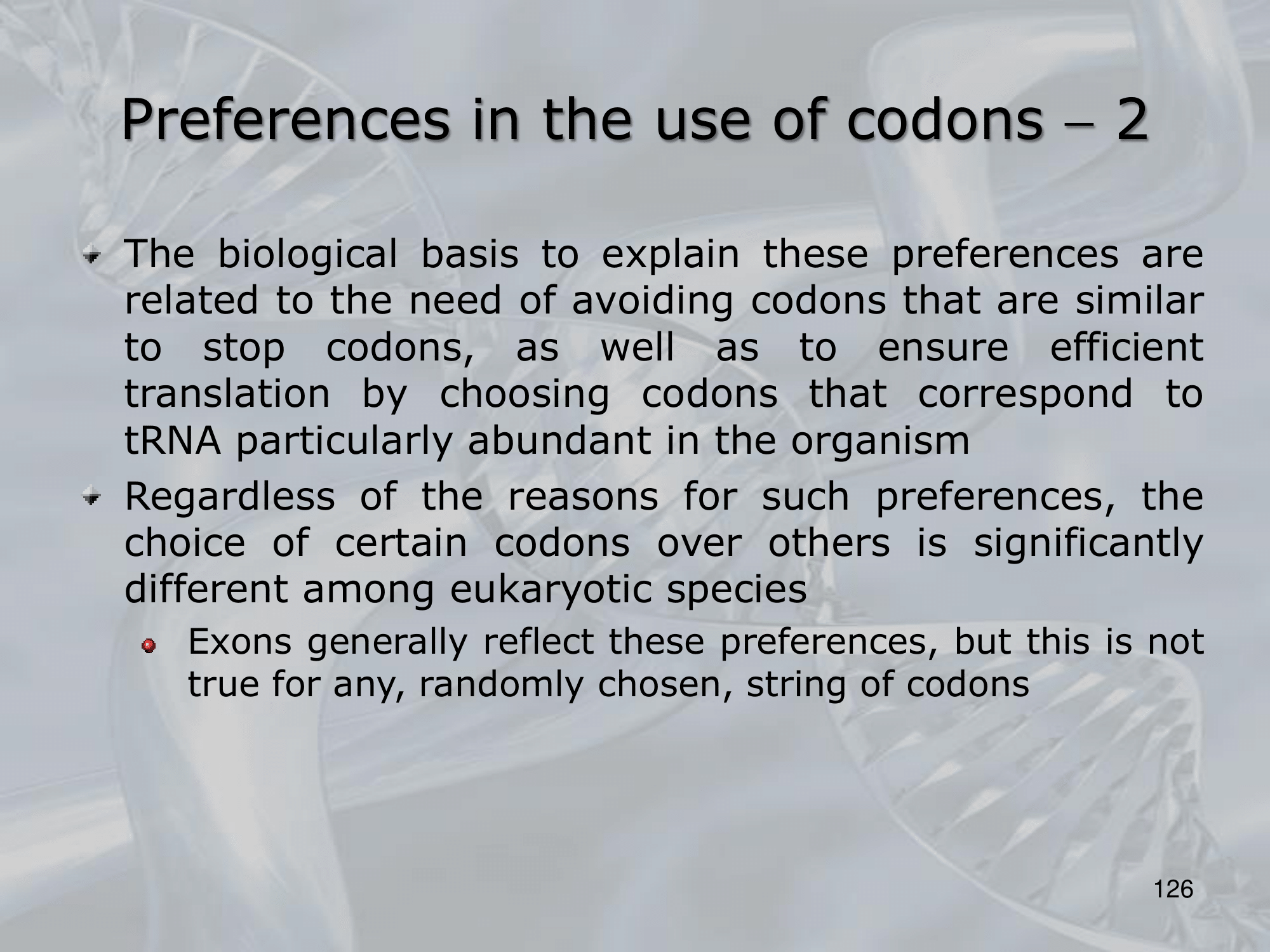
This preferences is because of the need to avoid the random changes of a codon into a stop codon, and to ensure efficient translation by choosing codons that correspond to tRNA particularly abundant in the organism.
IMPORTANTE What is tRNA?: L’RNA transfer (o RNA di trasporto), abbreviato in tRNA, è una piccola catena di RNA (costituita da circa 70-90 nucleotidi) che trasferisce un amminoacido specifico di una catena polipeptidica in crescita al sito ribosomiale della sintesi proteica durante la traduzione.
—————————————————————
Slides with Notes
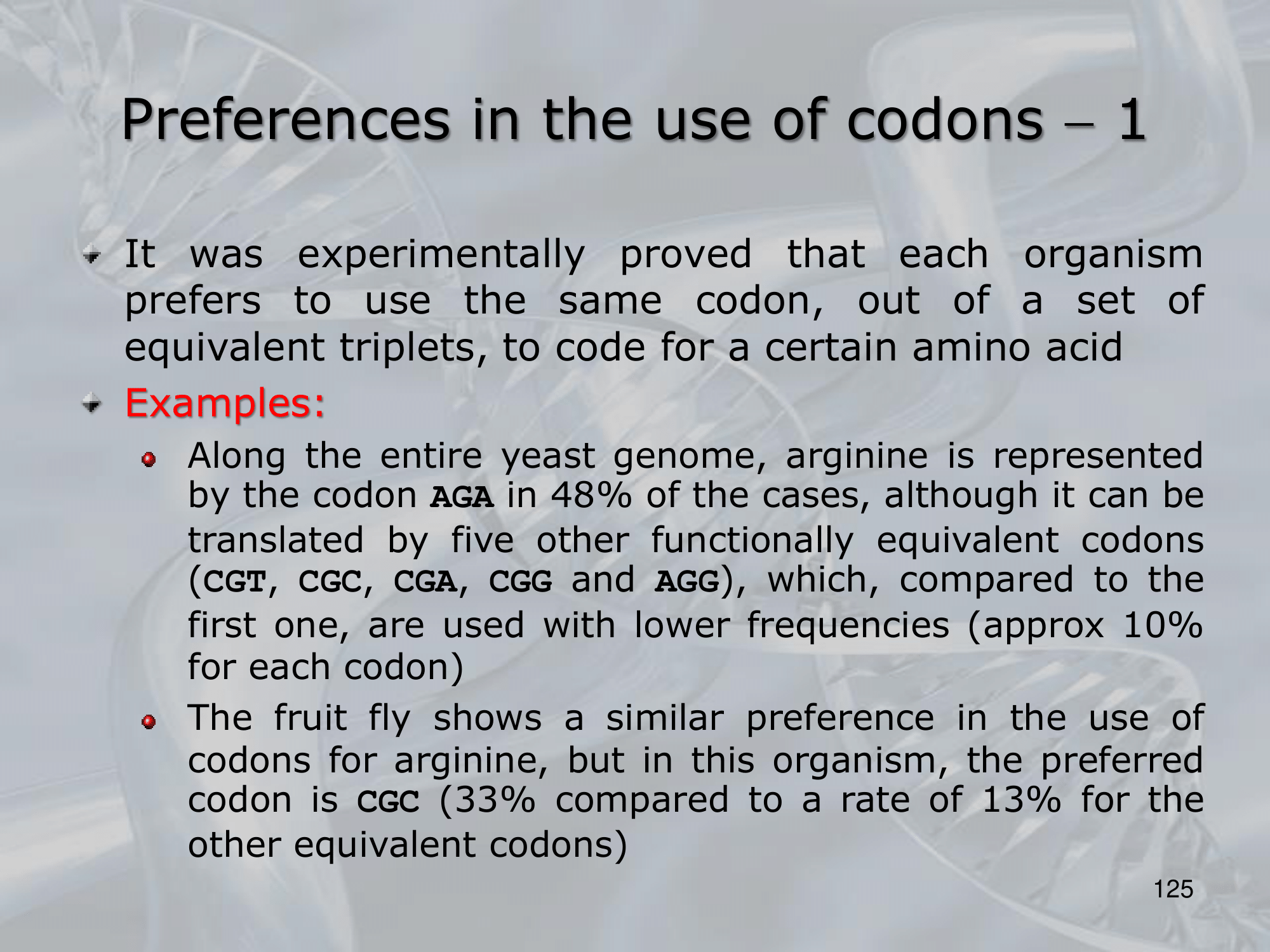
IMPORTANTE Codons Preferences: Remember that the possible combination of 3 letters taken from (A, T, C, G) is equal to 64. ==There exist 64 codons but only 20 amminoacids==. So many codons map for the same amminoacids. From experiments it has been proved that each organism has a preference for which codon maps which amminacids. ~Ex.: The codons that code for Argenine are 4: CGT, CGC, CGG, AGG, the yeast uses 48% the codon AGA, and only 10% the others.
This preferences is because of the need to avoid the random changes of a codon into a stop codon, and to ensure efficient translation by choosing codons that correspond to tRNA particularly abundant in the organism.
IMPORTANTE What is tRNA?: L’RNA transfer (o RNA di trasporto), abbreviato in tRNA, è una piccola catena di RNA (costituita da circa 70-90 nucleotidi) che trasferisce un amminoacido specifico di una catena polipeptidica in crescita al sito ribosomiale della sintesi proteica durante la traduzione.