Questions
- What are Functional Constraints?
- Functional constraints refer to the selective pressures that limit the range of mutations that can be tolerated in a gene or protein without affecting its function.
These constraints arise because the biological function of a gene or protein is often critical for the survival or reproduction of an organism. - For example, mutations that disrupt the active site of an enzyme or the binding site of a receptor may prevent the protein from performing its function, and thus reduce the fitness of the organism.
Similarly, mutations that affect the stability or folding of a protein may lead to misfolding, aggregation, or degradation, which can also impair its function. - Functional constraints can also act at the level of DNA sequence, where mutations that disrupt regulatory elements or splice sites may alter the expression or splicing of a gene, and thus affect its function.
- The strength of functional constraints can vary among genes and proteins, depending on factors such as their essentiality, tissue-specificity, interaction partners, or evolutionary history.
By studying the patterns of sequence conservation and variation in different genes and proteins, researchers can infer the strength and nature of functional constraints, and use this information to predict the effects of mutations on protein structure and function.
- Functional constraints refer to the selective pressures that limit the range of mutations that can be tolerated in a gene or protein without affecting its function.
- What are the Differences between Coding Regions and Non-Coding Regions?
- ==In genetics, the genome of an organism is composed of coding regions (also known as exons) and non-coding regions (also known as introns and intergenic regions)==.
- ==Coding regions (Exons) are the parts of the DNA sequence that are transcribed into mRNA and ultimately translated into protein==.
They contain the genetic code that specifies the amino acid sequence of a protein.
Coding regions are generally well-conserved among related organisms because mutations that alter the protein sequence can have deleterious effects on the function of the protein. - ==Non-coding regions (Introns), on the other hand, are the parts of the DNA sequence that do not code for protein==.
Introns are non-coding sequences that interrupt the coding regions of genes and are removed from the mRNA by splicing before translation.
Intergenic regions are non-coding sequences that lie between genes.
Non-coding regions can still be functional, however, as they may contain regulatory elements that control gene expression or serve as binding sites for proteins involved in various cellular processes.
- ==Coding regions (Exons) are the parts of the DNA sequence that are transcribed into mRNA and ultimately translated into protein==.
- The proportion of coding and non-coding regions in a genome can vary widely among different organisms.
In general, simpler organisms have a higher proportion of coding regions, while more complex organisms have a higher proportion of non-coding regions.
For example, the human genome is estimated to be about 1.5% coding regions and 98.5% non-coding regions.
- ==In genetics, the genome of an organism is composed of coding regions (also known as exons) and non-coding regions (also known as introns and intergenic regions)==.
- What are the Types of Non-Coding Regions?
- There are two main types of non-coding regions in the genome: introns and intergenic regions.
- ==Introns==: Introns are non-coding sequences that interrupt the coding regions (exons) of a gene.
They are transcribed into mRNA along with the exons, but are then removed from the mRNA by a process called splicing, so that only the exons are translated into protein.
Introns can vary in length from a few dozen to thousands of nucleotides, and their function is not completely understood.
However, some introns contain regulatory elements that affect the expression of the gene, and some have been implicated in alternative splicing, a process that generates different forms of mRNA and protein from a single gene. - ==Intergenic regions: Intergenic regions are non-coding sequences that lie between genes==.
These regions can vary in length from a few nucleotides to millions of nucleotides, depending on the organism.
==Intergenic regions may contain regulatory elements that control the expression of nearby genes, such as enhancers and silencers.
They may also contain repetitive DNA sequences, which can have various functions, such as maintaining chromosome structure or regulating gene expression==.
- ==Introns==: Introns are non-coding sequences that interrupt the coding regions (exons) of a gene.
- Recent studies have also identified other types of non-coding RNA molecules, such as microRNAs, long non-coding RNAs, and circular RNAs, which can have diverse regulatory functions in the cell.
These molecules are transcribed from non-coding regions of the genome and can interact with other RNA molecules, proteins, or DNA sequences to modulate gene expression.
- There are two main types of non-coding regions in the genome: introns and intergenic regions.
- What are Introns and Exons?
- In molecular biology, genes are composed of both coding and non-coding regions.
==Coding regions are regions of DNA that are transcribed into RNA and ultimately translated intoproteins, while non-coding regions are transcribed but not translated==.- Exons are the coding regions of a gene that are spliced together to form the final mRNA transcript.
In other words, exons are the portions of the gene that contain the genetic information that is used to build proteins. - Introns are the non-coding regions of a gene that are transcribed into RNA but are removed from the final mRNA transcript by a process called splicing.
Splicing involves the removal of introns from the pre-mRNA transcript and the joining together of exons to form the final mRNA molecule.
- Exons are the coding regions of a gene that are spliced together to form the final mRNA transcript.
- Therefore, the primary difference between introns and exons is that exons are the coding regions of a gene that contain the information necessary to build a protein, while introns are the non-coding regions that are removed during mRNA processing.
- In molecular biology, genes are composed of both coding and non-coding regions.
—————————————————————
IMPORTANTE
IMPORTANTE What are Introns and Exons: Introns and exons are nucleotide sequences within a gene. Introns are removed by RNA splicing as RNA matures, meaning that they are not expressed in the final messenger RNA (mRNA) product. While Exons go on to be covalently bonded to one another in order to create mature mRNA.
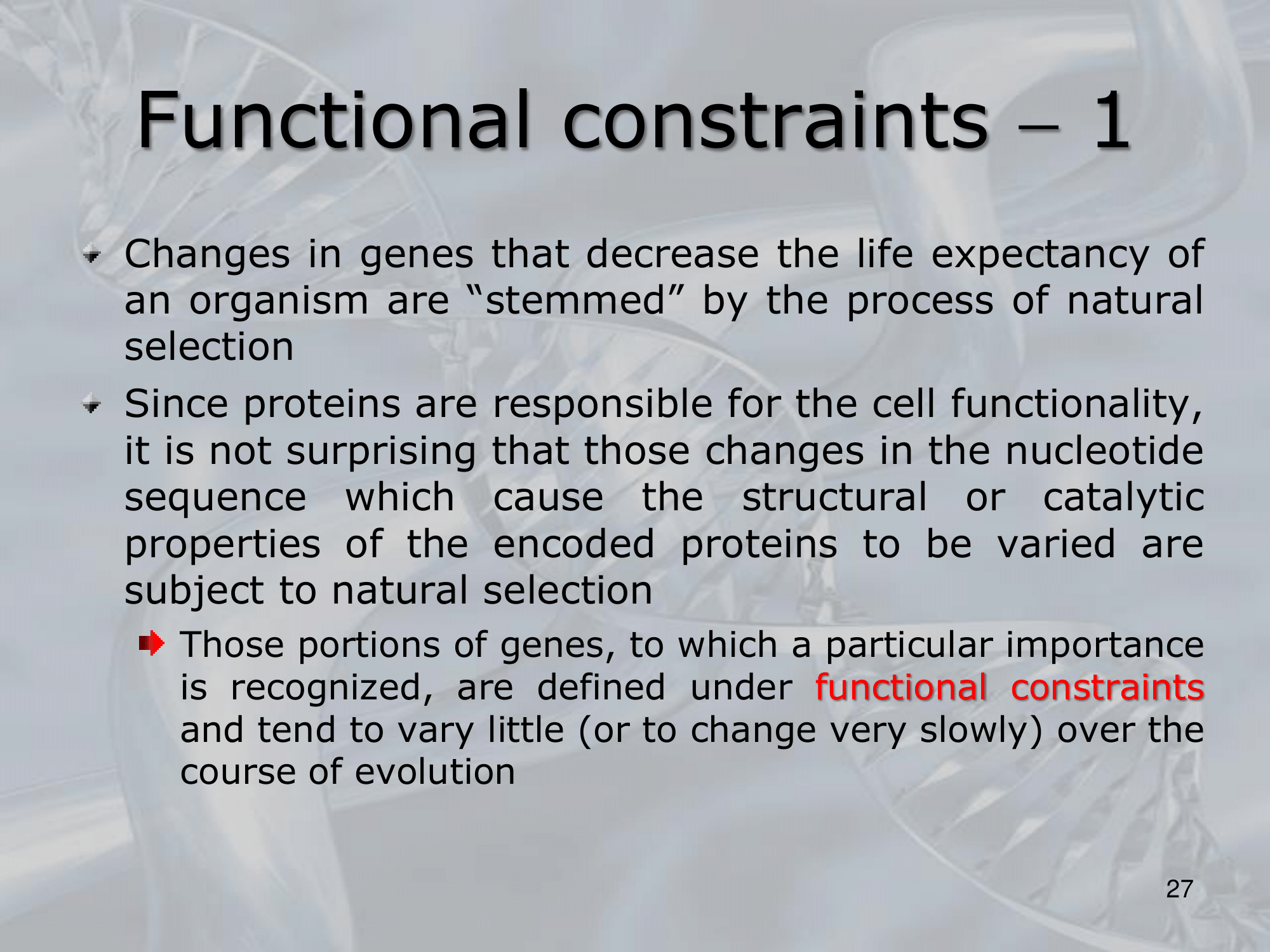
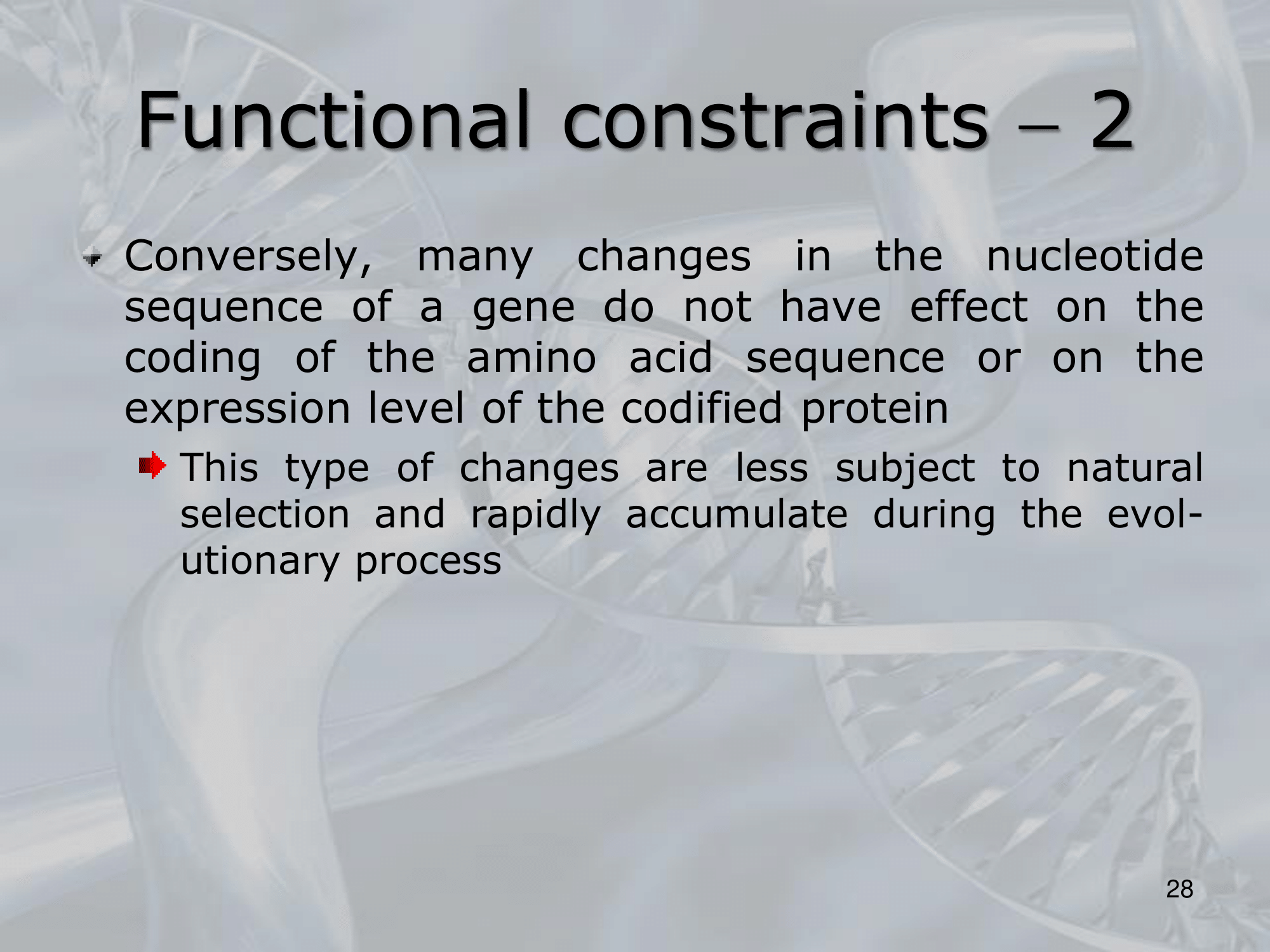
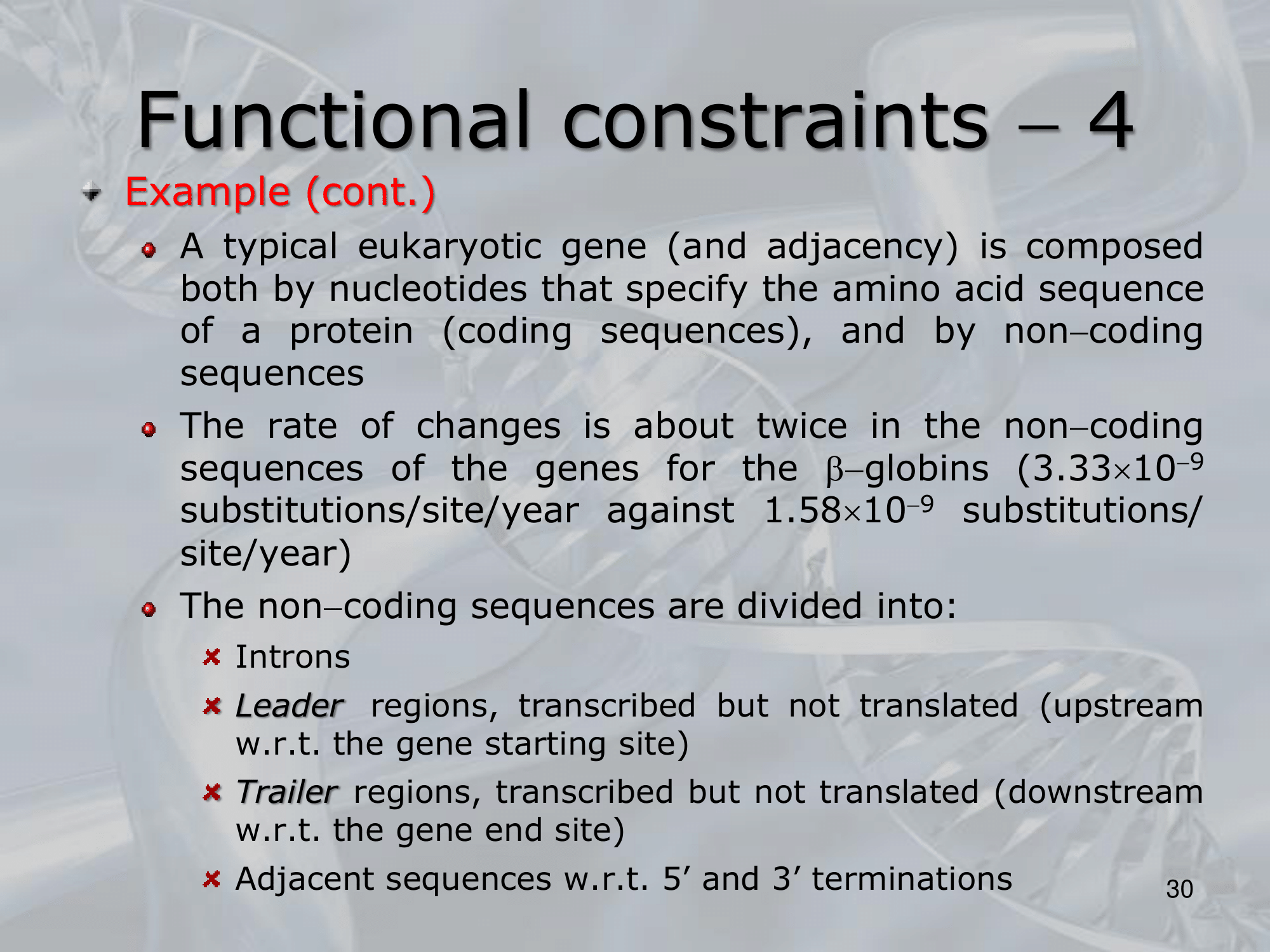
IMPORTANTE Tutti i cambiamenti che diminuiscono la durata media di vita di un organismo vengono eliminati dalla selezione naturale. #IMPORTANTE Nelle sequenze nucleotidiche esistono functional constraints che limitano le mutazioni su alcune sequenze nucleotidiche. Al contrario molti cambiamenti alle sequenze nucleotidiche non cambiamo la funzione della proteina tradotta, in questi casi cambiamenti su queste sequenze non sono fermati dalla soluzione naturale, e le mutazioni si accumulano rapidamente durante l’evoluzione. #IMPORTANTE Le sequenze non-codificanti si dividono in: Introni. Leader regions: regioni transcritte ma non tradotte (si trovano all’inizio del’ending-site del gene). Trailer regions: regioni transcritte ma non tradotte (si trovano alla fine del’ending-site del gene). Adjacent sequences rispetto alle terminazioni in e .
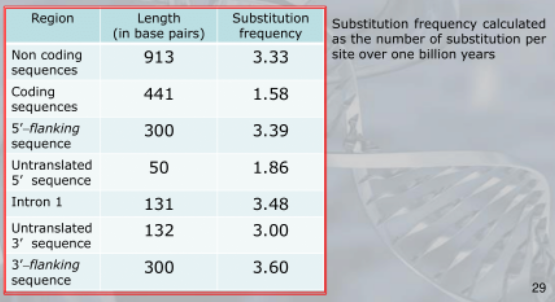
IMPORTANTE I cambiamenti si accumulano in ordine più rapidamente in:
- Introni
- Regioni che vengono trascritte ma non tradotte, e nella sequenza al terminale, che è funzionalmente importante per la sequente fase della traduzione in gene.
- Infine, meno rapidametne nelle sequenze codificanti.
~Grafico:
Per mettere in prospettiva, in una sequenza nucleotidica, gli introni cambiano di in un MILIONE di anni, per un umano sembra lento, ma relativamente per l’evoluzione molecolare è molto veloce.
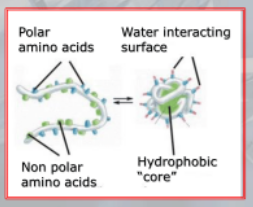
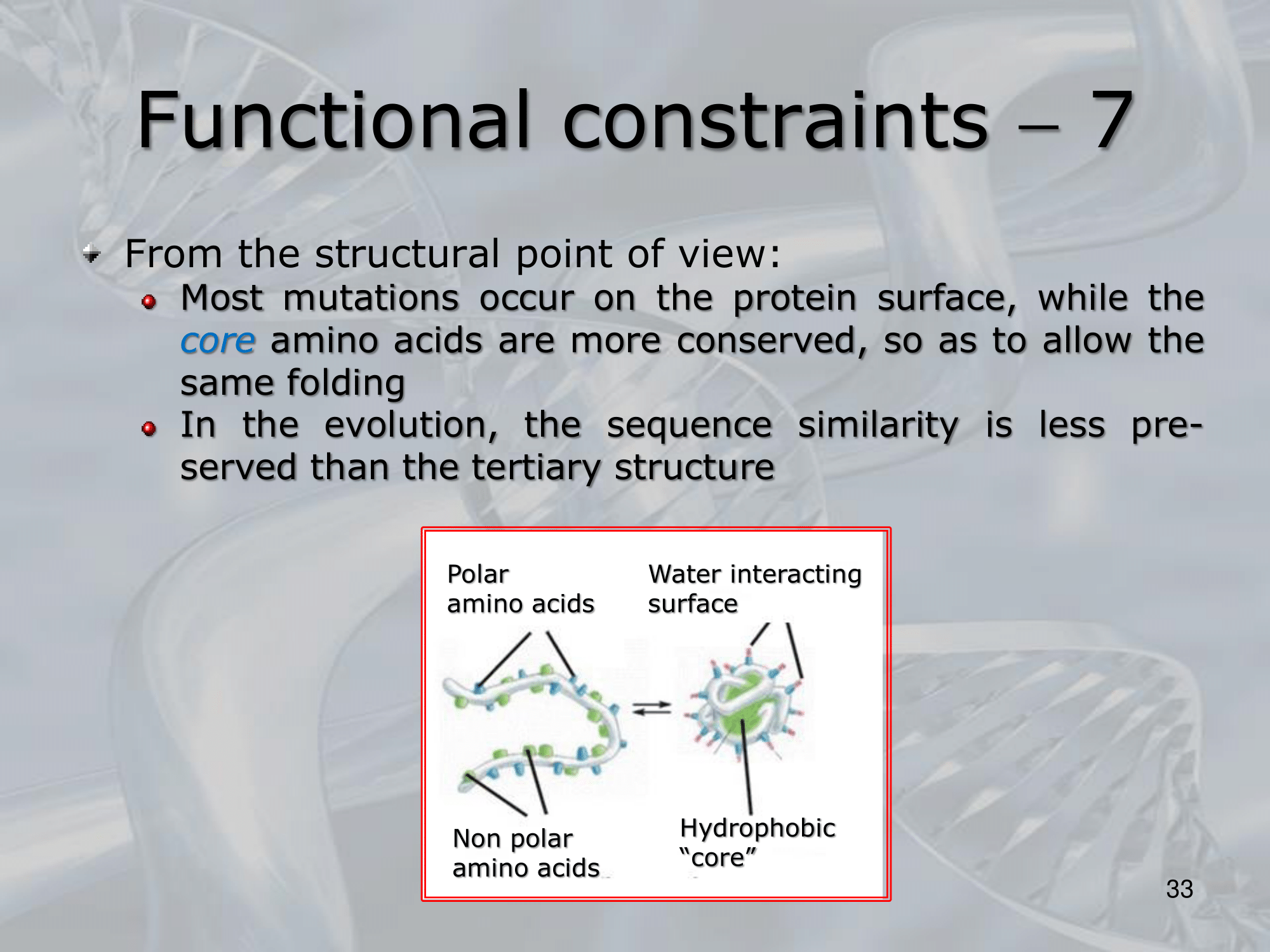
IMPORTANTE La maggior parte di mutazioni avvengono sulla superficie delle proteine, mentre vengono mantenuto il cuore della proteina, che determina la sua struttura, la struttura cerca di essere mantenuta. ~Ex.: Cambio di un amminoacido interno alla proteina:
—————————————————————
Slides with Notes
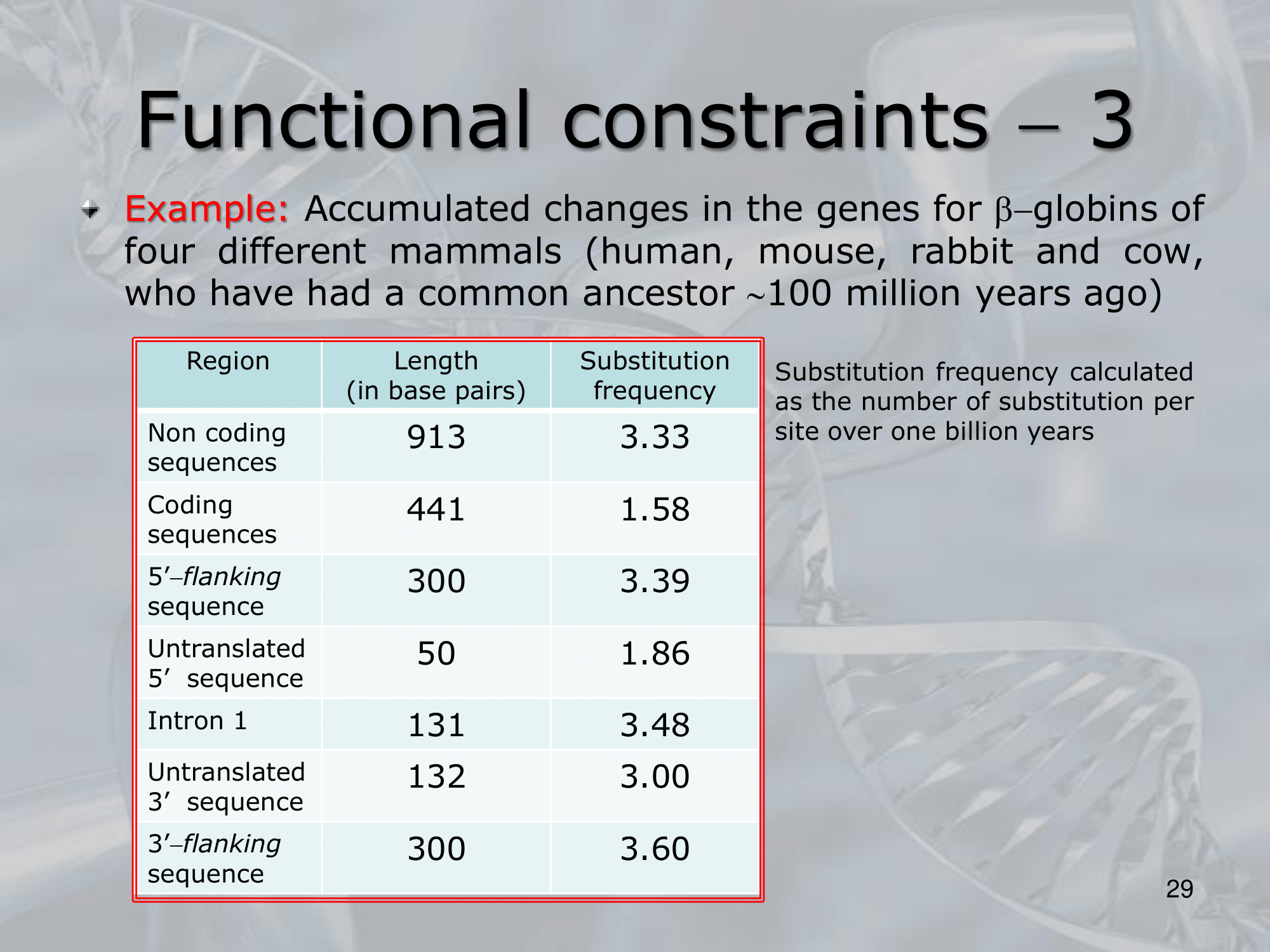
IMPORTANTE What are Introns and Exons: Introns and exons are nucleotide sequences within a gene. Introns are removed by RNA splicing as RNA matures, meaning that they are not expressed in the final messenger RNA (mRNA) product. While Exons go on to be covalently bonded to one another in order to create mature mRNA.
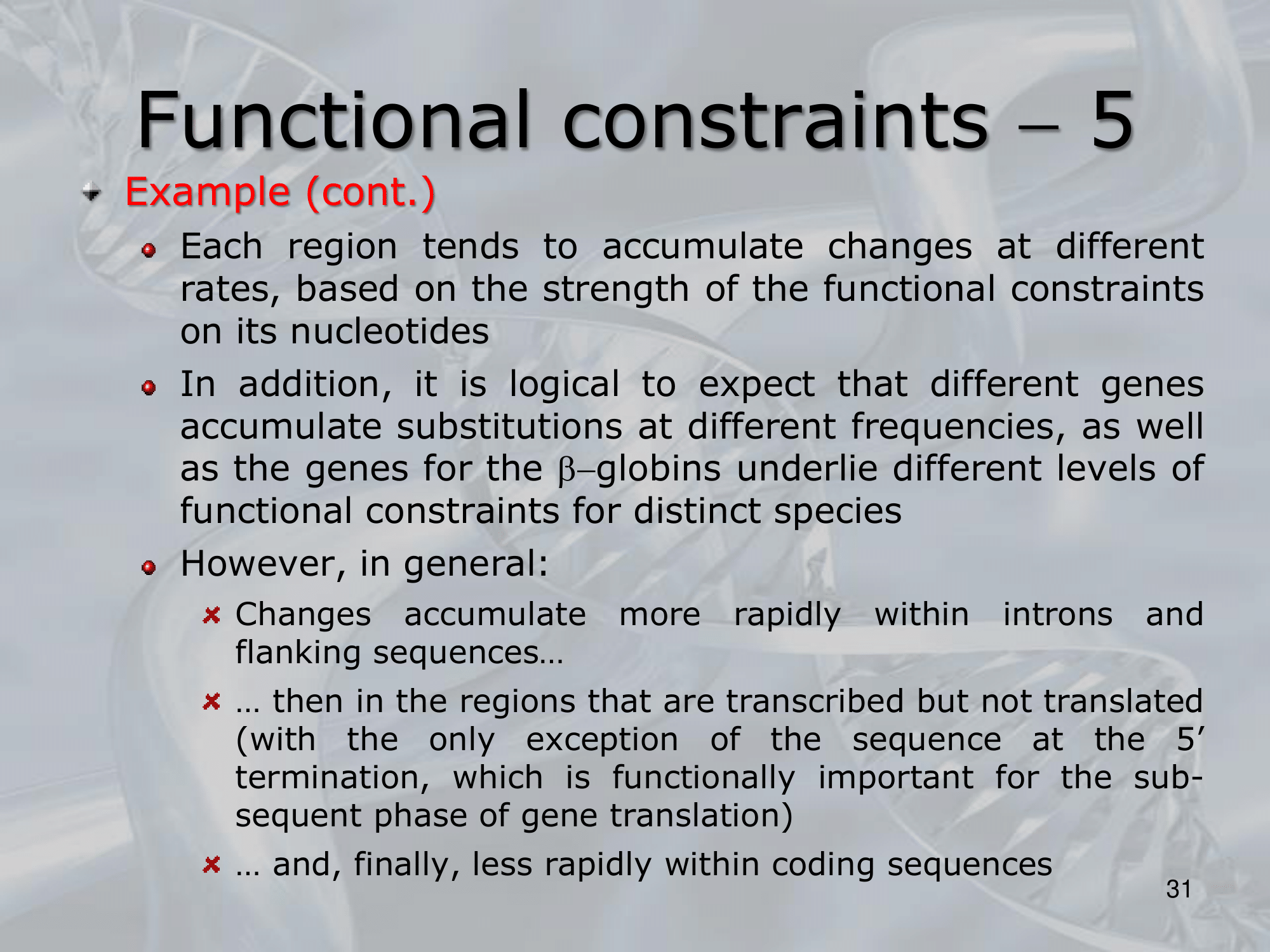
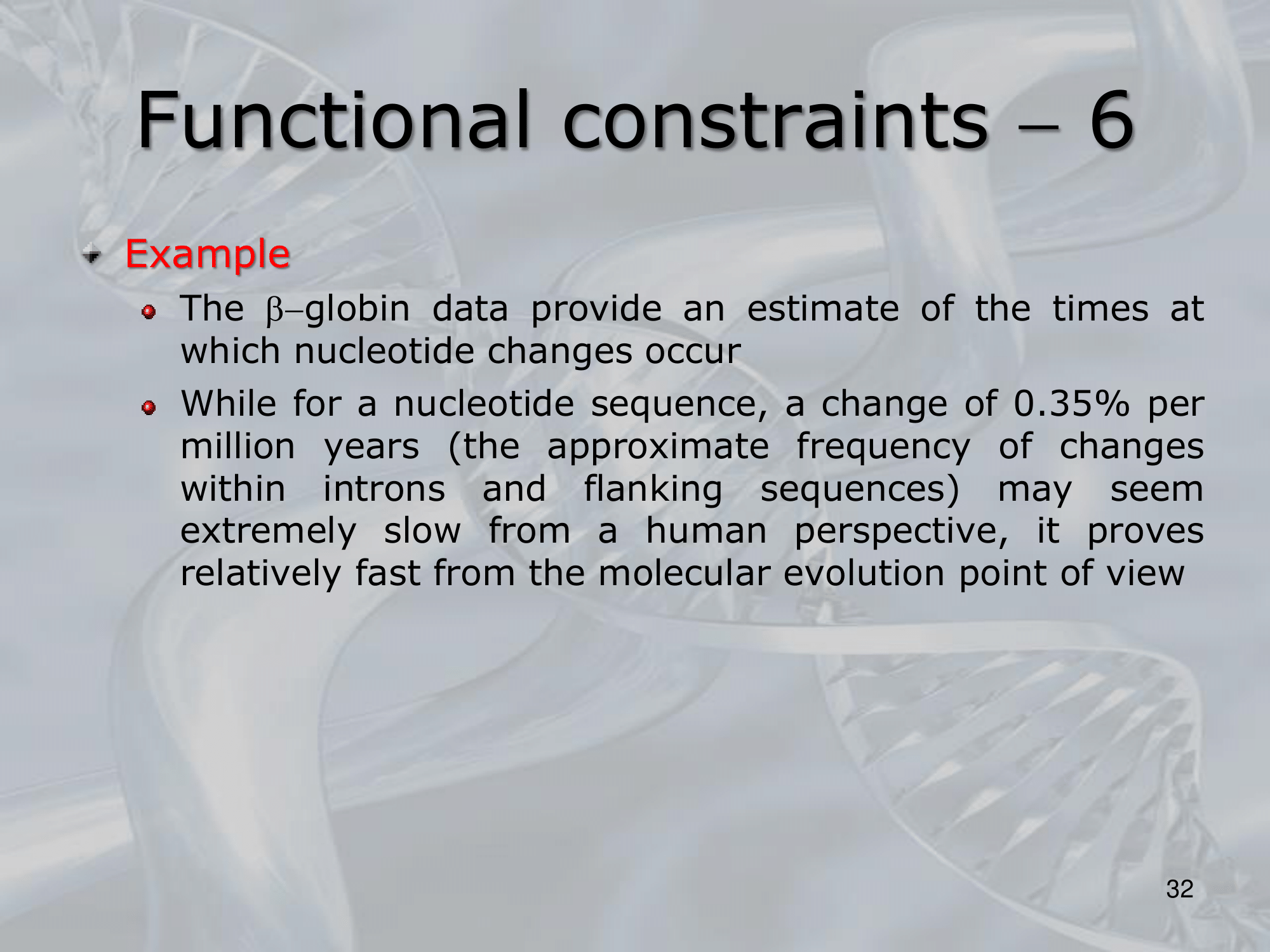
IMPORTANTE Tutti i cambiamenti che diminuiscono la durata media di vita di un organismo vengono eliminati dalla selezione naturale. #IMPORTANTE Nelle sequenze nucleotidiche esistono functional constraints che limitano le mutazioni su alcune sequenze nucleotidiche. Al contrario molti cambiamenti alle sequenze nucleotidiche non cambiamo la funzione della proteina tradotta, in questi casi cambiamenti su queste sequenze non sono fermati dalla soluzione naturale, e le mutazioni si accumulano rapidamente durante l’evoluzione. #IMPORTANTE Le sequenze non-codificanti si dividono in: Introni. Leader regions: regioni transcritte ma non tradotte (si trovano all’inizio del’ending-site del gene). Trailer regions: regioni transcritte ma non tradotte (si trovano alla fine del’ending-site del gene). Adjacent sequences rispetto alle terminazioni in e .
IMPORTANTE I cambiamenti si accumulano in ordine più rapidamente in:
- Introni
- Regioni che vengono trascritte ma non tradotte, e nella sequenza al terminale, che è funzionalmente importante per la sequente fase della traduzione in gene.
- Infine, meno rapidametne nelle sequenze codificanti.
~Grafico:
Per mettere in prospettiva, in una sequenza nucleotidica, gli introni cambiano di in un MILIONE di anni, per un umano sembra lento, ma relativamente per l’evoluzione molecolare è molto veloce.
IMPORTANTE La maggior parte di mutazioni avvengono sulla superficie delle proteine, mentre vengono mantenuto il cuore della proteina, che determina la sua struttura, la struttura cerca di essere mantenuta. ~Ex.: Cambio di un amminoacido interno alla proteina: