Questions
- What are Repeated Elements?
- Repeated elements are stretches of DNA that are found in multiple copies within a genome.
These elements can be short, ranging from a few base pairs to a few hundred base pairs in length, or long, spanning thousands of base pairs.
They can be dispersed throughout the genome or clustered in specific regions. - There are two main types of repeated elements: tandem repeats and interspersed repeats.
- ==Tandem repeats consist of adjacent, identical or nearly identical copies of a sequence, such as microsatellites or minisatellites==.
- Microsatellites, also known as simple sequence repeats (SSRs), are short DNA sequences consisting of a repeated motif of 1-6 nucleotides.
- Minisatellites, also known as variable number tandem repeats (VNTRs), are similar to microsatellites in that they consist of tandem repeats of DNA sequences.
However, they are longer than microsatellites, typically consisting of repeats of 10-60 nucleotides.
- ==Interspersed repeats, on the other hand, are dispersed throughout the genome and can be further classified into transposable elements and satellite DNA==.
- ==Transposable elements, including retrotransposons and DNA transposons==, are mobile genetic elements that can move around the genome and contribute to genetic diversity and genome evolution.
- Satellite DNA, on the other hand, consists of highly repetitive sequences that are usually located in the centromeres and telomeres of chromosomes and have important roles in chromosome stability and function.
- ==Tandem repeats consist of adjacent, identical or nearly identical copies of a sequence, such as microsatellites or minisatellites==.
- Repeated elements can have both positive and negative effects on genome function and evolution.
They can contribute to genetic diversity and facilitate the evolution of new genes, but they can also cause mutations, disrupt gene function, and contribute to genetic diseases.
Additionally, repeated elements can be used as molecular markers for genetic studies and forensic analyses due to their high levels of variability. - Overall, repeated elements are an important and diverse class of genomic sequences that continue to be an active area of research in genetics and genomics.
- Repeated elements are stretches of DNA that are found in multiple copies within a genome.
- Why does the DNA have Repeated Elements?
- There are several reasons why DNA can have repeated elements.
==One reason is that repeated elements can arise through errors in DNA replication and repair mechanisms, leading to duplications or rearrangements of genetic material.
In addition, repeated elements can be generated by the activity of transposable elements, which can insert copies of themselves into new locations within the genome==. - Repeated elements can also be selectively advantageous, providing functional benefits to the organism.
==For example, tandem repeats can help stabilize the structure of chromosomes, facilitate DNA replication and repair, and promote genetic diversity.
In some cases, repeated elements can also play important roles in gene regulation, such as by serving as binding sites for regulatory proteins==. - Moreover, repeated elements can have detrimental effects, such as by causing genomic instability, disrupting gene function, and contributing to genetic diseases.
For example, some types of repeated elements have been implicated in disorders such as fragile X syndrome, Huntington’s disease, and some types of cancer. - Overall, the presence of repeated elements in DNA can have both positive and negative effects on genome function and evolution, and their occurrence is influenced by a variety of factors, including genetic, environmental, and selective pressures.
- There are several reasons why DNA can have repeated elements.
—————————————————————
IMPORTANTE
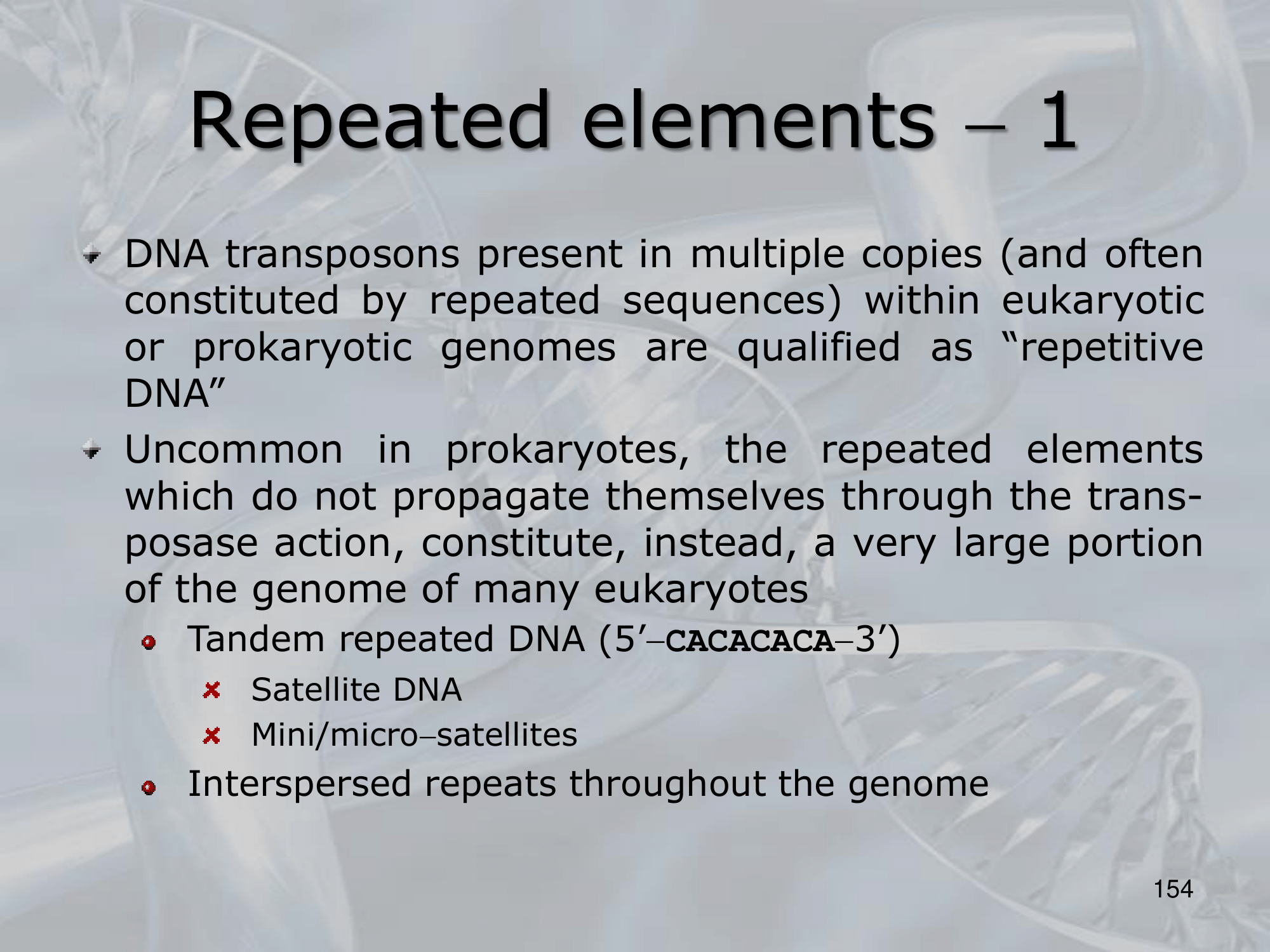
IMPORTANTE Repeated Elements: DNA transposons prensent in multiple copies (and ofter constituted by repeated sequences) within eukaryotic or prokaryotic genomes are qualified as “repeatitive DNA”. Reapeated elements are common in eukaryotes, but uncommon in prokaryotes
Types of repeated elements:
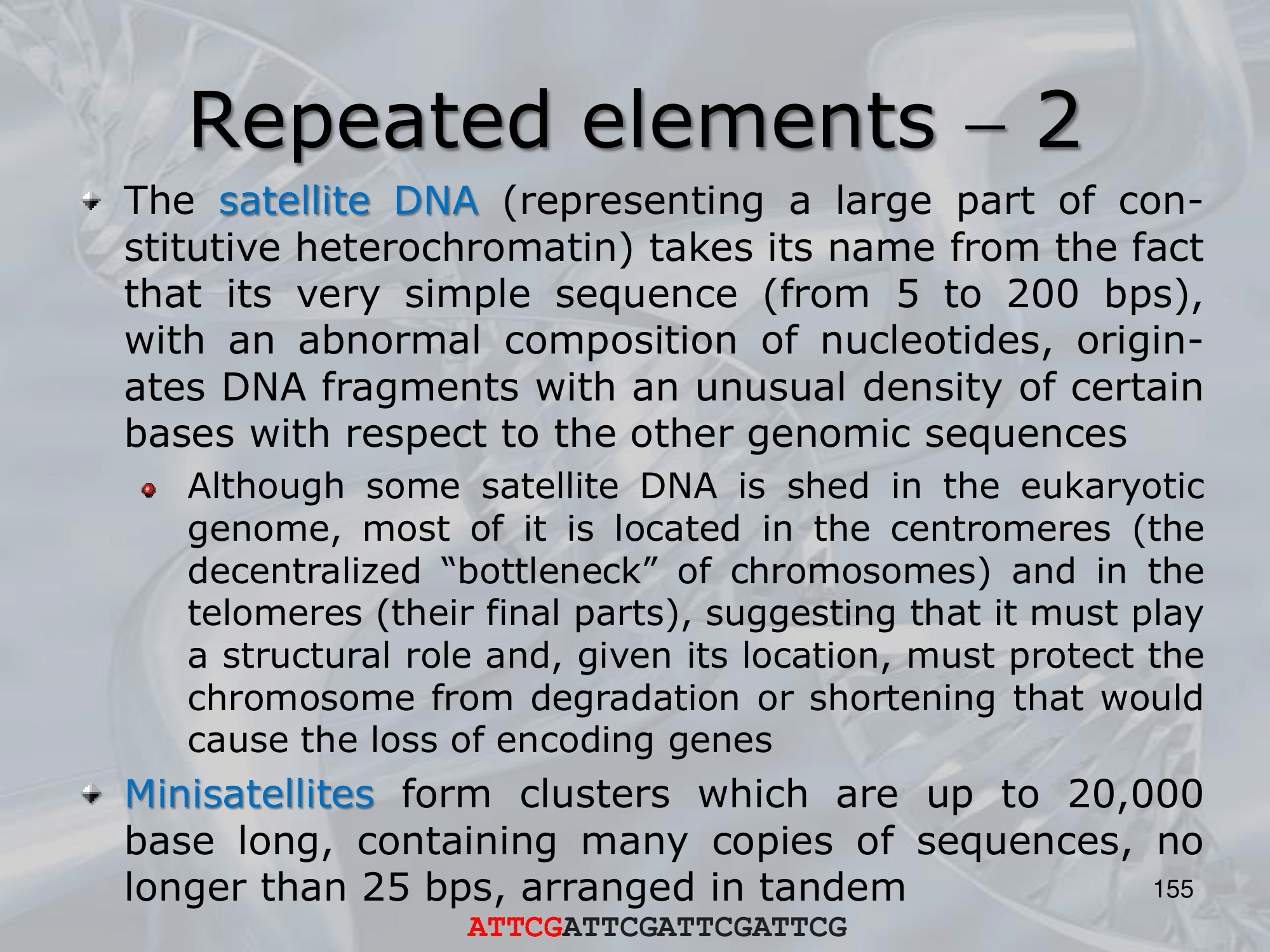
- Satellite DNA (representing a large part of the heterochromatin), it plays a structural role protecting the chromosome from degradation, or shortening that would cause the loss of encoding genes.
- Minisatellites: clusters up to bps, formed by copies of a sequence no longer than bps (~ex.: ATTCGATTCGATTCGATTCGATTCG…)
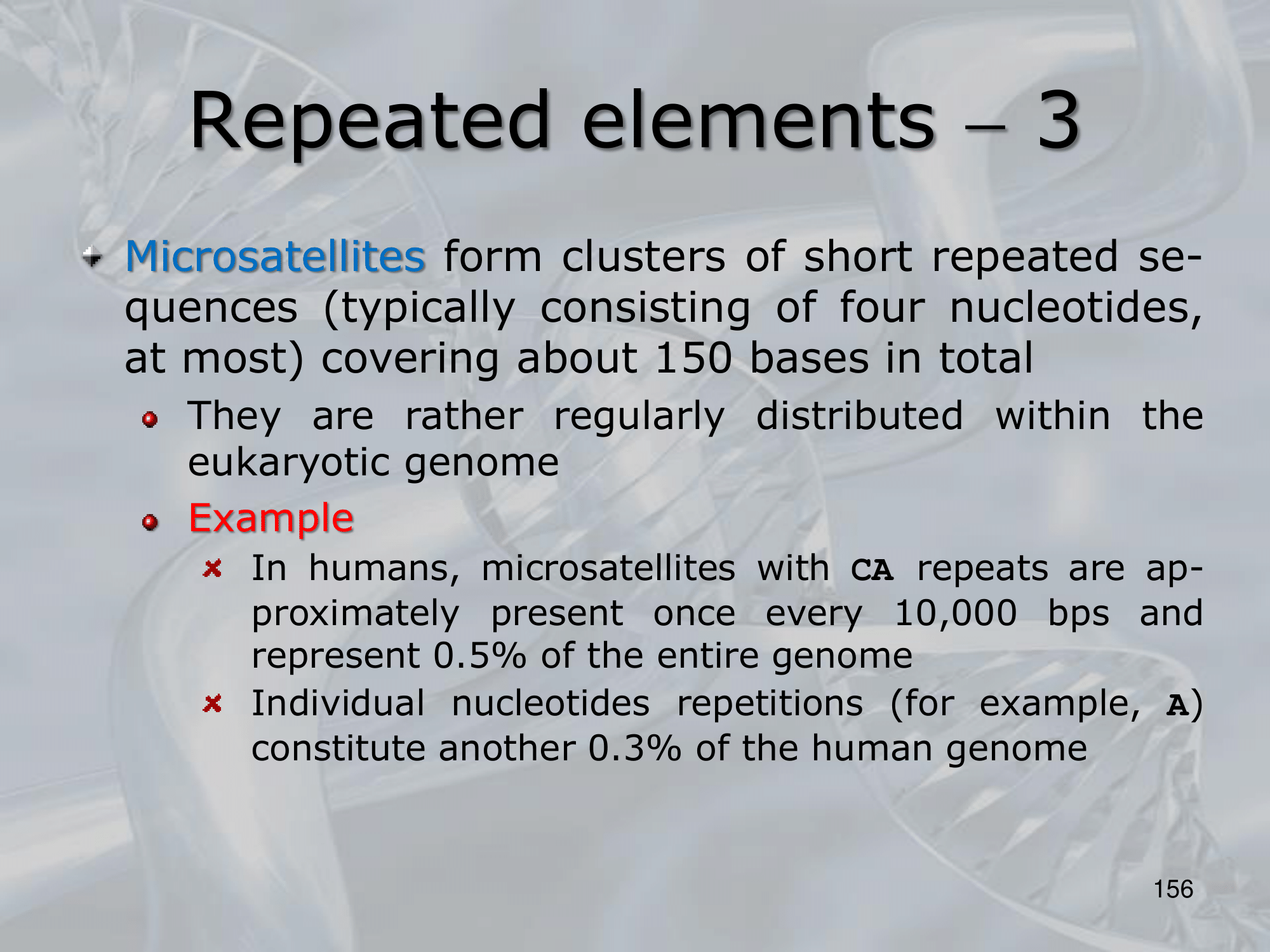
- Microsatellites: one or two bases repeated for up to bs (~ex.: ACACACACACAC…, AAAAAAAAAAAAA)
- Interpersed Repeats or Retrotrasposons:
- LINEs
- SINEs
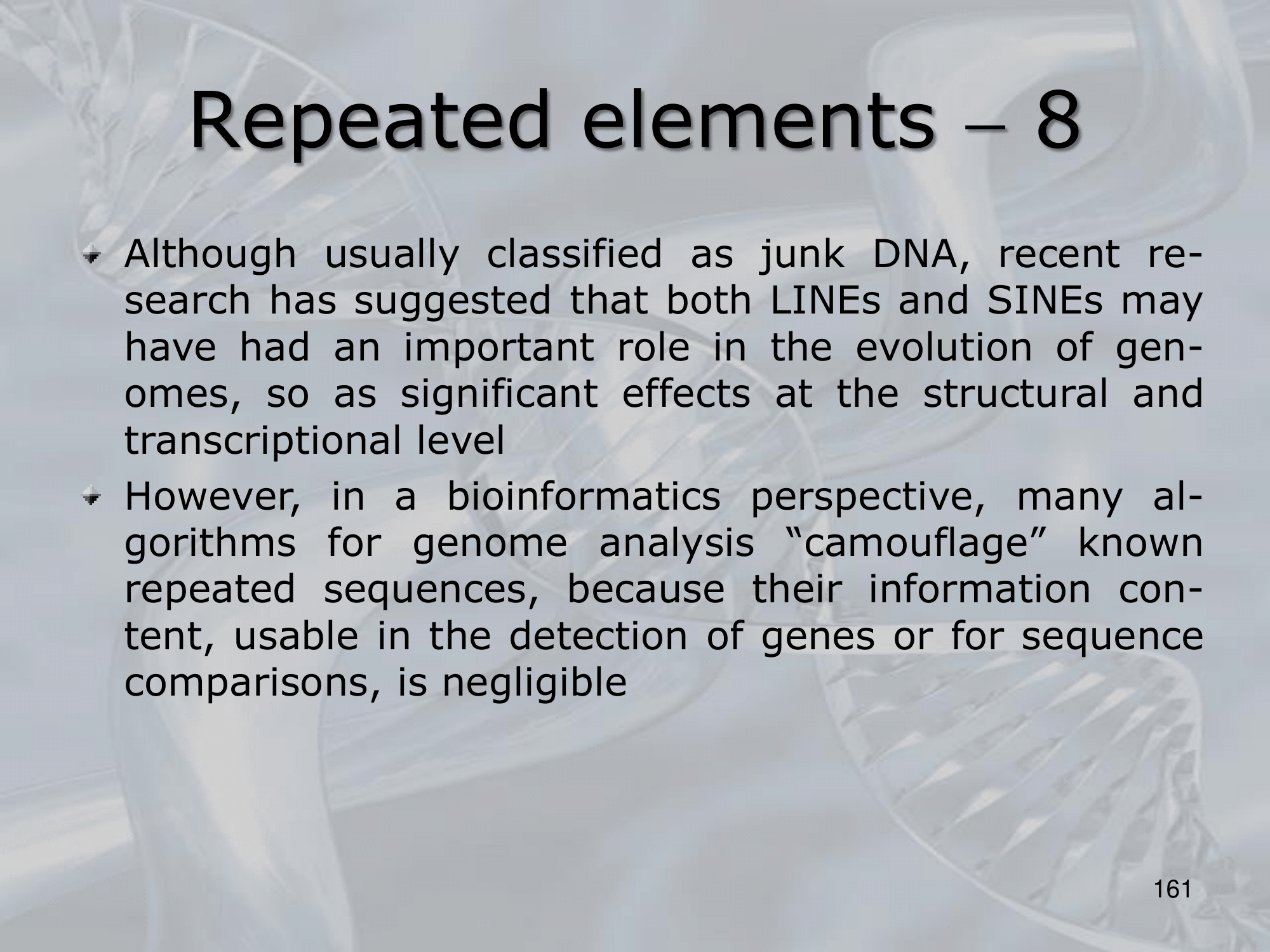
IMPORTANTE Interpersed Repeats or Retrotrasposons: DNA fragments that independently transcribe themselves into an intermediate RNA and that are consequently able (via intervetion of inverse transcriptase enzyme) to replicate copies in different position within the genome. The enzyme inverse transcriptase does not belong to the genes of normal cells, but it is acquired by infectios (single strand) retroviruses (similar to the human AIDS)
IMPORTANTE LINEs (Long Interspread Nuclear Elements):
- Long ( bps) interspread DNA sequences
- The human genome contains more than LINEs ( of the entire genome)
- Each LINE codes for genes, that code for:
- Reverse Transcriptase
- Integrase Activity
- With this two genes each LINE (and often other non-coding regions) can be COPIED and PASTED
IMPORTANTE SINEs (Short Interspread Nuclear Elements):
- Short ( bps) interspread DNA sequences
- The human genome contains more than SINEs ( of the entire genome)
- SINEs are rearly transcribed because they need the reverse transcriptase, which they do not encode, they are encoded by the reverse transcriptase produced by other genes, like LINEs.
- Like LINEs, SINEs are COPIED and PASTED.
—————————————————————
Slides with Notes
IMPORTANTE Repeated Elements: DNA transposons prensent in multiple copies (and ofter constituted by repeated sequences) within eukaryotic or prokaryotic genomes are qualified as “repeatitive DNA”. Reapeated elements are common in eukaryotes, but uncommon in prokaryotes
Types of repeated elements:
- Satellite DNA (representing a large part of the heterochromatin), it plays a structural role protecting the chromosome from degradation, or shortening that would cause the loss of encoding genes.
- Minisatellites: clusters up to bps, formed by copies of a sequence no longer than bps (~ex.: ATTCGATTCGATTCGATTCGATTCG…)
- Microsatellites: one or two bases repeated for up to bs (~ex.: ACACACACACAC…, AAAAAAAAAAAAA)
- Interpersed Repeats or Retrotrasposons:
- LINEs
- SINEs
IMPORTANTE Interpersed Repeats or Retrotrasposons: DNA fragments that independently transcribe themselves into an intermediate RNA and that are consequently able (via intervetion of inverse transcriptase enzyme) to replicate copies in different position within the genome. The enzyme inverse transcriptase does not belong to the genes of normal cells, but it is acquired by infectios (single strand) retroviruses (similar to the human AIDS)
IMPORTANTE LINEs (Long Interspread Nuclear Elements):
- Long ( bps) interspread DNA sequences
- The human genome contains more than LINEs ( of the entire genome)
- Each LINE codes for genes, that code for:
- Reverse Transcriptase
- Integrase Activity
- With this two genes each LINE (and often other non-coding regions) can be COPIED and PASTED
IMPORTANTE SINEs (Short Interspread Nuclear Elements):
- Short ( bps) DNA sequences
- The human genome contains more than SINEs ( of the entire genome)
- SINEs are rearly transcribed because they need the reverse transcriptase, which they do not encode, they are encoded by the reverse transcriptase produced by other genes, like LINEs.
- Like LINEs, SINEs are COPIED and PASTED.