Questions
- What are Phylogenetic Trees or Dendograms?
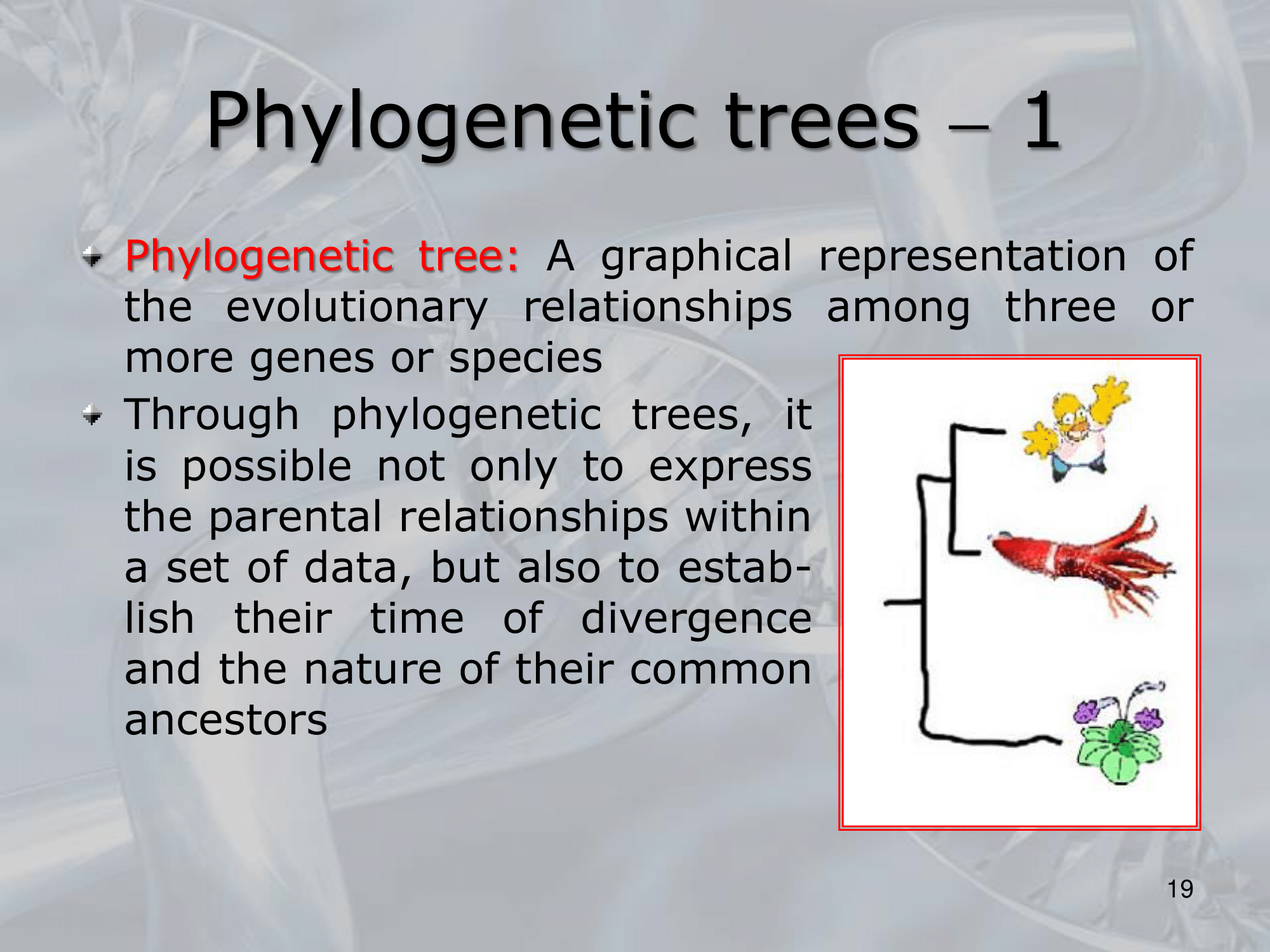
- Phylogenetic trees, also known as dendrograms, are graphical representations of evolutionary relationships among species or groups of organisms.
They show the pattern of descent with modification, or evolutionary history, of a set of species or genes.
Phylogenetic trees are constructed based on molecular, morphological, or behavioral data, and they illustrate the evolutionary relatedness between taxa by depicting their shared ancestry and the sequence of divergences that led to their current diversity.
==The branches of a phylogenetic tree represent the lineages of organisms, and the nodes represent the most recent common ancestors of those lineages.
The length of the branches reflects the amount of evolutionary change, or genetic divergence, that has occurred between lineages==.
Phylogenetic trees are useful tools for understanding the history of life on Earth, and for reconstructing the evolutionary processes that have shaped the diversity of organisms.
- Phylogenetic trees, also known as dendrograms, are graphical representations of evolutionary relationships among species or groups of organisms.
- What is a Taxon?
- A taxon is a group of organisms that is classified and named according to their evolutionary relationships.
It can refer to any taxonomic rank, from the highest (such as domain or kingdom) to the lowest (such as species or subspecies).
For example, the taxon “Chordata” includes all animals that have a notochord at some point in their development, while the taxon “Homo sapiens” includes all modern humans.
Taxa are used in taxonomy and systematics to organize and classify the diversity of life on Earth.
- A taxon is a group of organisms that is classified and named according to their evolutionary relationships.
- What we mean with Terminal Node and Internal Node of a Phylogenic Tree?
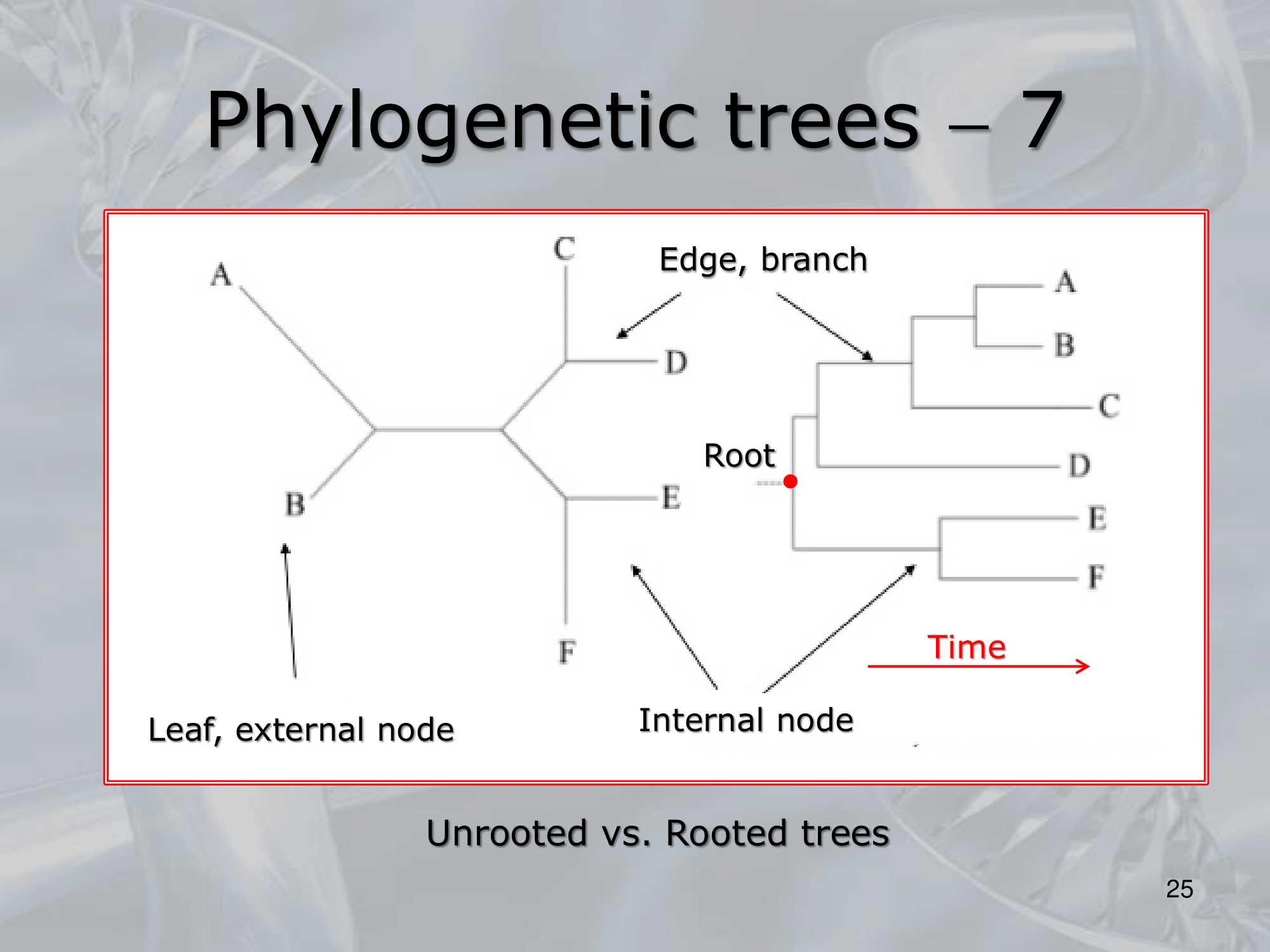
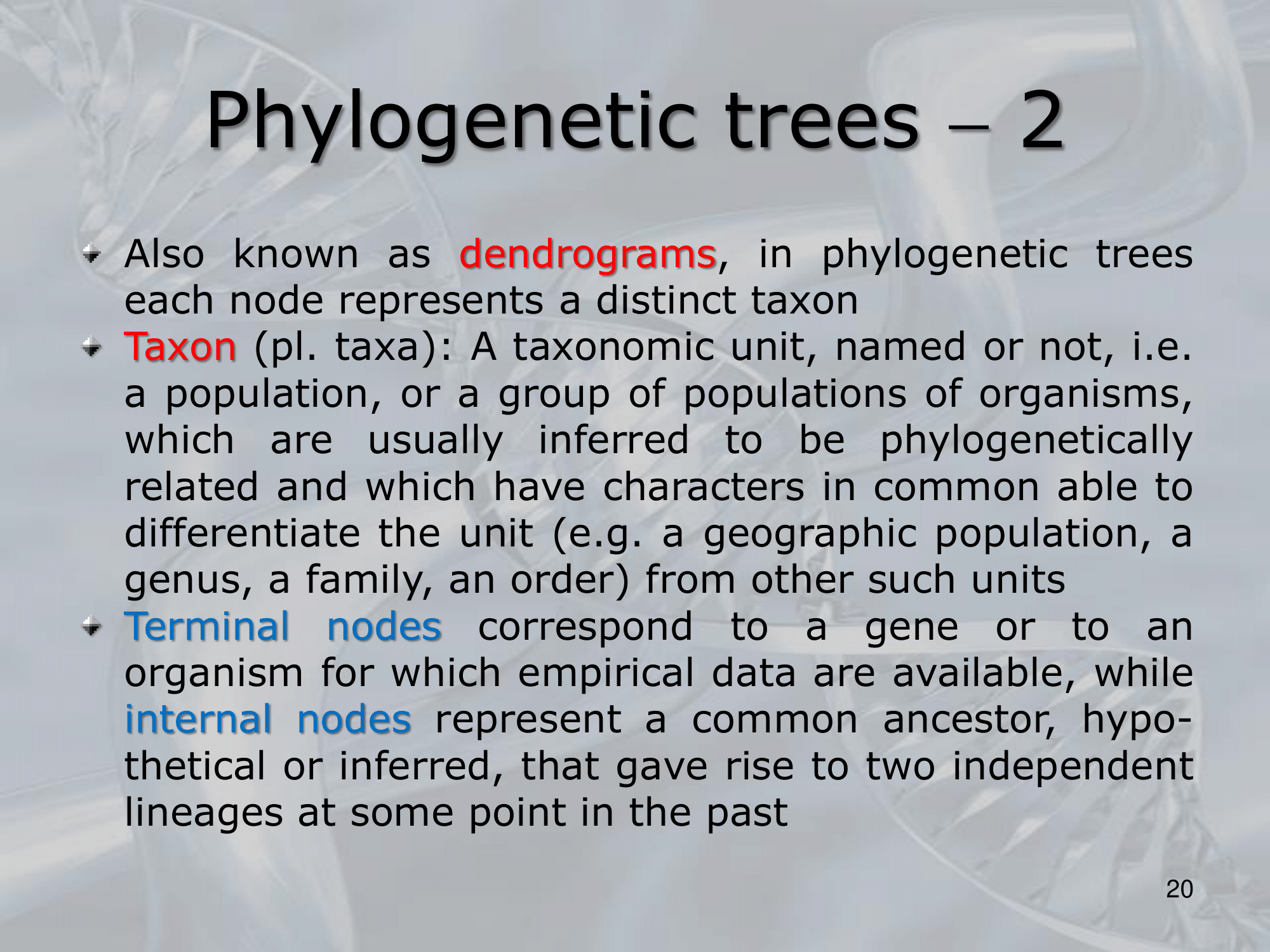
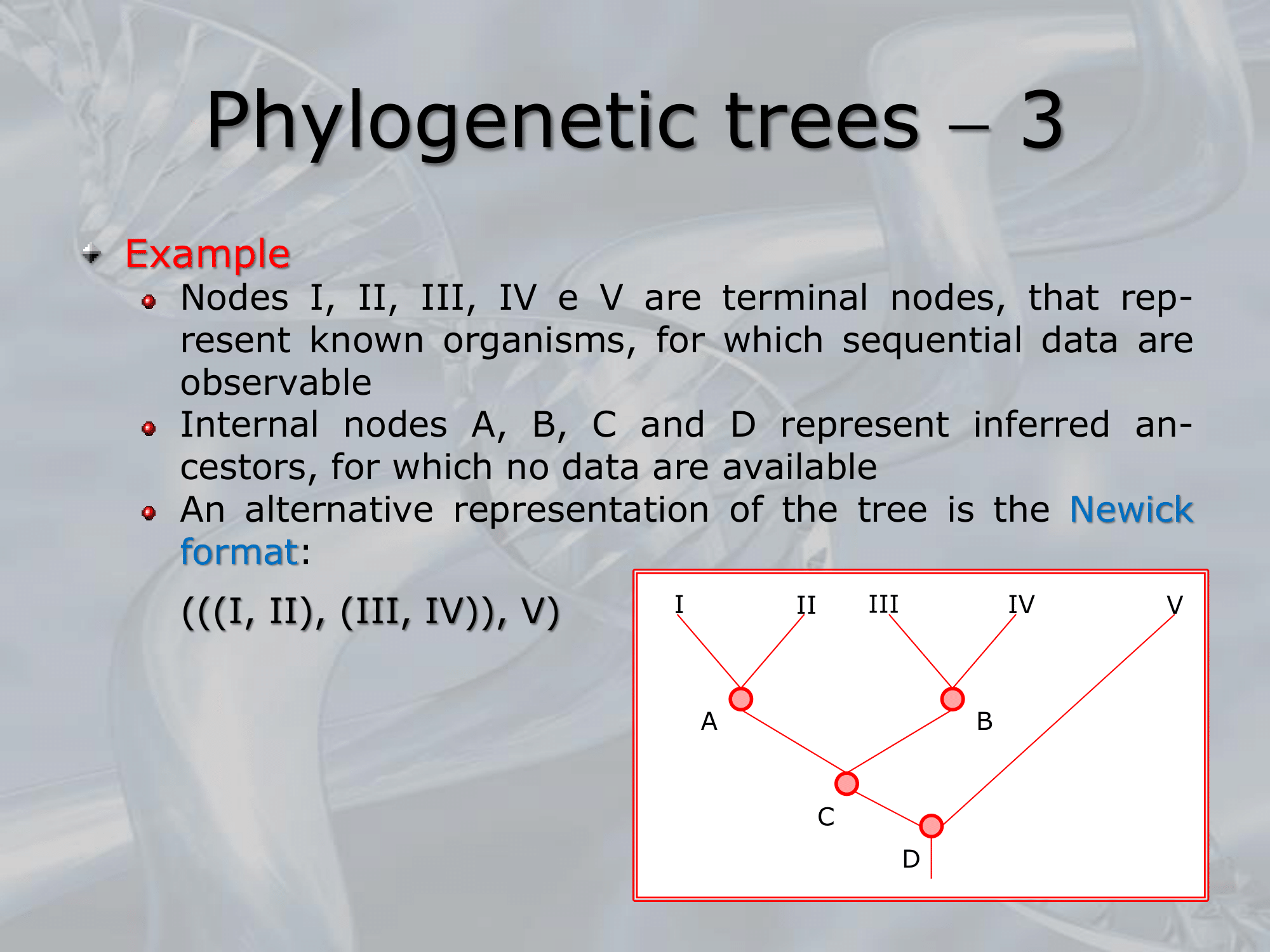
- ==In a phylogenetic tree, a terminal node represents an observed or sampled organism, while an internal node represents a hypothetical common ancestor of the organisms on the branches descending from it==.
The internal nodes are also referred to as ancestral nodes, while the terminal nodes are also called leaf nodes. - Terminal nodes are at the tips of the branches and represent the species or groups being compared in the analysis.
Internal nodes represent inferred ancestors and are placed at the points where branches split, indicating the point at which the two lineages diverged from their common ancestor.
The length of the branches can also provide information on the amount of evolutionary change that has occurred between the nodes.
- ==In a phylogenetic tree, a terminal node represents an observed or sampled organism, while an internal node represents a hypothetical common ancestor of the organisms on the branches descending from it==.
- What are the Types of Phylogenetic Trees?
- There are several types of phylogenetic trees, including:
- Cladograms: A tree that represents the branching patterns of organisms based on their shared characteristics.
The length of the branches in a cladogram does not necessarily reflect the amount of evolutionary change. - Phenograms: A tree that represents the degree of similarity between organisms based on quantitative data such as gene expression or protein sequences.
The length of the branches in a phenogram typically reflects the degree of similarity between organisms. - Phylograms: A tree that combines the branching patterns of a cladogram with the branch lengths of a phenogram to show both the evolutionary relationships and the degree of evolutionary change between organisms.
- Chronograms: A tree that includes information on the timing of evolutionary events, such as the age of fossils or the rate of molecular evolution.
The branch lengths in a chronogram represent the amount of time between evolutionary events. - Network trees: A tree that includes reticulations or “nets” to represent evolutionary events such as hybridization or horizontal gene transfer that do not fit into a strictly bifurcating tree structure.
- Cladograms: A tree that represents the branching patterns of organisms based on their shared characteristics.
- There are several types of phylogenetic trees, including:
—————————————————————
IMPORTANTE
IMPORTANTE Alberi filogenetici, o dendrogrammi sono alberi binari in cui ogni nodo rappresenta un’unità taxonomica, ovvero rappresenta una popolazione o un gruppo di popolazioni di organismi, le foglie degli alberi filogenetici rappresentano geni, o specie attualmente esistenti, o di cui abbiamo dati concreti, i nodi interni invece sono antenati comuni, i cui dati sono solo teorici, basati sui dati dei possibili discendenti (che abbiamo).
IMPORTANTE Alberi scalati: gli archi degli alberi hanno un valore, inteso come distanza di anni (milioni di anni tipicamente) che passano tra un nodo e il suo common ancenstor. Mentre alberi non-scalati sono quelli in cui si considera solo la parentela.
IMPORTANTE Alberi con radice: la radice rappresenta il common ancestor comune a tutte le foglie. #IMPORTANTE Alberi senza radice.
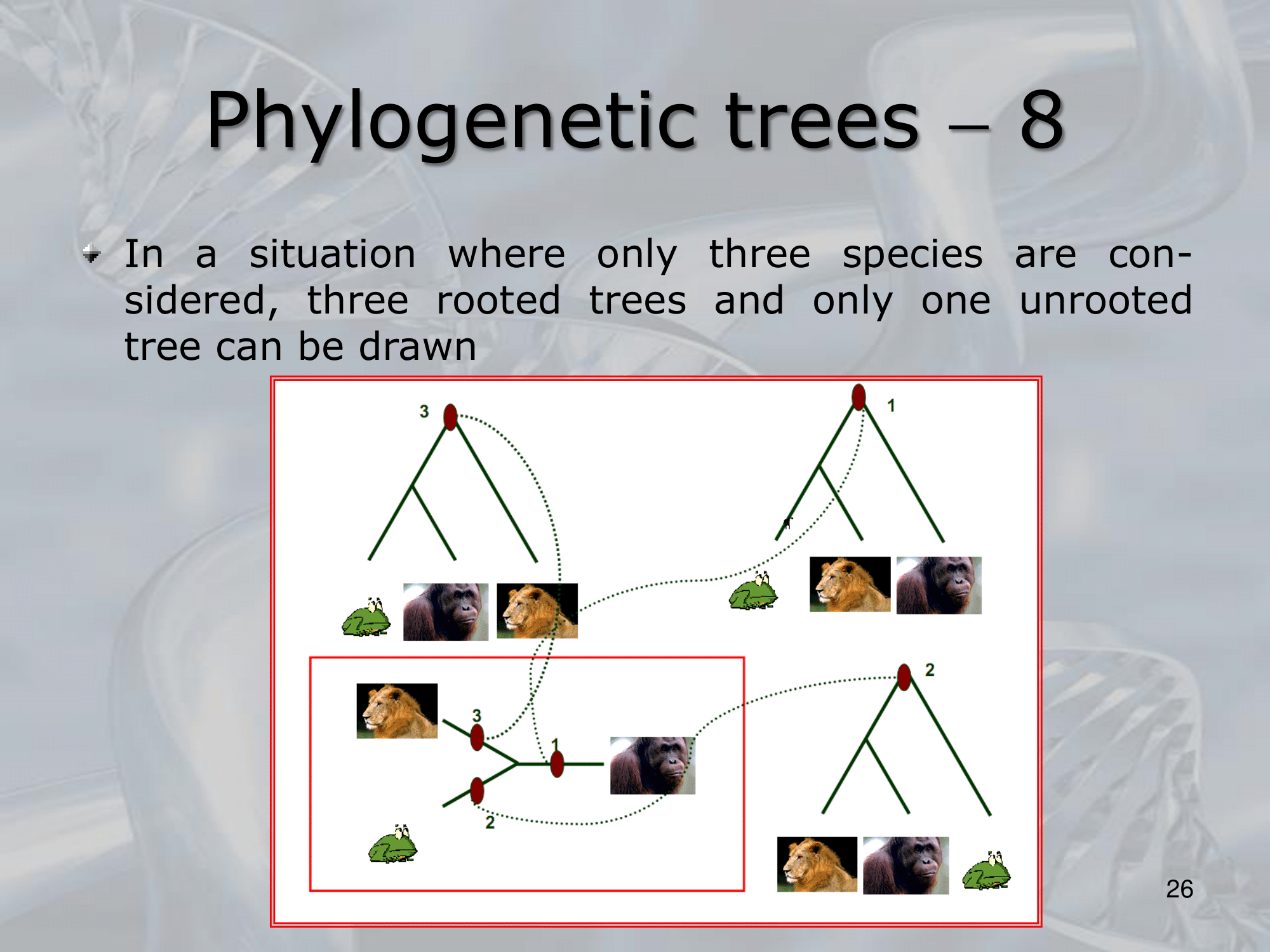
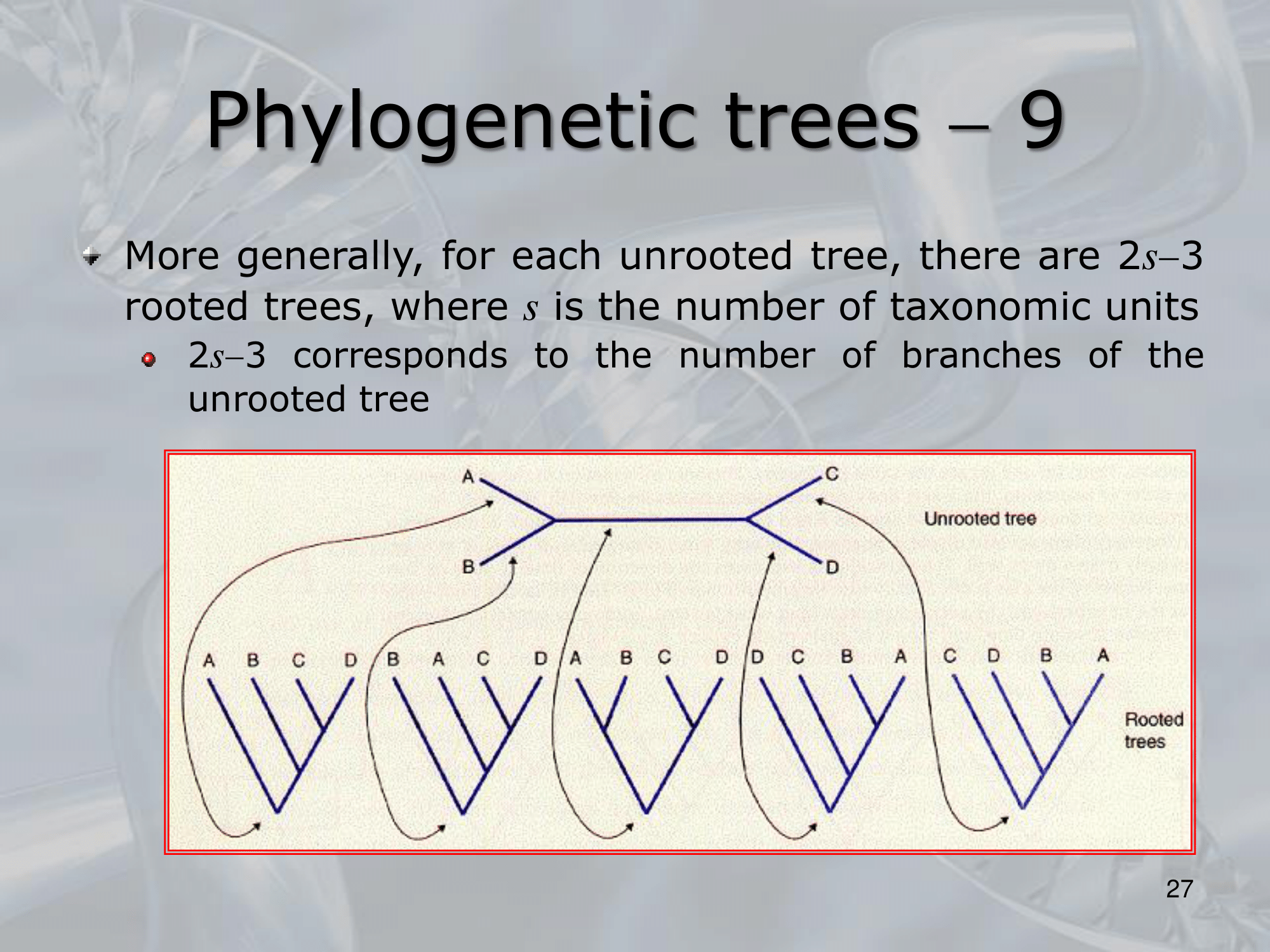
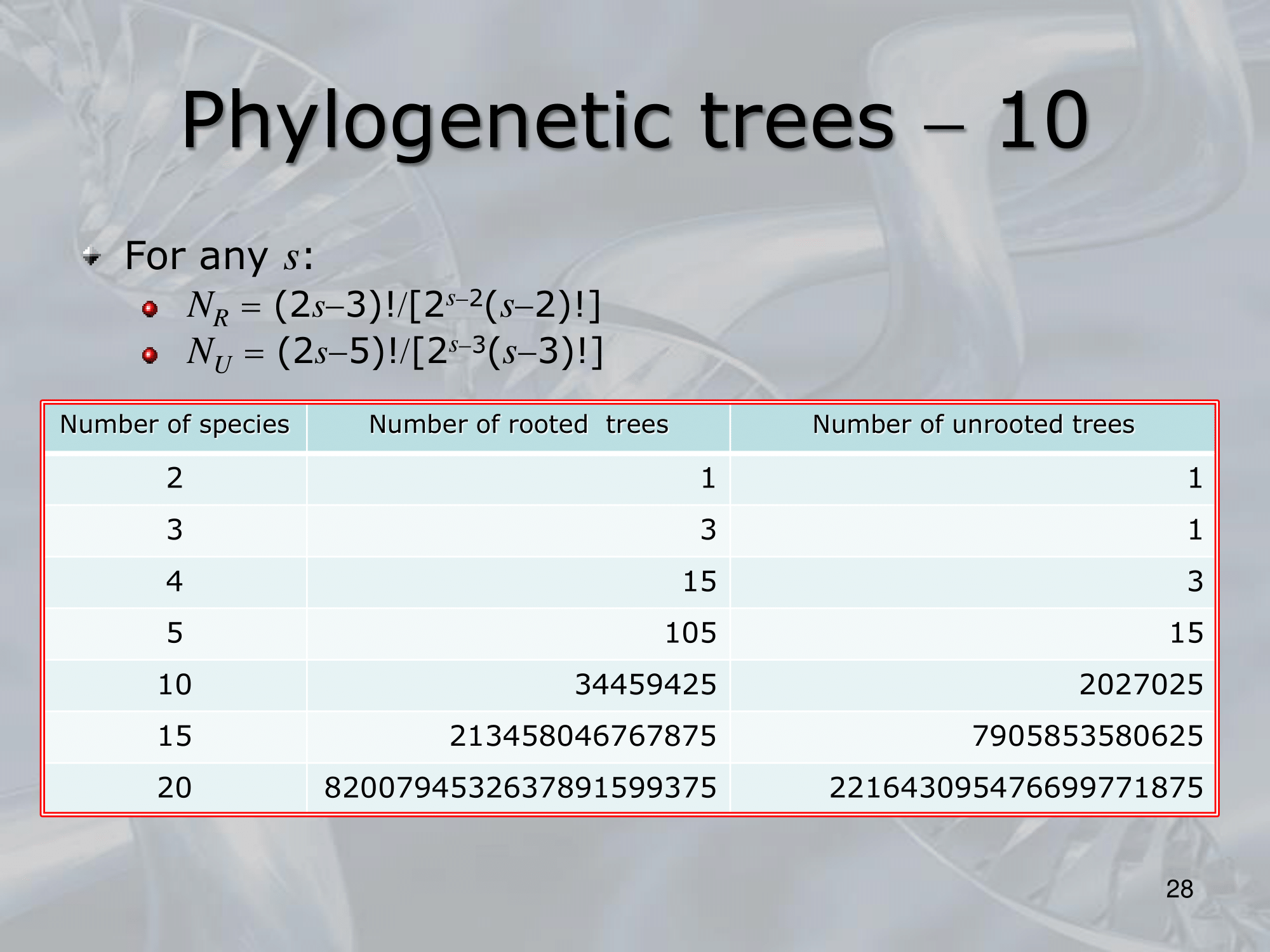
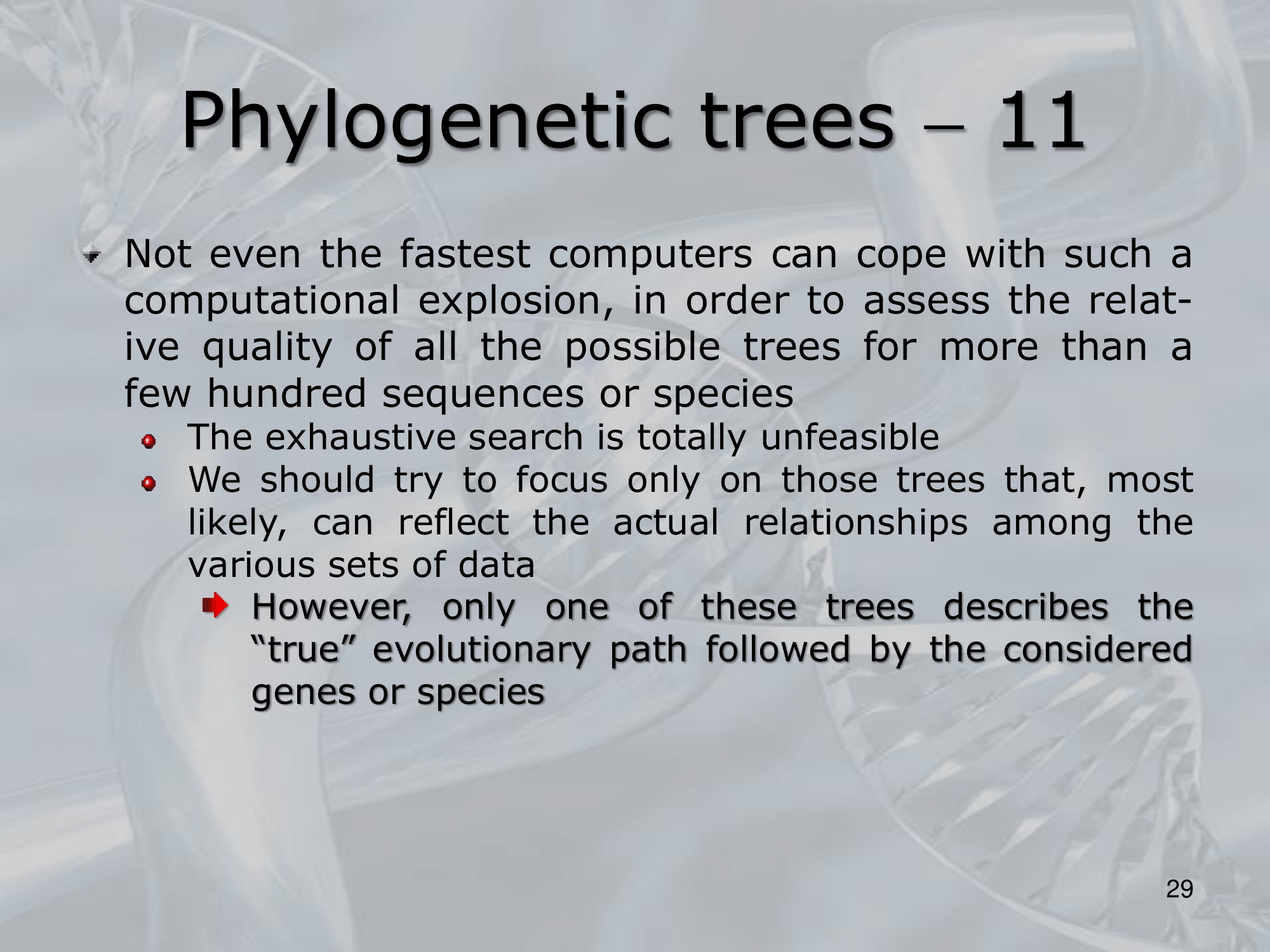
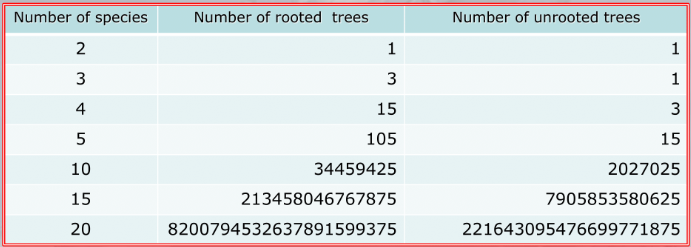
Da un albero senza radice è possibile ricavare un albero con radice, in particolare da un albero senza radice è possibile creare alberi con radice (dove è il numero di folgie) Ma in ogni caso il numero di alberi con o senza radice possibili che possiamo creare date foglie crescono in modo esponenziale.
—————————————————————
Slides with Notes
IMPORTANTE Alberi filogenetici, o dendrogrammi sono alberi binari in cui ogni nodo rappresenta un’unità taxonomica, ovvero rappresenta una popolazione o un gruppo di popolazioni di organismi, le foglie degli alberi filogenetici rappresentano geni, o specie attualmente esistenti, o di cui abbiamo dati concreti, i nodi interni invece sono antenati comuni, i cui dati sono solo teorici, basati sui dati dei possibili discendenti (che abbiamo).
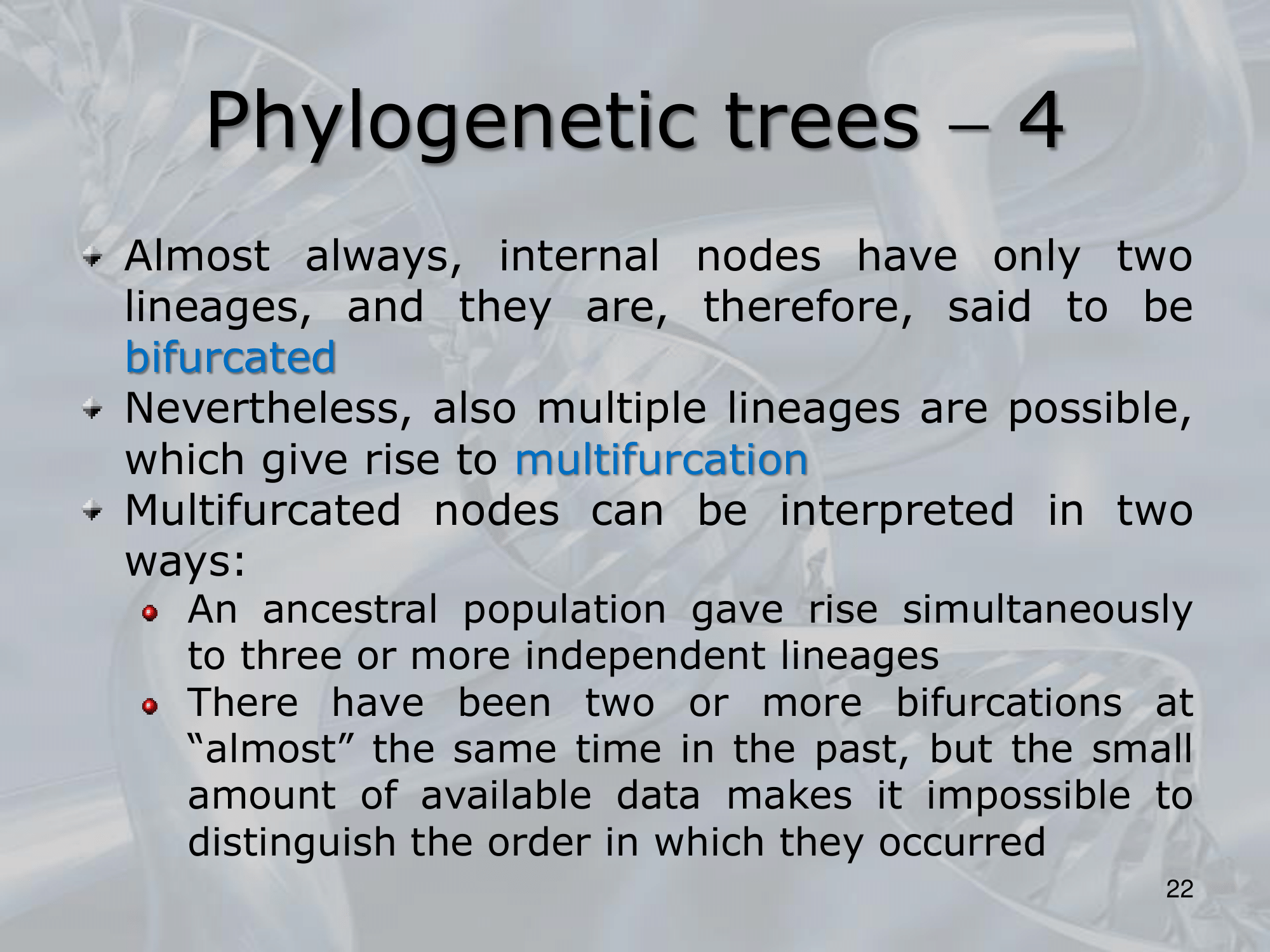
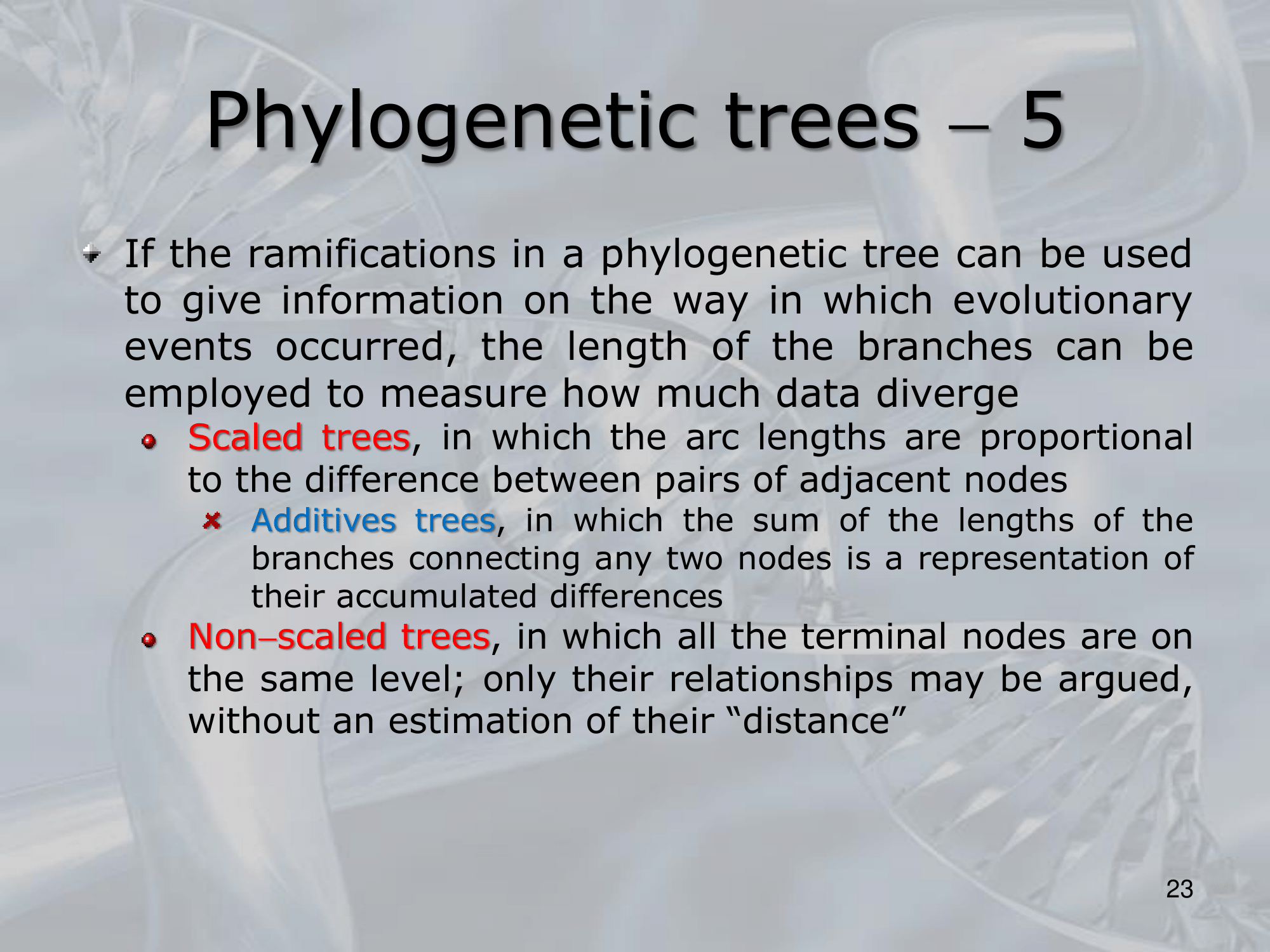
IMPORTANTE Alberi scalati: gli archi degli alberi hanno un valore, inteso come distanza di anni (milioni di anni tipicamente) che passano tra un nodo e il suo common ancenstor. Mentre alberi non-scalati sono quelli in cui si considera solo la parentela.
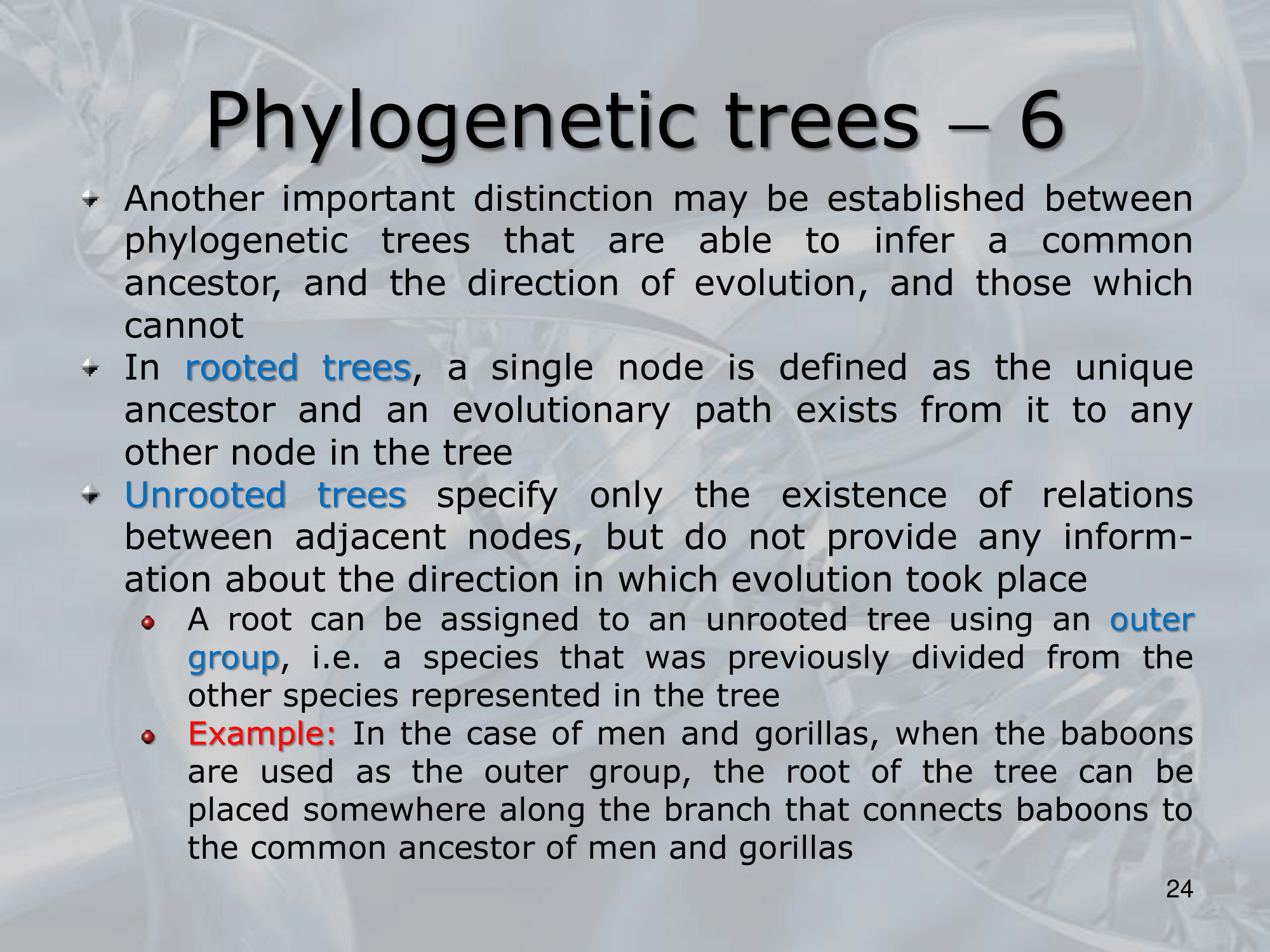
IMPORTANTE Alberi con radice: la radice rappresenta il common ancestor comune a tutte le foglie. #IMPORTANTE Alberi senza radice.