Questions
- Can you Explain the Consensus Trees Method for Quick Search Stragtegies?
- Consensus tree methods are used to summarize the information from multiple trees generated by different search methods or data sets in phylogenetic analysis.
These methods can be used to identify the most supported parts of the tree, reconcile differences among conflicting topologies, and provide a more accurate estimate of the phylogeny. - There are several types of consensus trees, but two of the most commonly used are:
- Majority-Rule Consensus: This method involves identifying the clades that are present in the majority of the input trees.
The consensus tree is then built by collapsing the branches that are not part of the majority clades, and retaining the branches that are present in more than half of the input trees. - Strict Consensus: This method involves identifying the clades that are present in all of the input trees.
The consensus tree is then built by retaining only the branches that are part of these shared clades.
- Majority-Rule Consensus: This method involves identifying the clades that are present in the majority of the input trees.
- There are also more sophisticated consensus tree methods that take into account the relative support for each clade across the input trees, such as Bayesian consensus trees and maximum likelihood consensus trees. These methods use statistical measures to weight the input trees based on their likelihood scores or posterior probabilities, and build a consensus tree that reflects the most probable topology.
- Consensus tree methods are useful for summarizing the results of multiple analyses, and can help to identify areas of agreement and disagreement among different data sets or search methods. However, it is important to note that consensus trees are not always fully representative of the true phylogeny, especially when the input trees are highly conflicting or poorly resolved. Therefore, it is always important to carefully evaluate and interpret the results of consensus tree analyses, and consider alternative methods for resolving any remaining uncertainty or conflict.
- Consensus tree methods are used to summarize the information from multiple trees generated by different search methods or data sets in phylogenetic analysis.
—————————————————————
IMPORTANTE
IMPORTANTE The result of parsimony algorithms are all equal consensous trees, to sum them up we use consensuous trees:
Strict-consensus trees: Tutti i nodi di tutti gli alberi (equamente parsimoniosi) sono considerati quando si costruisce l’abero generale More than 50% consensus rule: Se un nodo esiste solo in più del 50% dei casi lo consideriamo come veritiero, altrimenti lo raggruppiamo o ignoriamo.
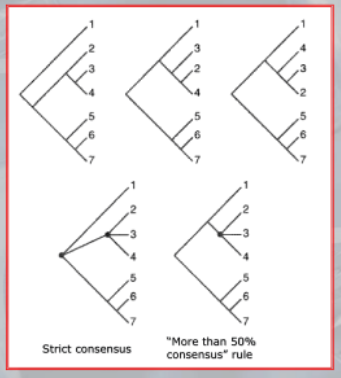
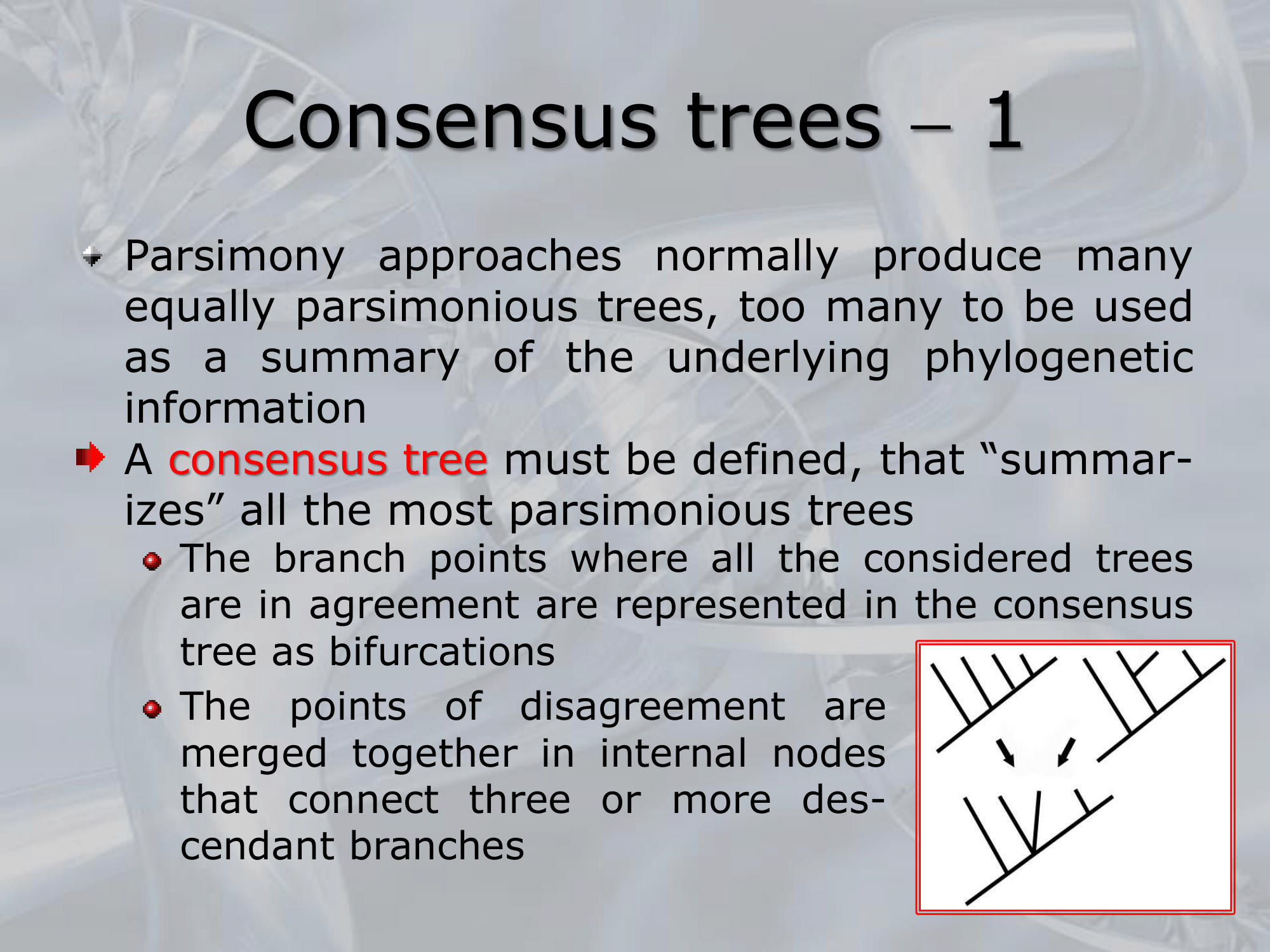
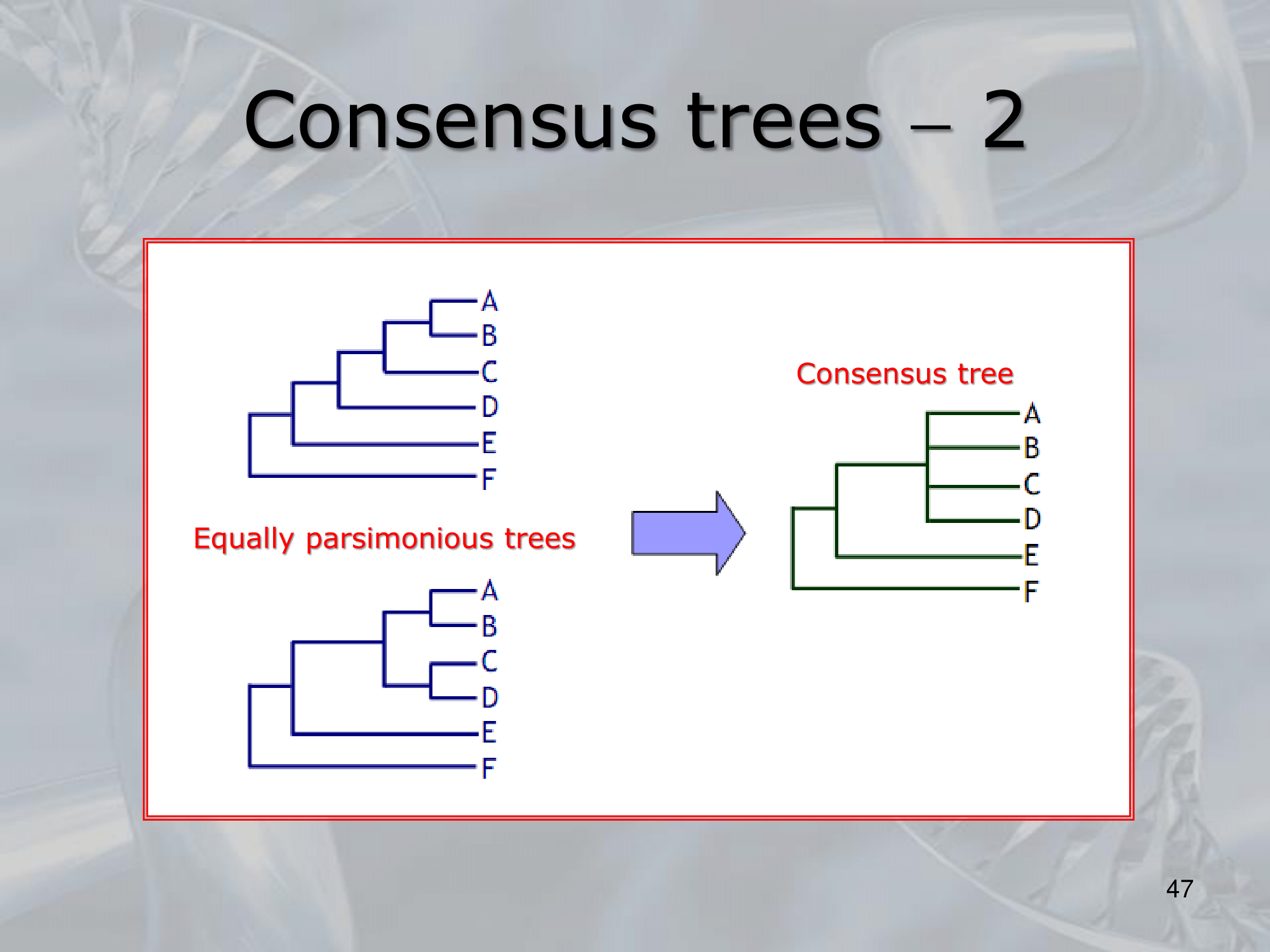
- Parsimony approaches normally produce many equally parsimonious trees, too many to be used as a summary of the underlying phylogenetic information. ⇒ A consensus tree must be defined, that “summarizes” all the most parsimonious trees
- Consensus Trees can be constructed following two processes:
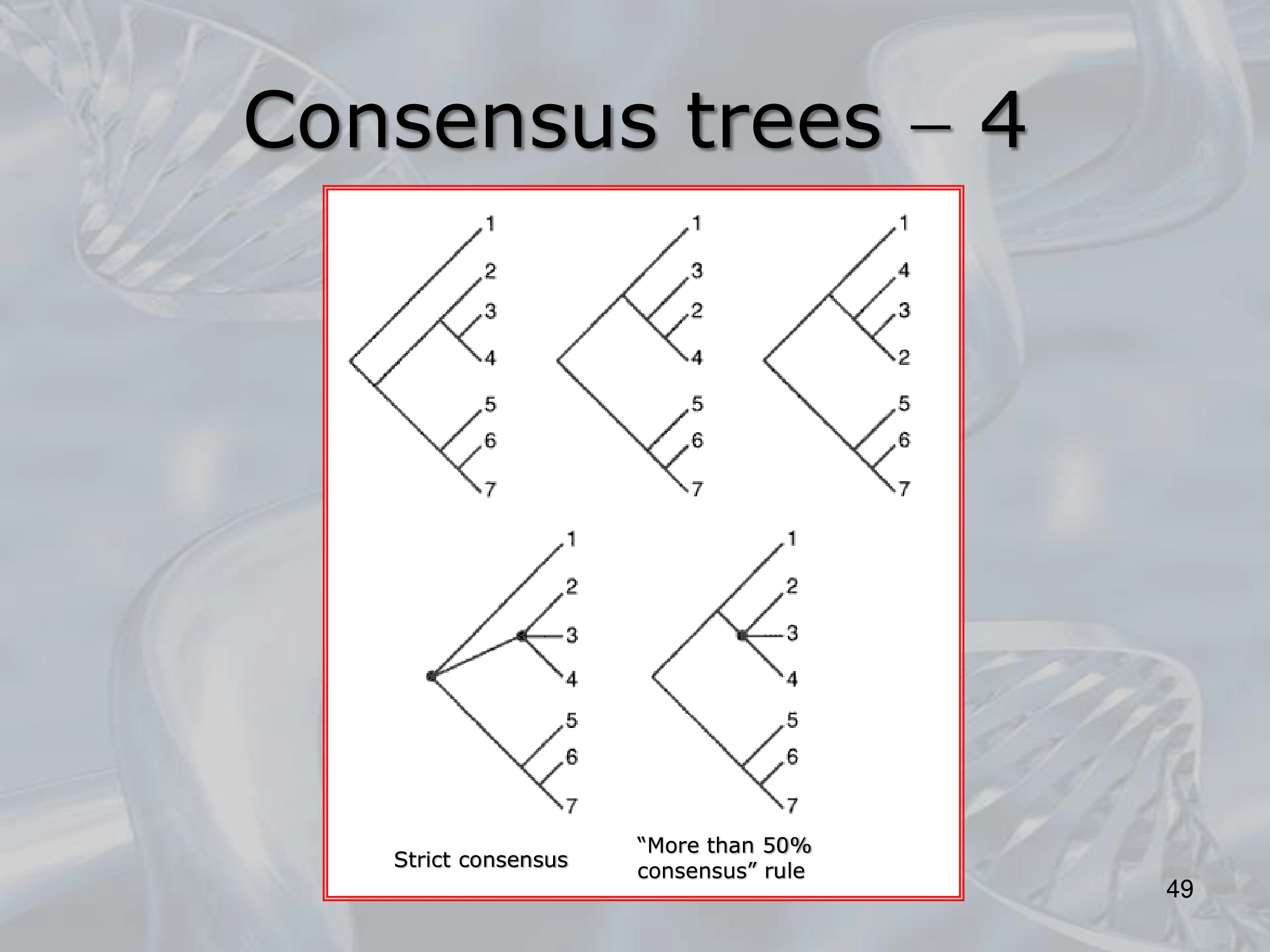
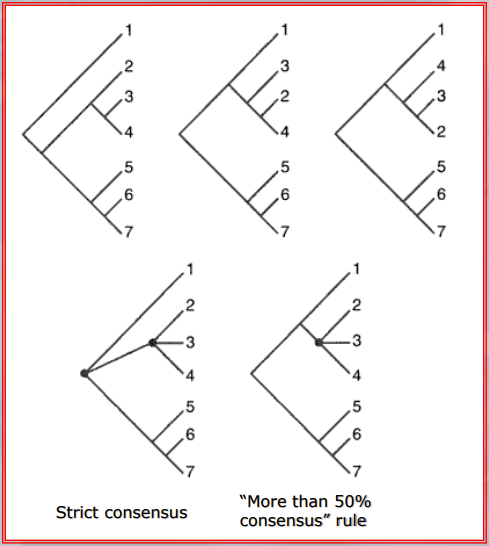
- Strict Consensus Tree: all the disagreement points are treated in an uniform manner, even when a single tree is not consistent with hundreds of others, which agree with respect to a particular branch point.
- More than 50% Consensus Rule: Each internal node that is present in at least half of the trees is represented as a simple bifurcation, while the nodes on which less than half of the trees are in agreement are represented as multifurcations.
- ~Example:
—————————————————————
Slides with Notes