Index
Electric Microphone
A special example of a capacitive microphone is the electric microphone.
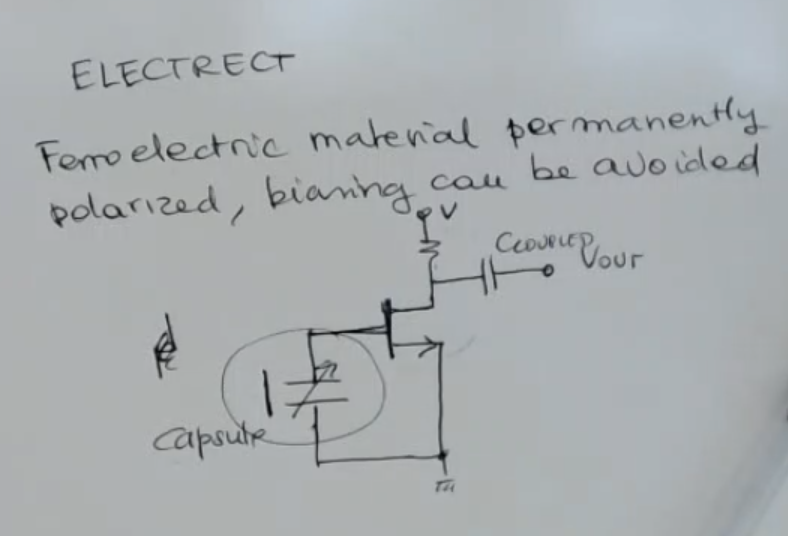
- In this case the dielectric is a ferroelectric material.
This ferroelectric material has the property of being permanently polarized, it’s like a permanent magnet but it’s permanent in the electrical domain, we don’t need a source voltage.
Tho we do need an amplifier afeterwards, to be able to read the output. - So this is a very simple structure of a microphone, where we don’t need an excitation.
- is a coupling capacitance, it is needed because everything here is AC-coupled, because we know that our signal is only a varying signal, we don't need to carry the DC values, we can filter them out.
Proximity Sensor and Touch Screen
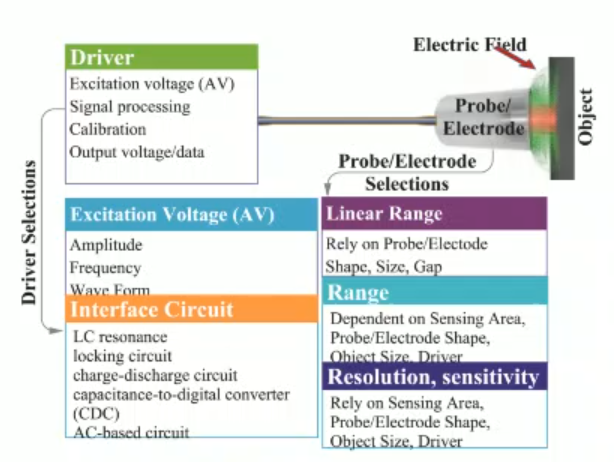
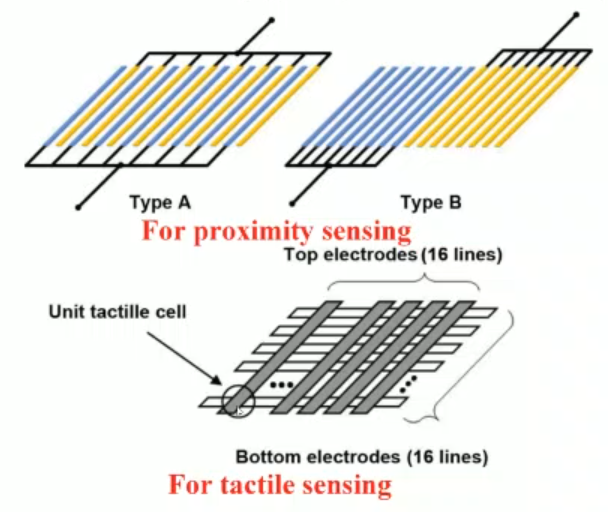
- How a touch screen can be arranged with contact which are rows and columns and the measuring of the capacitance between an individual row and a colon reveals the presence of the finger.
Also something about the readout circuit which can be used in conjunction with the sensor depending on the specific problem:
- oscillator or locking circuit (a circuit that helps maintain a stable and reliable output signal from the capacitive sensor).
- AC base circuit that we have divided into FM and AM circuits.
- Switching Capacitance.
- A/D Converter.
==The most important problem to be taking into account, is the effect of the electric noise and so it is required the presence of shielding, If the sensor is far from the frontend
Tthis problem is far less dramatic if instead you have the sensor close to the front end electronics==.