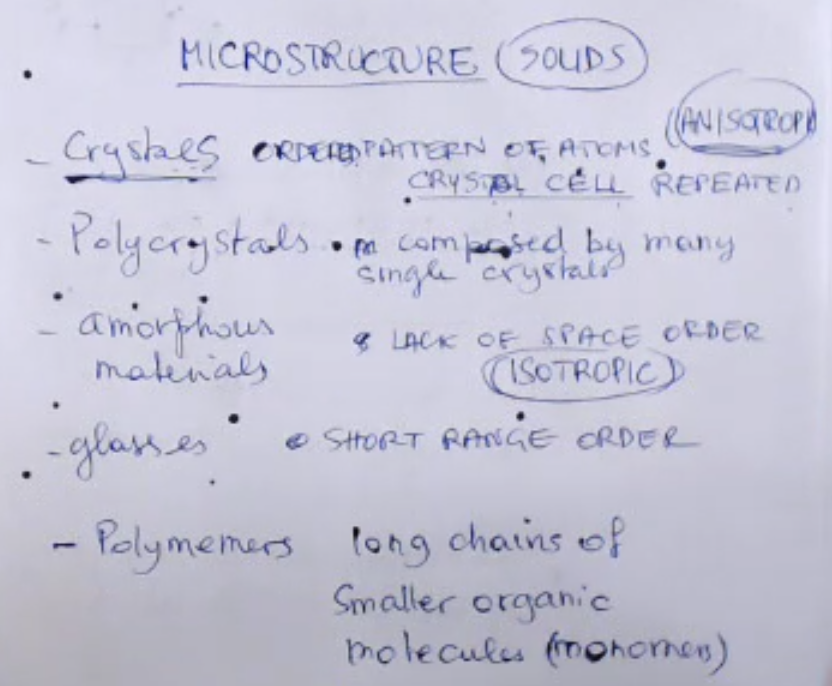
Crystals
- They formed by ordered pattern of atoms, which extend in the space.
And so they are formed by a lattice, which is the same all through the macro-crystal - So the whole solid is made up of an ordered structure.
- ==The basic building block is called crystal cell (made up of few atoms)==, which is repeated through all the crystals, so we have a large structure, but if we cut this structure into pieces, we find always the same ordered pattern.
Then we have this solid here are very interesting for sensor because they have some special properties we will see. - ==Moreover, usually. they are anisotropic, which means that the response of the material depends on the direction of application of the excitation.
So if I stretch, if I apply a force that the deformation will depend on the direction of application of the force.
So the response of the material depends on the input quantity direction==. - ==Usually crystals are very resistant to high temperature==.
Polycrystals
- Solids, which are composed by many single crystals, which are very small, and so this order is maintained in some small domains.
==Also each crystal domain has a random orientation==. - ==These domains are put one close to the other, divided by the so called grain boundaries==.
- ==So the overall structure, unless you do some special operations is usually isotropic==.
Glasses
- Have a short range order, not long range like crystals.
Polymers
- ==They are long chains of smaller organic molecules called monomers (~ex of a polymer.: plastic)==.
- Usually they are artificial materials and they have many interesting properties for sensors.
- ==The property of polymers depend on the type of monomer, which is the smaller organic molecule, which is repeated along the chain==.
So it depends on the type of monomer that is used.
But also on how these monomers link together, in order to get the overall chain, which is the polymer, called the “chain type”. - The reason why they are very used and interesting for sensors is that they can be prepared with low cost preparation routes and processes.
==Polymers are usually low cost materials based on carbon and hydrocarbon usually==.
==The main problem with this kind of structure is the temperature operation range, it is limited being this an organic material==.
However, there are few polymers which resist to high temperatures.