Remeber:
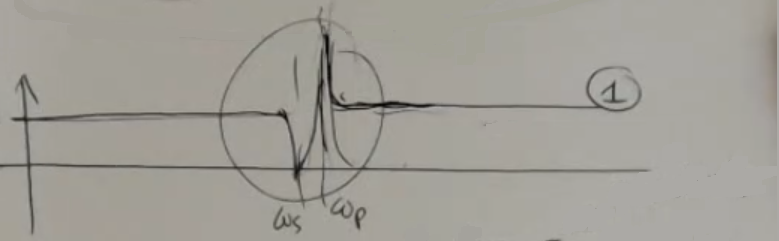
We defiened the AT-cut quartz’s impedance as:Where at , we gave some common values:Then we defined:And:Giving us the reactance formula :If we were to plot we would obtain this graph, as we have already seen:
- Remember: ==, and consequently and depends on the type of cut of the quartz==.
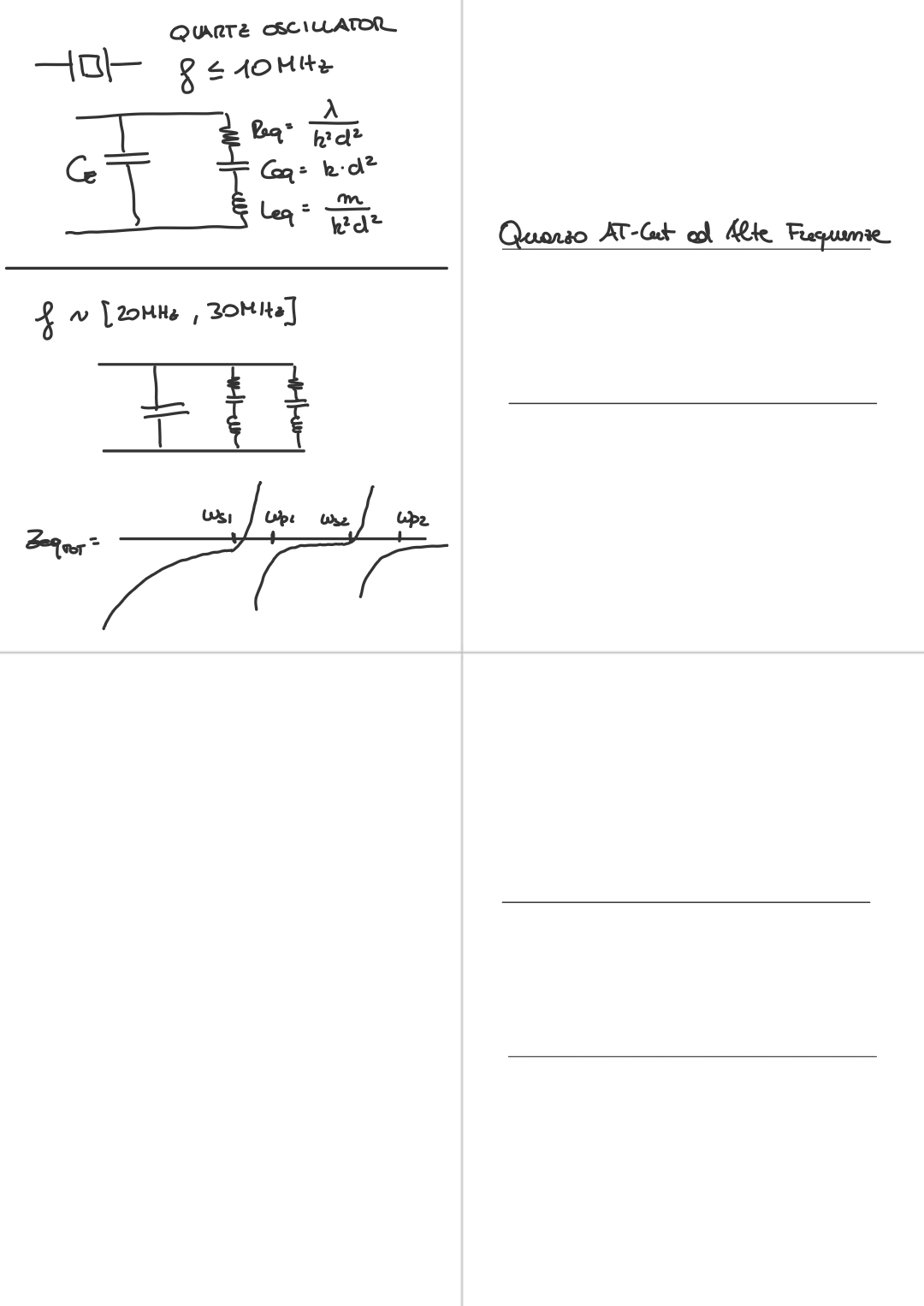
Actally this is an approximation, if we were to plot and model the real behaviour of the quartz we wold need an infinite numeber of impedances in parallel to :
- If we work at a high frequency , we need to consider this additional impedaces, after the first.
- If we work at lower frequencies we can consider just the first ().
We can write the relationships of the different components:And also define each value for :However this is not very accurate
Memory Card
We need the transverse propagation velocity and not the longitudinal one , so:
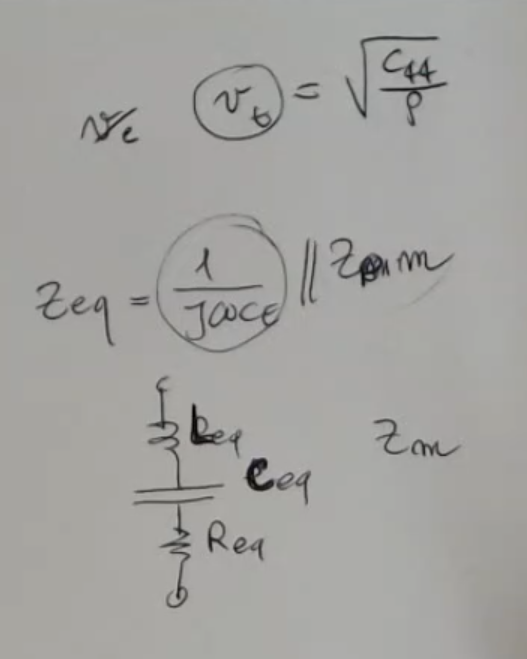
- : is the equivalent impedance of the quartz we have found.
- is a novelty and is the mechanical impedance of the medium, it is usually negligible since the quartz is extremely light, with respect to the body it’s mounted on.
And we have also seen that we can define (for ) as:
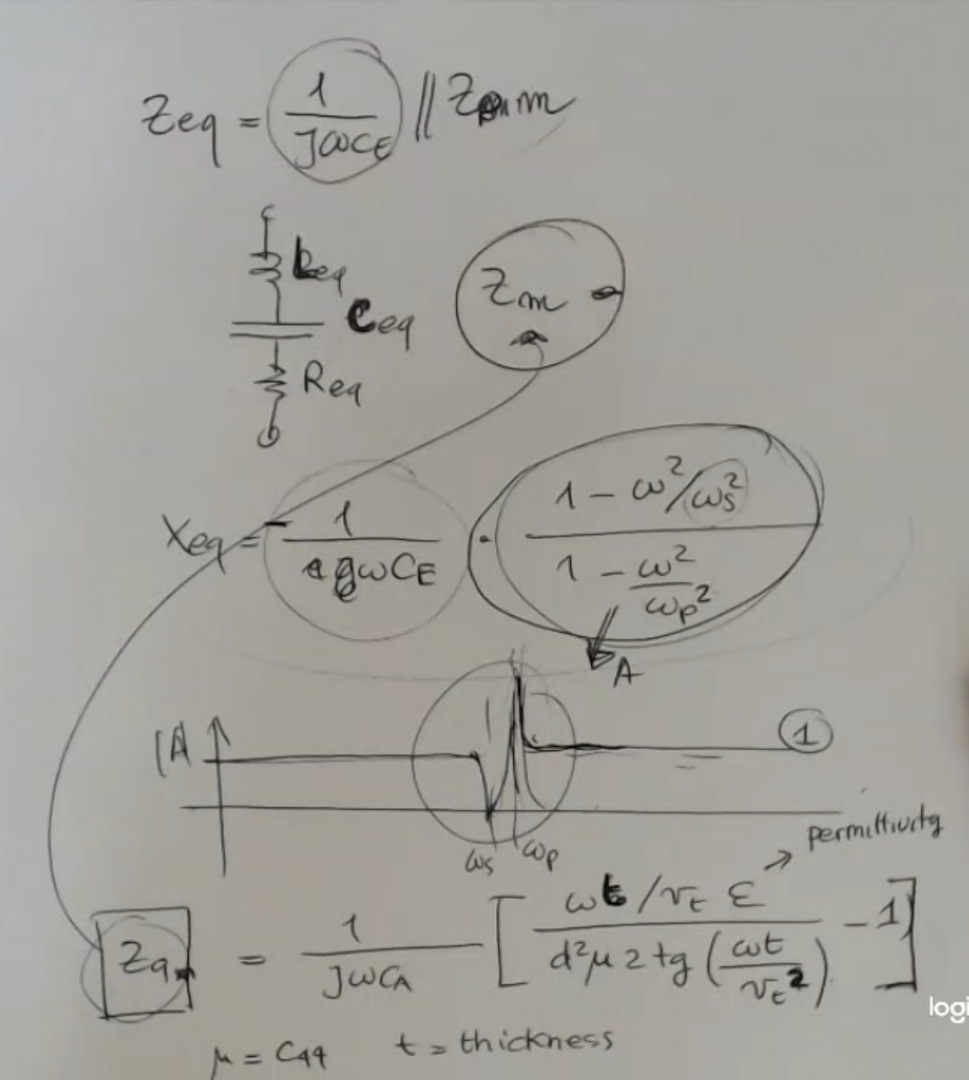
- Also we see again the plot of .
- You can see that the quartz behaves as the capacitance (defined by the construction of the capacitance quartz), except for a small range where it acts as an inductance, this small range and inductance value is due to the parallel with , and it is decided by the cut-type and quartz-type.
- : is the real value of also considering .NOT_SURE_ABOUT_THIS
We can expand as the parallel of an infnite number of impedances, like so: ==NOTE: This is the real behavior of the quartz==
Each can be considered as an open circuit expect for a small frequency range, where it resonates.
Where:
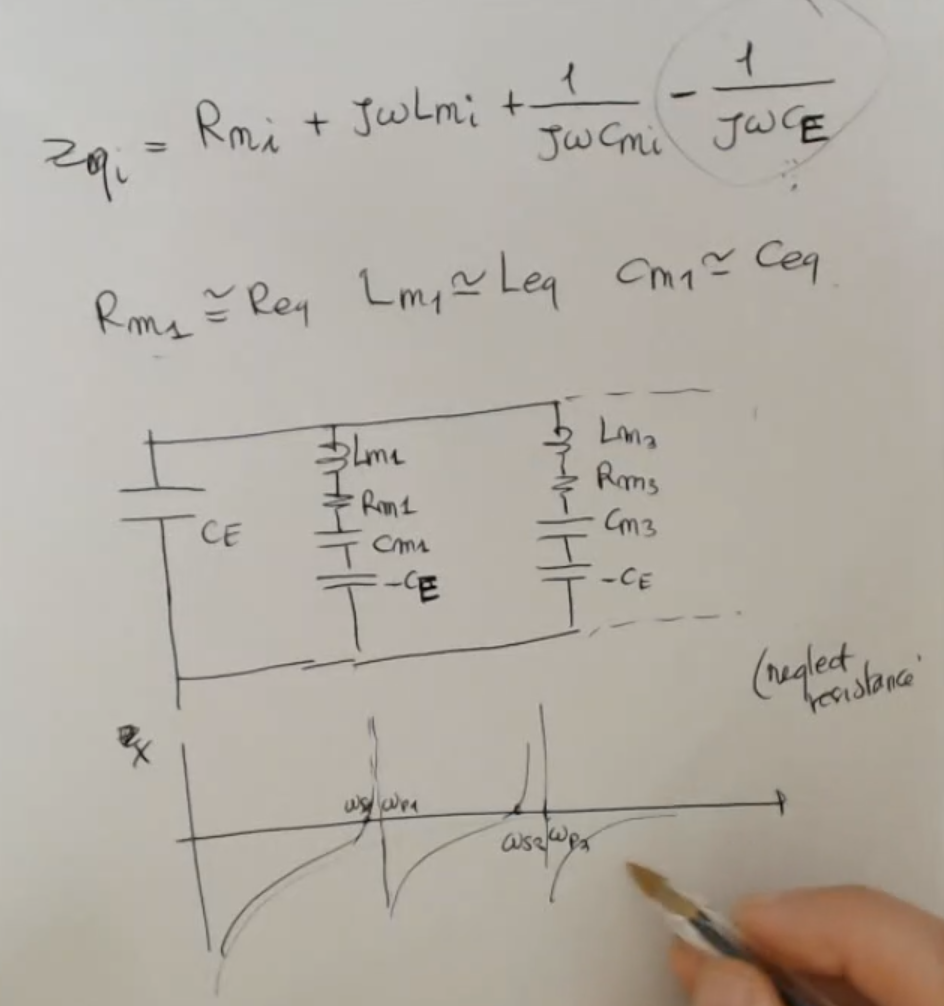
- The plot is a simplified version to understand what happens.
Again in this graph we have negleted the resitance. - As you can see we have stopped at the first resonance, but if for any reason our frequency grows we will encounter another resonance, , then and so on…
- If we work at high frequency ( MHz), we need to consider them.
If we work at low frequncy ( MHz) we can consider just the first.
So we can write the relationships of the different components, and also define each value for :
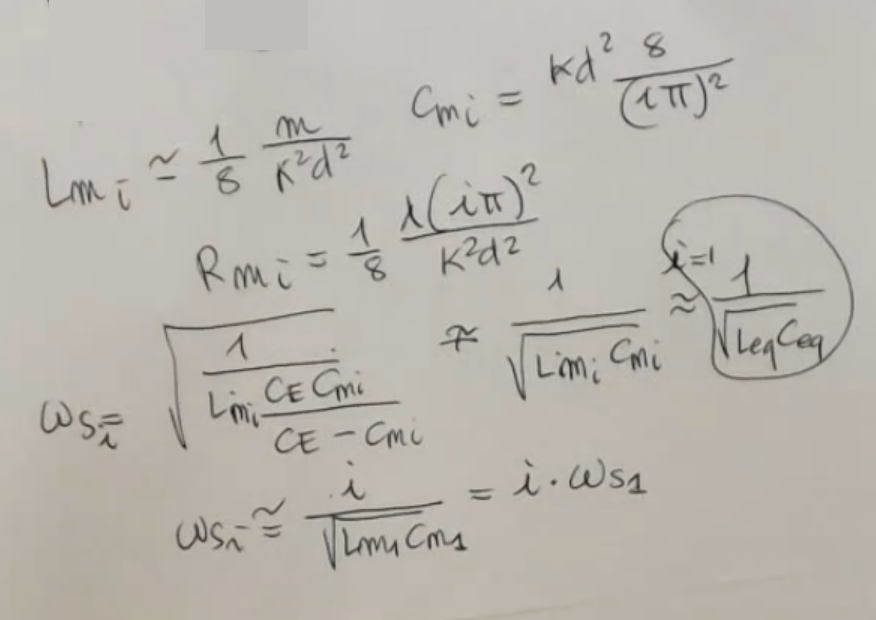
- The first one, we already found is around
- The others are around:With:
- However this is not very accurate.
- This is the real behavior of the quartz.