Remeber:
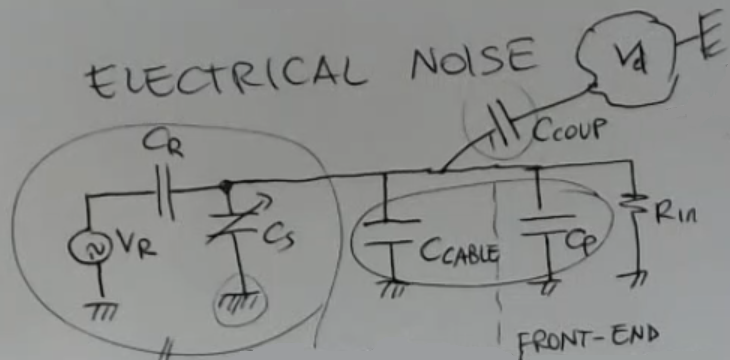
If we take a simple circuit which contains:
- : reference voltage.
- : reference capacitance.
In other cases you can have no reference capacitance, for instance if you measure humidity.- : sensor.
- : in case of a long cable, i need to consider it.
- : parasitic capacitance with external electric potential .
This could be for instance another appliance, or a person which moves.- : input resistance to front-end electroncis.
- : parasitic capacitance (from the front-end electronics).
- We can consider:
- Then across , will be equal to:
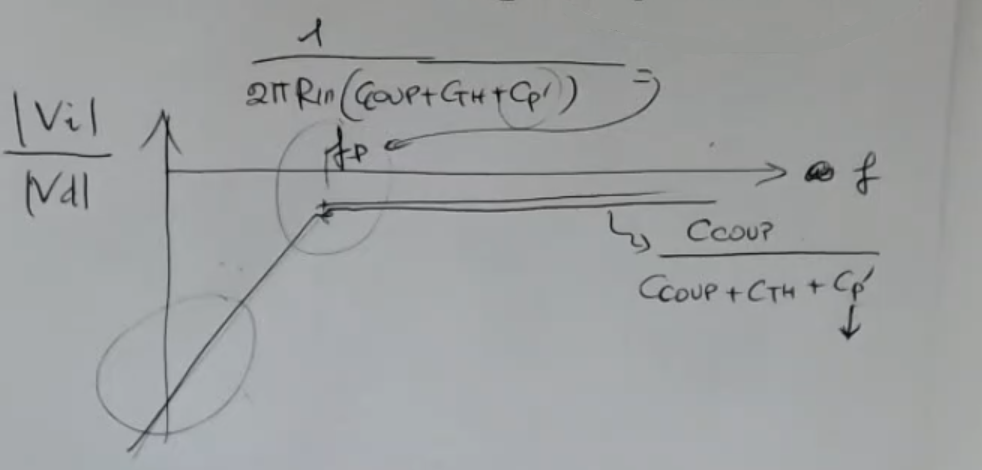
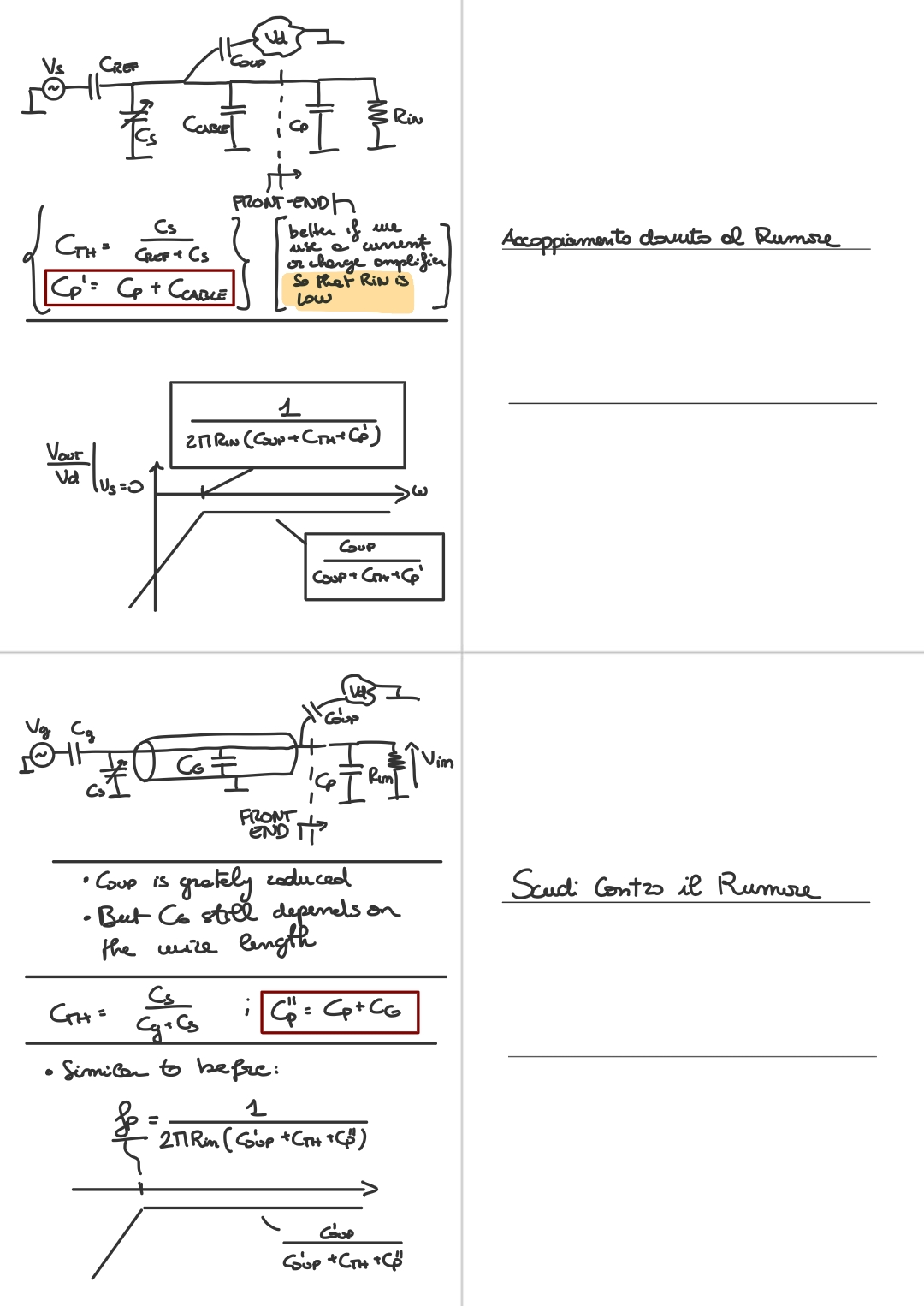
So we have a bode plot like this:
- Also at low frequency, meaning: , we can approximate as:Especially in this case, if this resistance is small, the sensitivity of the circuit to electrical noise becomes smaller (a good thing).
⇒ ==So it’s better, if possible, to use a front end amplifier with low resistance==.
⇒ Meaning, that it’s better to use current, or charge amplifiers, so that we have the resistance very low, resulting in a cutoff frequency very very high.- However in this case we cannot choose a small input resistance, since if I put the resistance at , I don’t read anything .
- Still, remember that when dealing with high source measurements, the better frontend is a low input impedance amplifier.
- ==Another thing to underline is that it would be better to have the cutoff frequency much larger than ==.
Why?
==Because one of the most important source of electrical noise is the power line wiring, that we have everywhere, and the power lines generate noise at ==.
Memory Card
Electrical Noise
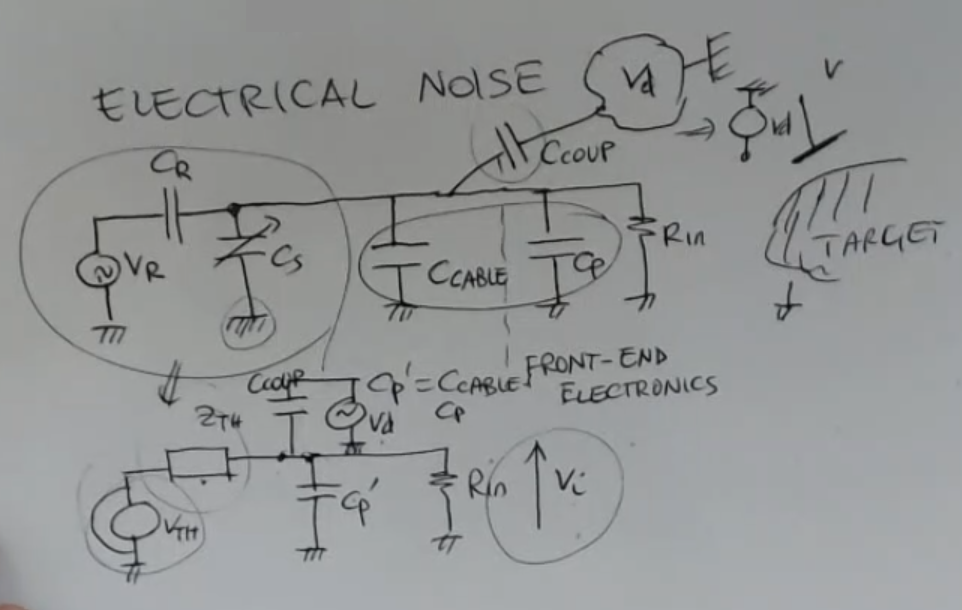
- Where:
- : reference voltage.
- : reference capacitance.
In other cases you can have no reference capacitance, for instance if you measure humidity. - : sensor.
- : in case of a long cable, i need to consider it.
- : parasitic capacitance.
- : parasitic capacitance with external electric potential .
This could be for instance another appliance, or a person which moves. - : input resistance to front-end electroncis
I can group some capacitances:
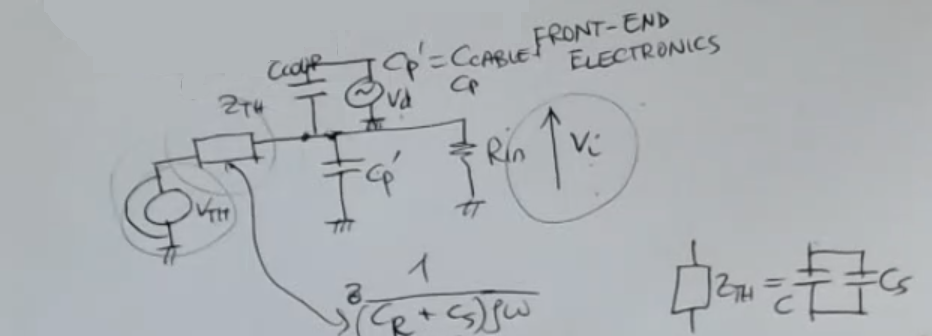
So at this point I can represent everything with its Thevenin equivalent:
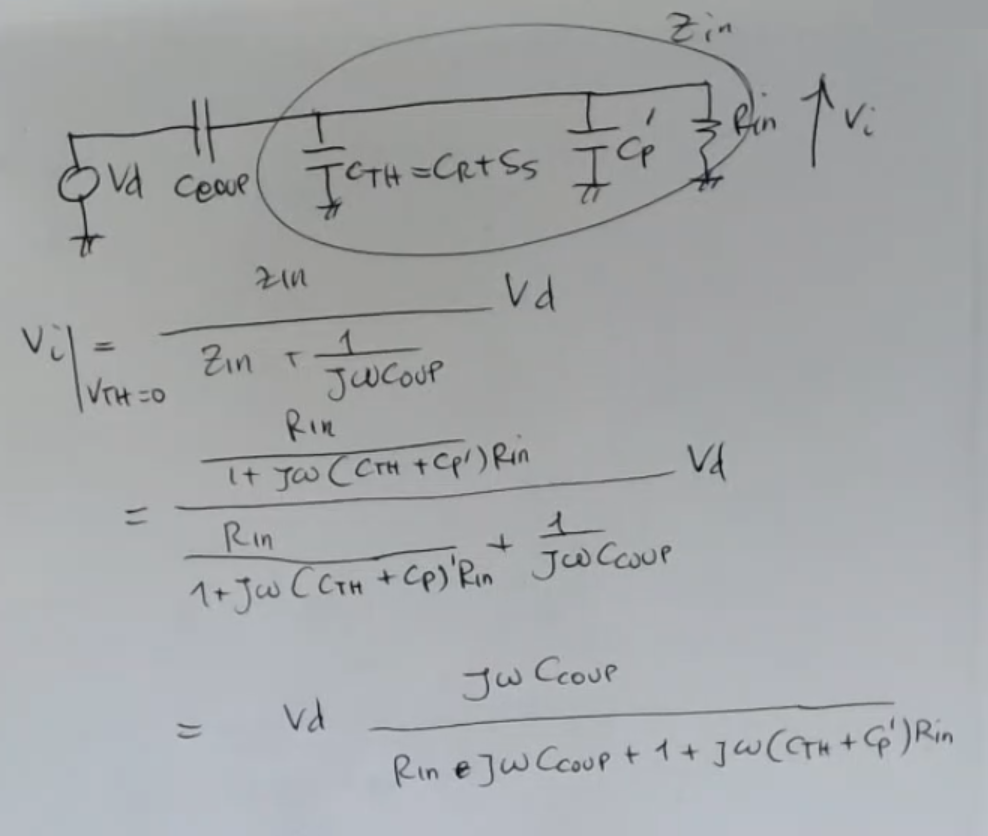
- So I would like to understand what happens to this input voltage when there is no signal, so is shorted and the only source present is the disturbance.
I want to see how the input varies due to the disturbance, and not to the signal itself.
Let’s draw the frequency domain, what happens here:
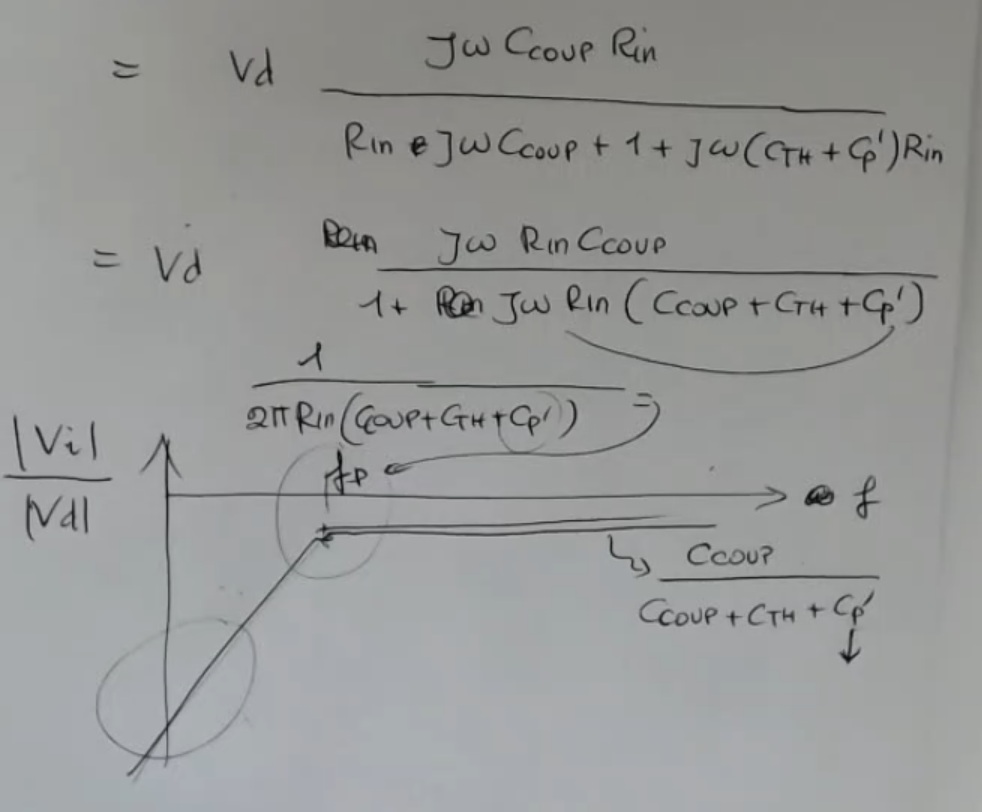
- You have a zero in zero.
- You have a pole in
- And what happens here, you see that the best thing is to work at low frequency, because at this frequencies the electric noise, (which is due to the electric cable coupling of my circuit with electrical environment) is ==off-band: so it’s cut from the high pass behavior of the disturbance coupling==
⇒ This means:- We want a low value for noise and disturbances, at high frequency we have the maximum value which is:So we decide to stay in low fraquency.
- We have that: So the frequency is higher if is smaller.
- Also at low frequency, meaning: , we can approximate as:Especially in this case, if this resistance is small, the sensitivity of the circuit to electrical noise becomes smaller (a good thing).
⇒ ==So it’s better, if possible, to use a front end amplifier with low resistance==.
So if possible, it’s better to use current, or charge amplifiers, so that we have the resistance very low, resulting in a cutoff frequency very very high.
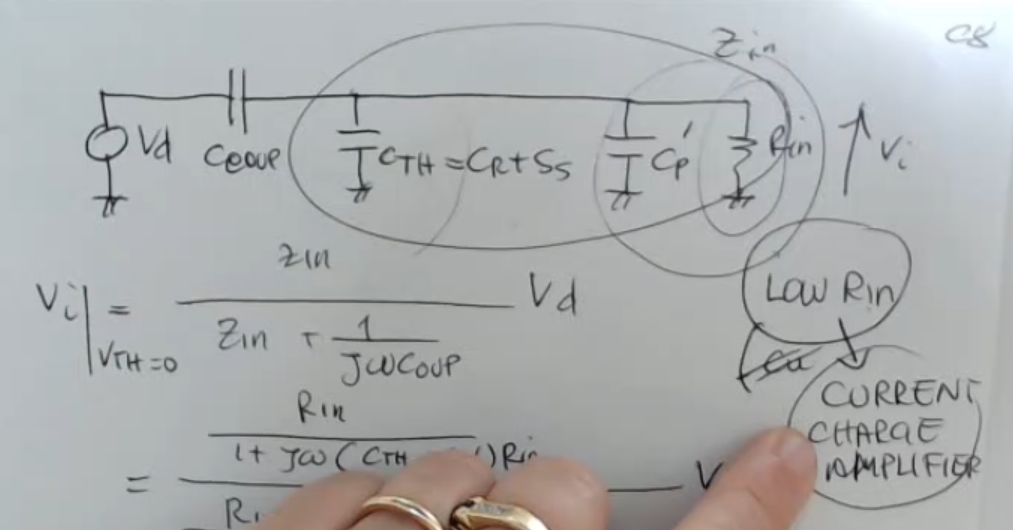
But In this case, it is not possible.
Why?
Let’s look at our starting excitation circuit:
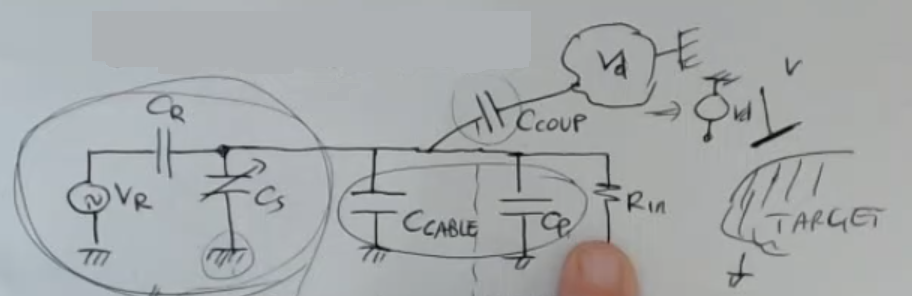
- We find that if I put the resistance at , I don’t read anything, because I put a short circuit parallel to my capacitance.
So in this case, it’s not viable and we have to do something different. - Still, remember that when dealing with high source measurements, the better frontend is a low input impedance amplifier.
==Another thing to underline is that it would be better to have the cutoff frequency much larger than ==. Why? ==Because one of the most important source of electrical noise is the power line wiring, that we have everywhere, and the power lines generate noise at ==. And this is the reason why when this frequency here is very low, we’ll have many problems of electrical coupling.