Remeber:
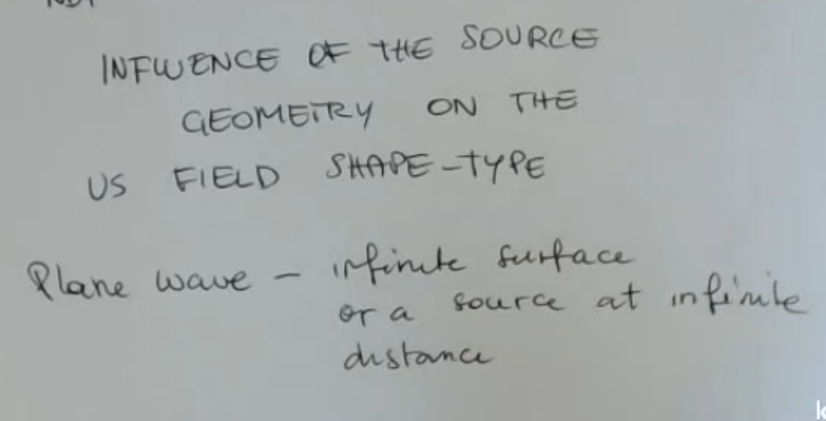
When we talked about US waves we have mentioned planar waves, however we need to remember that this type of wave is purly theorical, in fact it can only be generated by an infinite surface vibrating, or by a surface which is at an infinite distance from the spot of observation.
If instead we consider to have a finite area source (so more of a Real World Case), the front waves have different geometry, let’s see two examples:
- ~Ex.: Point surface:
- ~Ex.: Transducer which is a Plane Piston Circular (more usual and real case):
In this case, you have a different shape of the wave front, depending on the position:
- Inside the cilinder it can be considered approximately planar, this particular “part” of wavefront is called the “Frensel Region” or “Near Field”, and sometimes we say that in this part “the beam is not yet formed”.
- Outside the cilinder instead we have a “Far Field Region”, behaving like a spherical wavefront.
For the Transducer which is a Plane Piston Circular, if I find two obstacles within the “far region field”, both are seen by simultaneusly the probe and they appear as to be only one obstical, so they can’t be distinguished (with a still probe):
Instead suppose to have an object in front and another object covered by the first one, then if we just move the probe you can see the second (covered) obstacle, even if it is not easy to distinguish them.
Memory Card
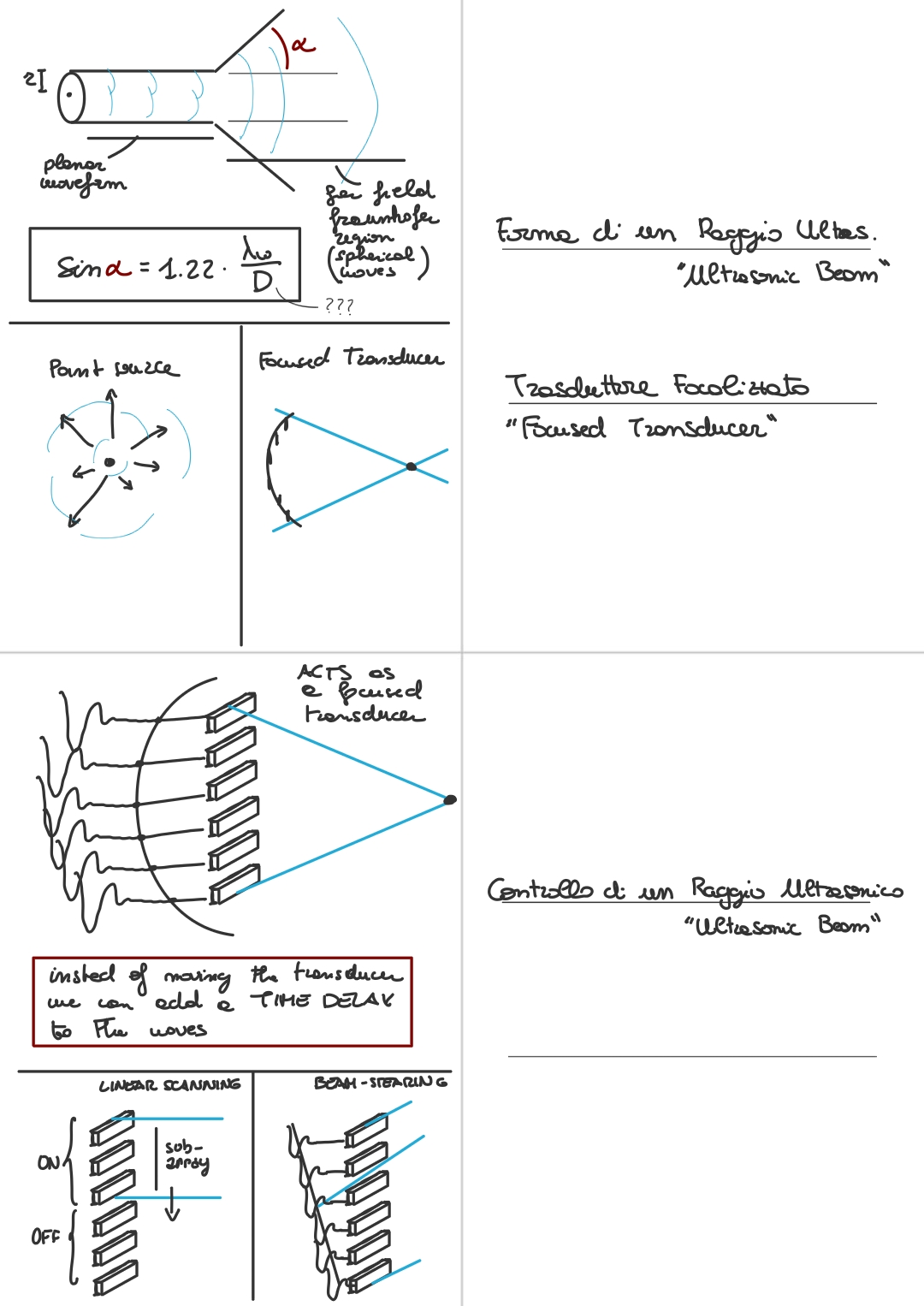
We have thought a lot we have spoken about ultrasonic plane waves, so we have considered all the fields constant, all these planes which are perpendicular to the direction of propagation of the wave. But when we generate an ultrasonic wave with a transducer, we have a source which has a finite area.
So a plane wave can be thought to be generated by an infinite surface vibrating, or by a surface which is at an infinite distance from the spot of observation
If instead we consider to have a finite area source, the front waves have different geometry.
~Ex.: Point surface:
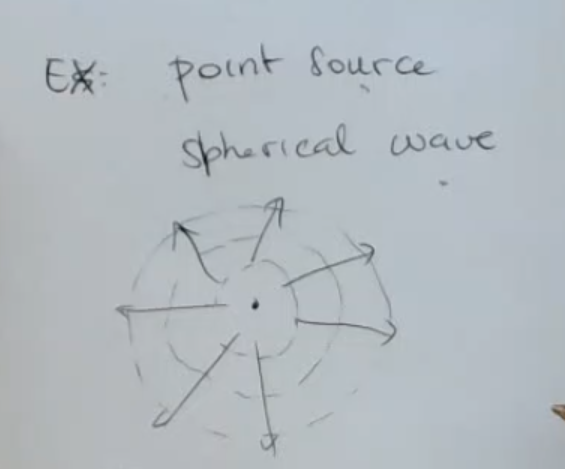
Let’s go to more real case, a transducer which can be considered as a plane piston.
~Ex.: Transducer which is a Plane Piston Circular:
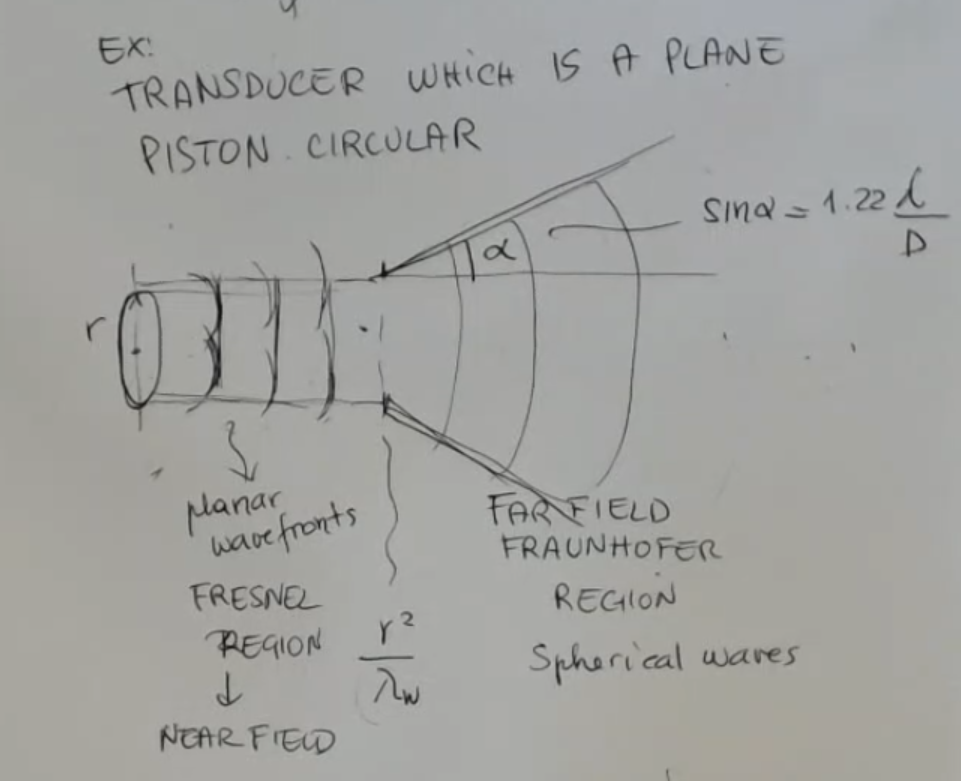
- You have a strange shape of the wave front, inside the ciliinfer it can be considered approximately planar, this particular “part” of wavefront is called the “Frensel Region” or “Near Field”, and sometimes we say that in this part “the beam is not yet formed”
- Outside the cilinder instead we have a “Far Field Region”, behaving like a spherical wavefront.
If I find two obstacles with the “far region field”, both are seen by the probe and they appear as to be only one obstical, so they can’t be distinguished:
Instead if you have an object in front and an object outside covered by the first one, then only moving the probe you can see this second obstacle, again not easy to distinguish them