Memory Card
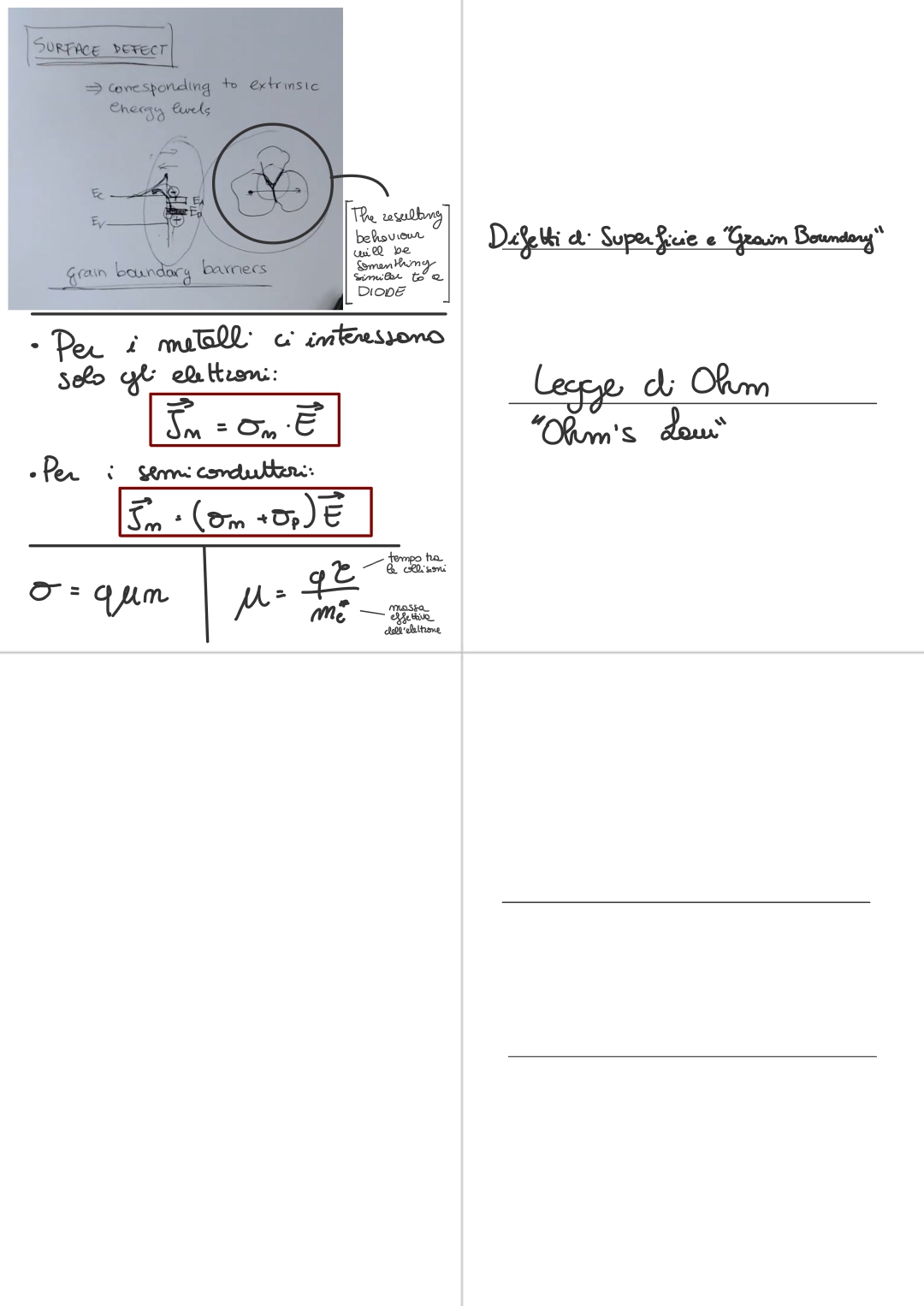
- What are Surface Defects and Grain Boundary Barriers:
- Surface Defects are imperfections or irregularities that exist on the surface of a material.
- Due to this Surface Defects, in a non-uniform material (or more specifically a crystal) Grain Boundaries are formed.
- Grain Boundaries are interfaces that separate different crystalline regions or grains within a material.
When a material is not a continuous crystal but consists of many small crystals or grains, the grain boundaries are where these grains meet. - Grain Boundaries can act as barriers to various processes and properties in materials.
==You always have surface defects==.
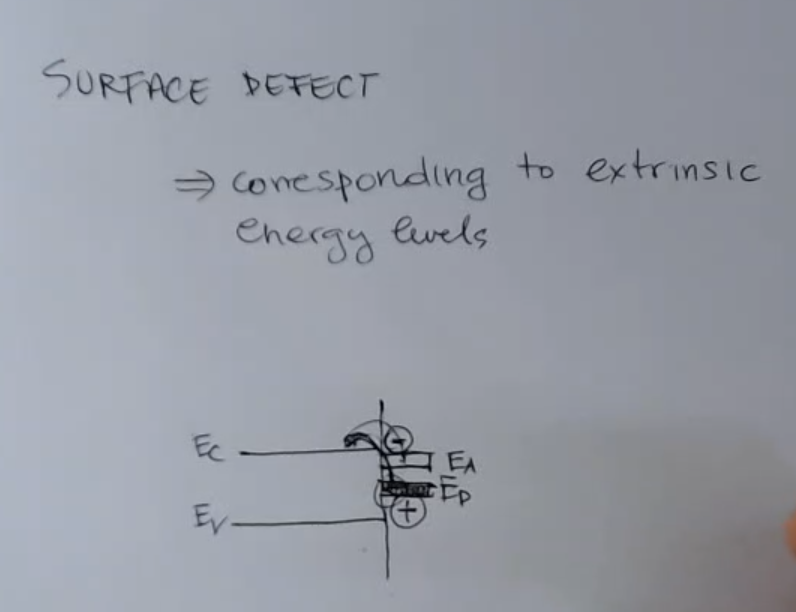
- You can represent a surface defect as a difference in energy levels, here you can see a normal intrinsic silicon represented by and and attached to it an imperfection in the extrinsic silicon, it is represetned as a doped silicon with and the acceptor energy level and donor energy level.
- If we have a surplus or fewer electrons due to the imperfection, an electron will be given/taken from the intrinsic silicon, resulting in the creation of a small localized electric charge.
- If the donor level loses the electron, or if they acceptor take the electrons, you have some localized charge at the surface.
The localized charge gives form to an electric field:
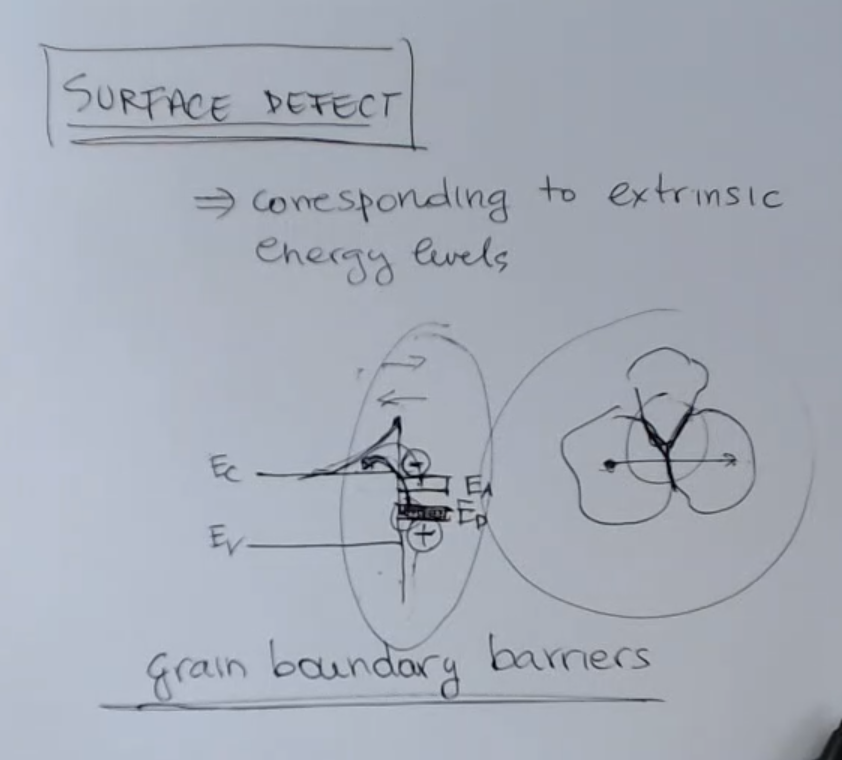
- The resulting behaviour will be somenting similar to a diode.