Remeber:
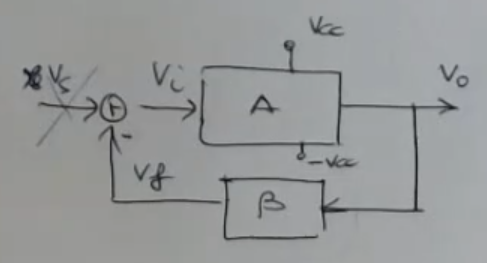
- The basis of an oscillator is a circuit like this:
- Not only that but we want it to have a AC output even if .
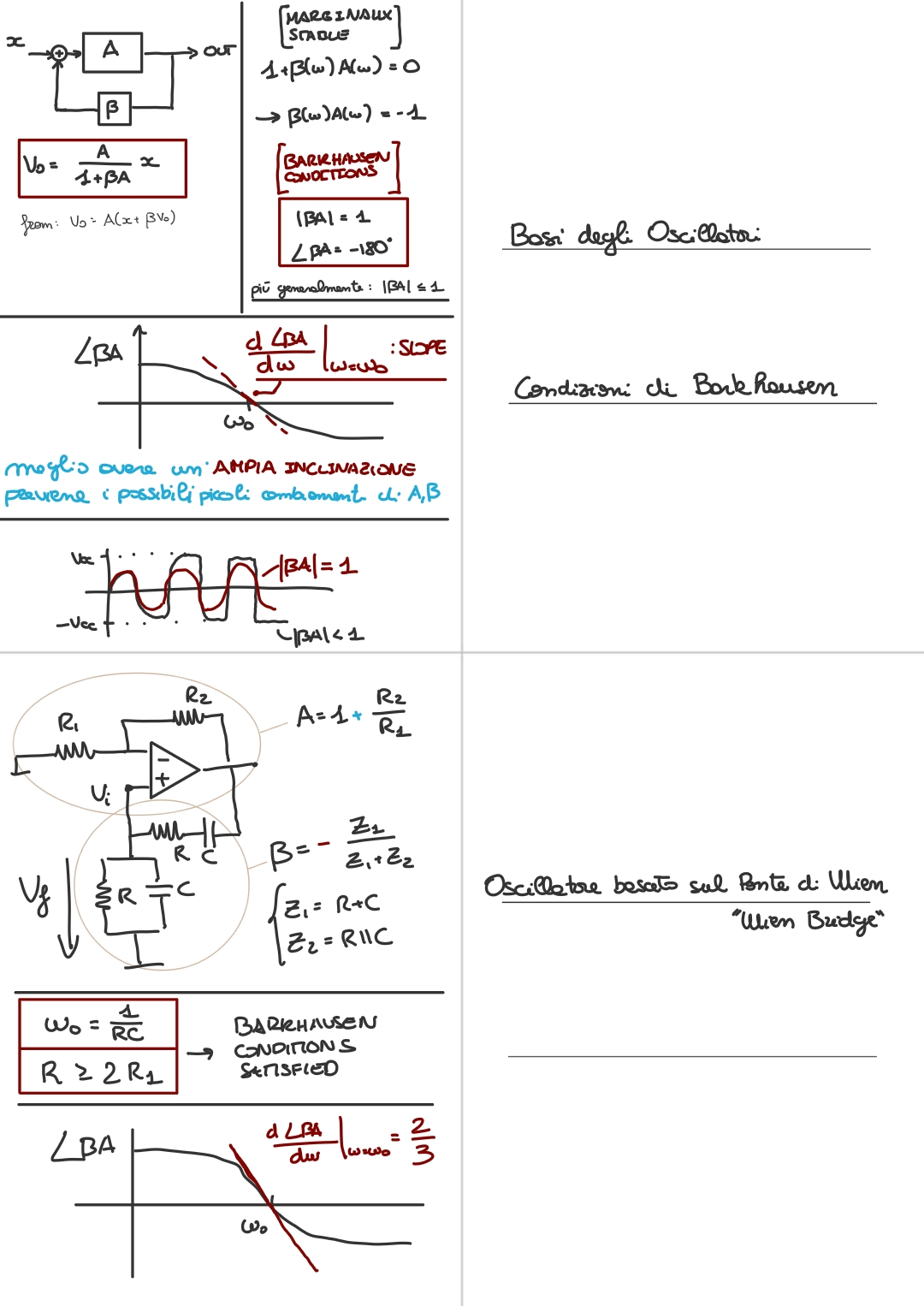
- To do this we first define the input-output transfer function:As we can see from this formula to have a “diverging output”, so that the transient part does not decay, we need two things, we will later see more in detail in the Barkhausen Conditions:
- In an oscillator, I want a which is unstable or marginally stable.
So with a couple of poles which are complex and conjugate, and contrary to stable poles, we actually need:Actually, we can make a distinction between two outcomes: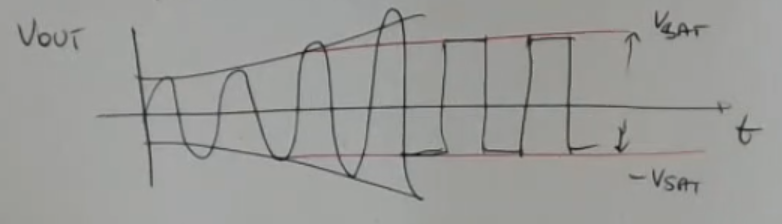
- We can have: : unstable poles ⇒ The output will become a square wave do to the voltage source.
- Or instead: : marginally stable poles ⇒ The output will become a sine wave.
Memory Card
We have said that the AC excitation was given by a voltage generator, sometimes I called it oscillator.
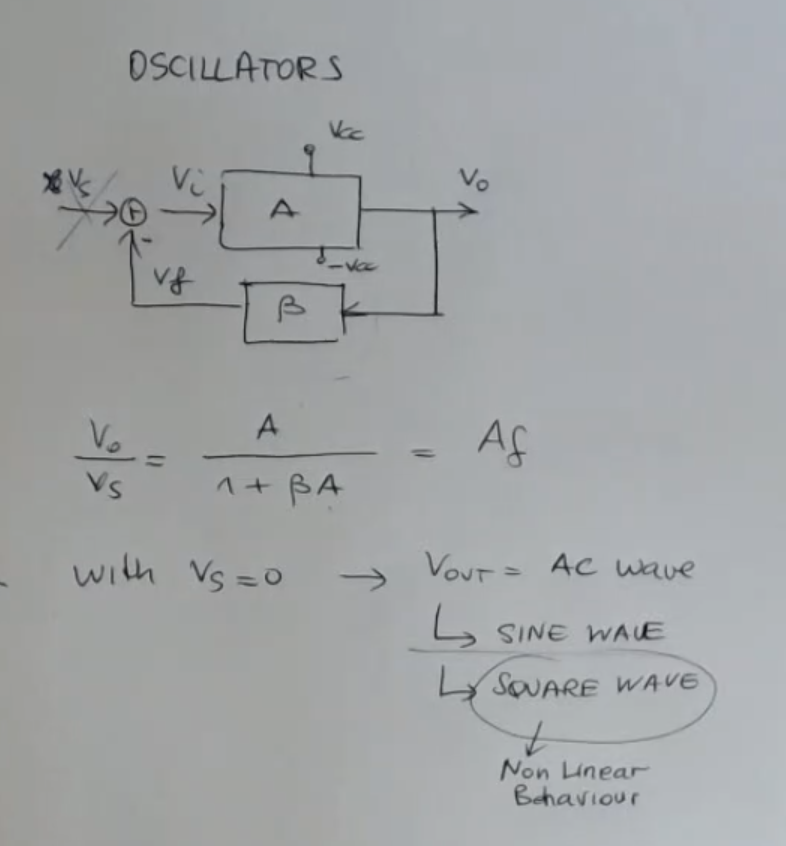
- The base of oscillating circuit is a feedback circuit.
- So we have to refer to the simple schematic of an amplifier , and a feedback network , which is sent to the input with a negative feedback
- Iwant also to put here this two terminals, (), because this is a network where we have an active device, an amplifier, which is provided by a continuous DC power.
- Then we have a passive network, which is the feedback network, which brings back the output voltage to input, with this node here.
- Every time we have used an operational amplifier, we use this kind of structure here.
- Usually the feedback loop is used to control the output, make sure that it converges to a certain value, assurign that the response is stable and the transient vanishes.
For oscillators is the opposite. - NOTE: in this case is the gain of the amplifier, for definition it is:
Now we want to have a circuit which we don’t provide the input for, so
==We want to have a circuit which provides a variable output with no input==.
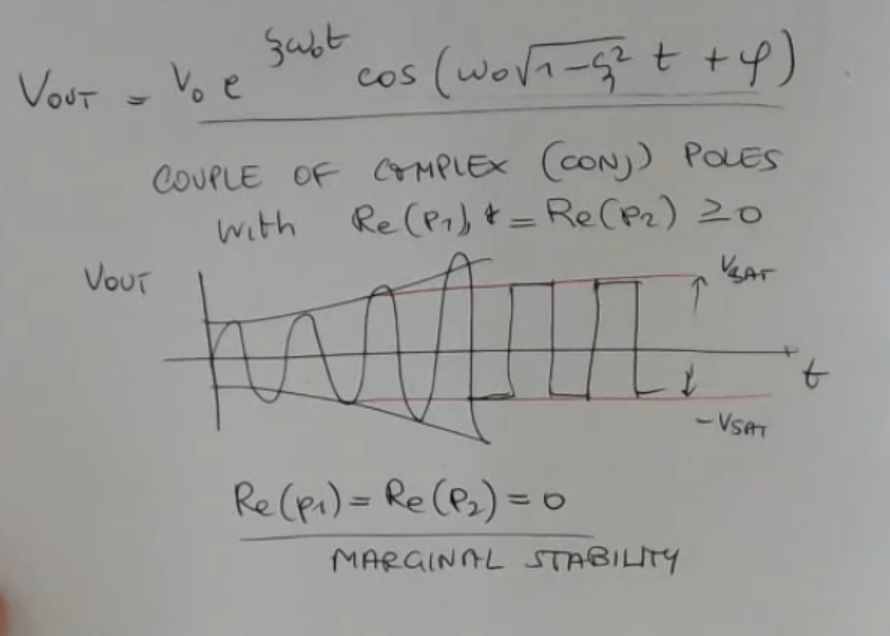
- What we want is therefore a circuit which is not stable since we want that with the signal input equal to zero, the output signal is a wave, an AC wave.
- Two types I can accept:
- A sine wave.
- Or a square wave (actually I’ll only have this if I take into account the nonlinear behavior, so I’m out from the normal modeling).
- I want a like this, which is unstable or marginally stable with a couple of poles which are complex and conjugate.
- So I need a couple of complex conjugated poles with real part, larger or equal to zero.
- ==When I take into account this kind of situation, I will have that the response to the initial condition, or the transient response in any case will never finish, will be persistent and this is what I need from a oscillator==.