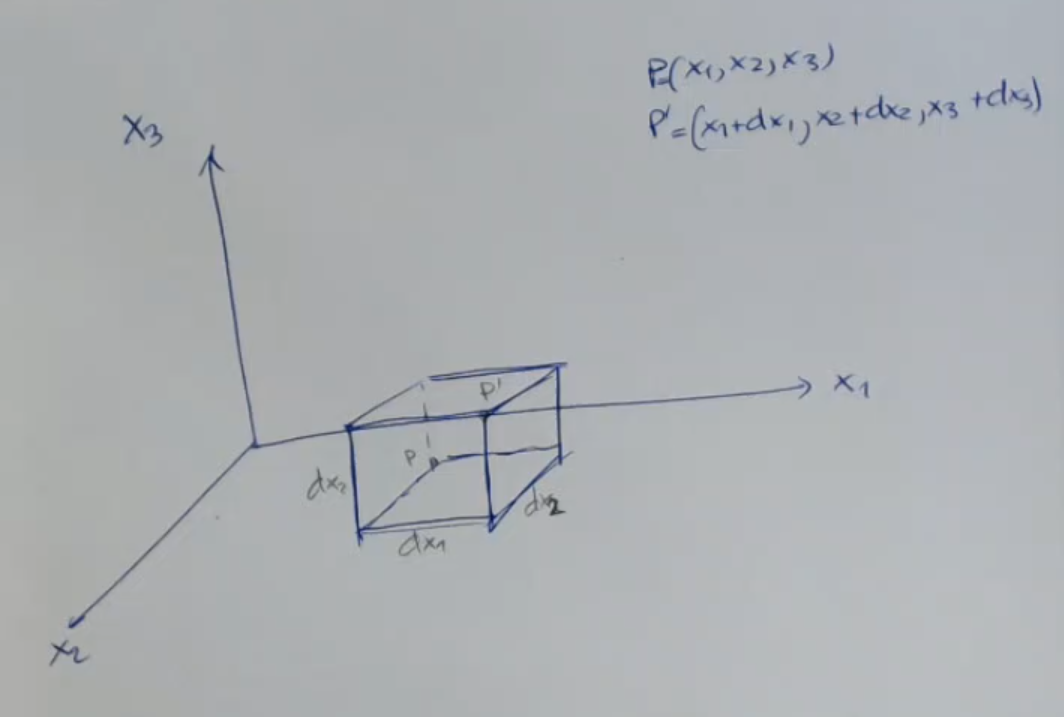
The force (F1) can be found in two ways: from stress (F=T⋅A) : F1=++T11(x1+dx1,x2,x3)⋅dx2⋅dx3−T11(x1,x2,x3)⋅dx2⋅dx3+T12(x1,x2+dx2,x3)⋅dx1⋅dx3−T12(x1,x2,x3)⋅dx1⋅dx3+T13(x1,x2,x3+dx3)⋅dx1⋅dx2−T13(x1,x2,x3)⋅dx1⋅dx2And from the Second Newton’s law (F=m⋅a) :F1==u¨1⋅(ρ⋅ΔV)ρu¨1dx1dx2dx3
Calculate the wave equation:ρu¨j=cijkl∂xj∂xl∂uk
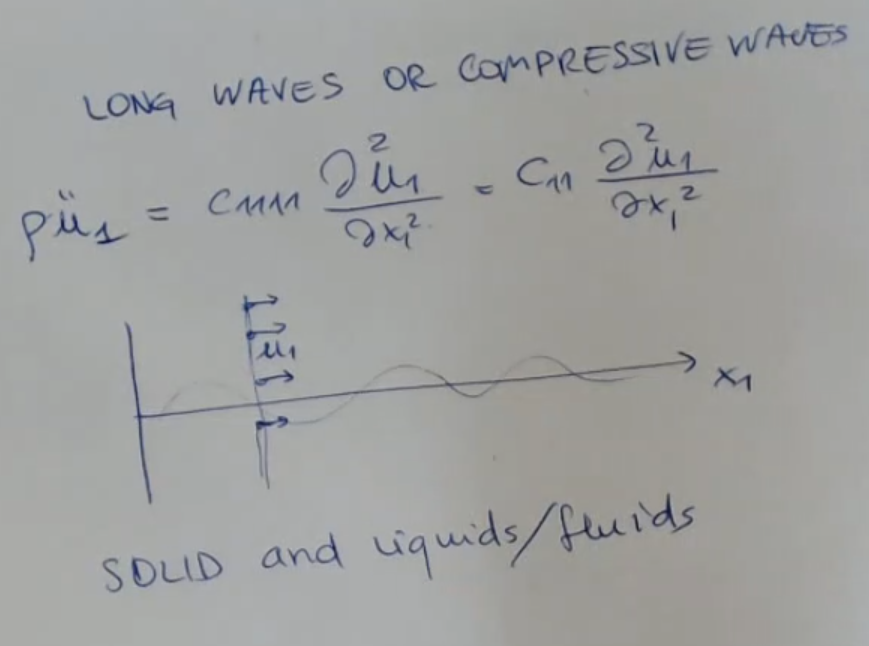
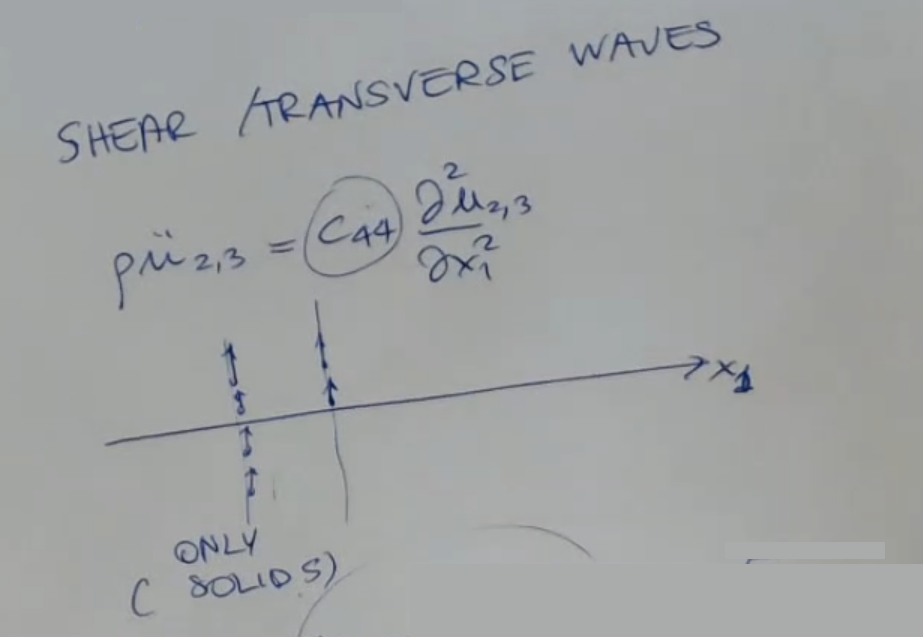
In the same media we can have two velocity for a wave:longitudinal velocity:transverse velocity:vl=ρc11vt=ρc44
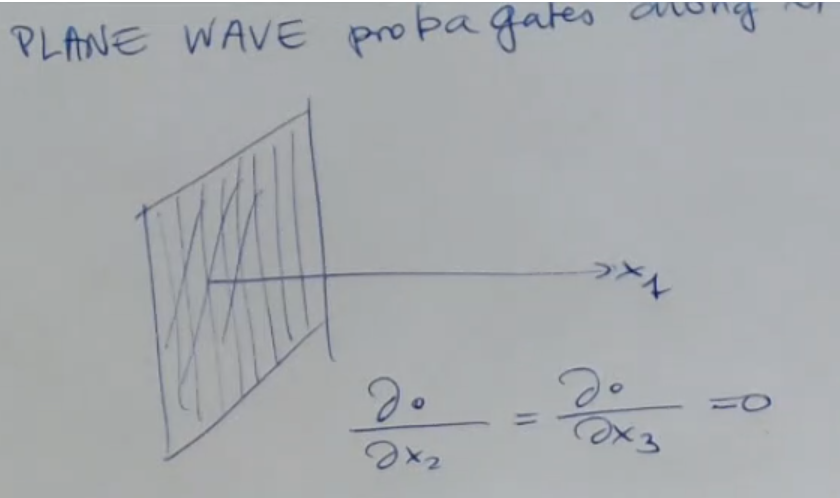
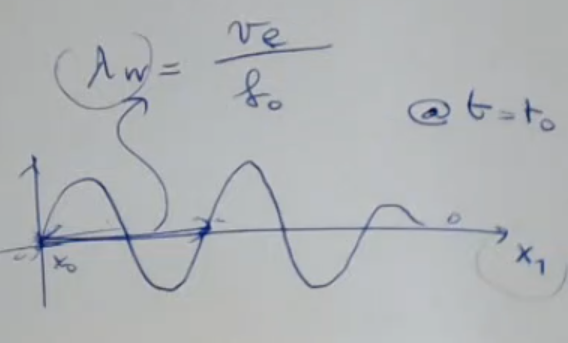
We can define the “components” of a generic planar wave (U1,U2,U3, primitives of u¨):longitudinal:transverse:U1(t,x1)=U1F(t−vlx1)+U!B(t+vlx1)U2(t,x1)=U2F(t−vtx1)+U2B(t+vtx1)
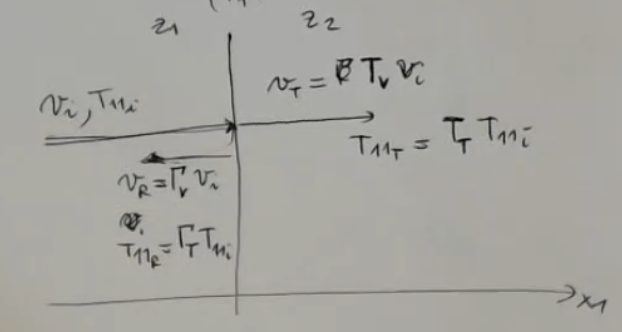
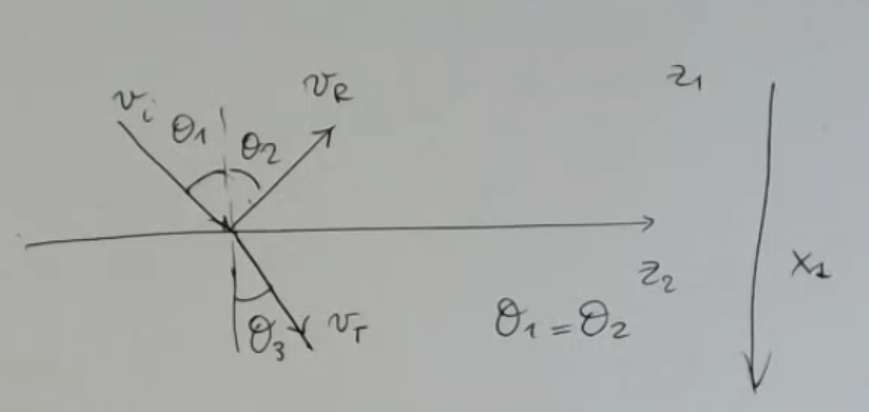
We define:vivR=ΓV⋅vivT=TV⋅viT11iT11R=ΓT⋅T11iT11T=TT⋅T11i(intial velocity of the wave)(velocity of the reflected wave)(velocity of the transmitted wave)(intial stress over the i-th dimension)(reflected wave’s stress)(transmitted wave’s stress)
Formulas:TV=Z1+Z22Z1TT=Z1+Z2Z1−Z2ΓV=Z1+Z22Z2ΓT=Z1+Z2Z2−Z1(transmitted coefficent for the velocity)(transmitted coefficent for the stress)(reflected coefficent for the velocity)(reflected coefficent for the stress)