Remeber:
==Pure transverse waves are possible only in solids. If the displacement of the particles are perpendicular to the propagation of the wave==, then it is called a transverse wave:
Using the definition Hooke’s law, we have found previously:We have that a transverse wave has:Where:
- direction in which the wave propagates.
- direction in which the material or particles that form the wave move.NOT_SURE_ABOUT_THIS
==For transverse waves we have ==.
Memory Card
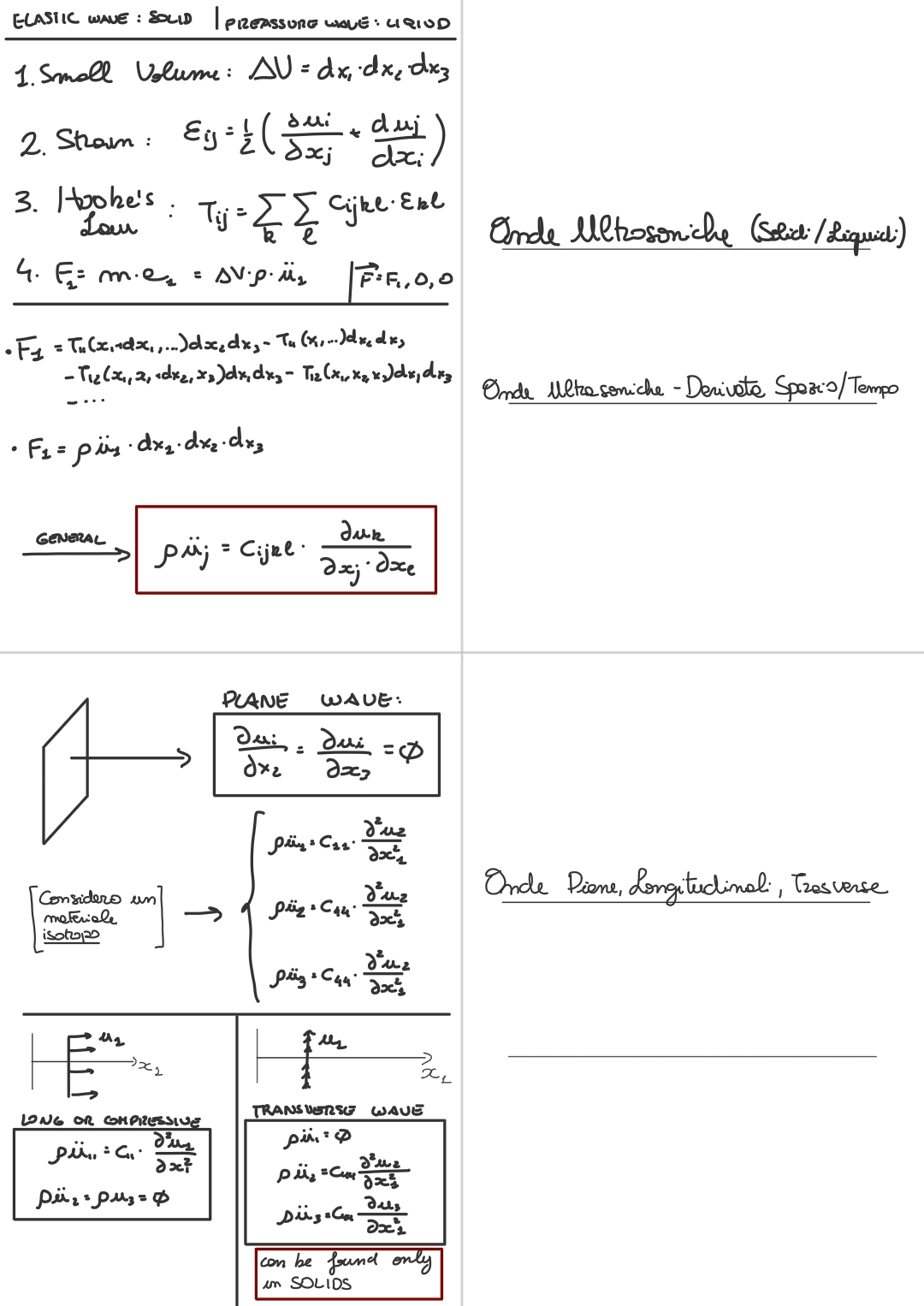
While if the displacement of the particles and wave move in perpendicular directions, we call it a shear or transfers wave.
- This waves are present only in solid.
- Remeber to not look, or try to make sense of the indecies for the compressed notation for , since for example does not refer to 4th dimension.
- Like longitudinal waves they are defined only for , where and are referning tho this part: , however they do not have a component, we find acceleation only for and , as we can see by the formula Again for the derivative of and over we multiply it by the coefficent .
⇒ So the only difference between longitudinal waves and transverse waves (looking at the formulas) is that: ==longitudinal waves have a component while for transvere waves ==. - NOTE:NOT_SURE_ABOUT_THIS
- : represents the elastic constant associated with the longitudinal (compression or dilatation) deformation of the material.
It characterizes the material’s resistance to changes in volume due to compression or expansion along the same direction as the applied stress. - : represents the elastic constant associated with shear deformation.
It characterizes the material’s resistance to shearing forces that cause changes in the shape of the material without changing its volume.
- : represents the elastic constant associated with the longitudinal (compression or dilatation) deformation of the material.
- What are Transverse Waves? (ChatGPT)
- A transverse wave is a type of mechanical wave where the particles of the medium move perpendicular to the direction of the energy transfer.
- In other words, the oscillations or vibrations of the particles occur in a direction that is perpendicular to the wave’s propagation.