Remeber:
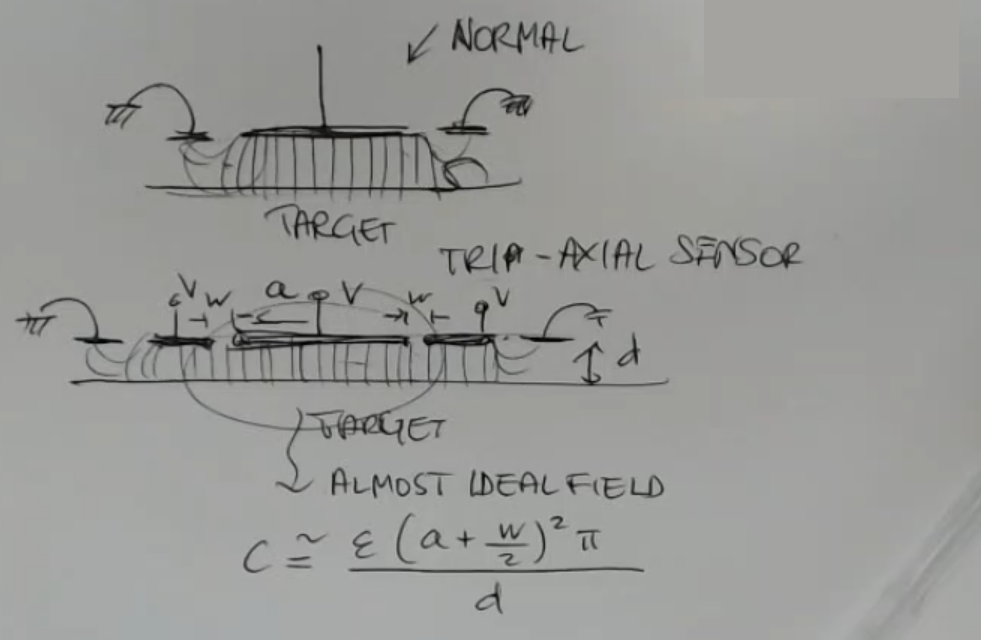
Difference between a normal capacitive proximity sensor, and a tri-axial sensor:
- The inner shield in a tri-axial sensor is driven, so it is kept at a voltage , same as the source voltage of the inner sensor.
- The field in the normal sensor, is bend at the edges, instead for a tri-axial sensor that is not the case, we consider the field as “almost ideal”.
- You can imagine that in a tri-axial sensor, it’s like having a continuous plate, If this gap is small (an “insulating gap”), then it’s like having a continuous plate here.
- In the tri-axial sensor, the “guard system”, prevents the distortion of the field due to something outside the sensing area.
The best thing that can be done with this kind of measurements is use this special cables which are the tri-axial cables, and tri-axial sensors.
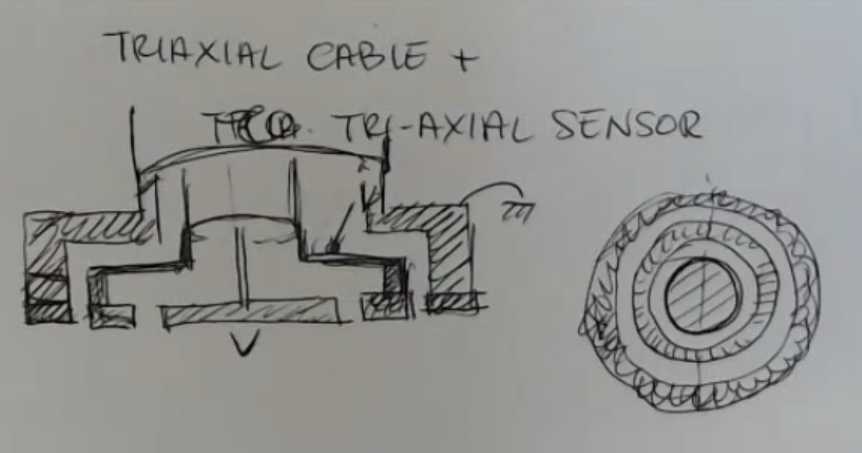
Difference between a normal proximity sensor, and a tri-axial sensor:
- The inner shield in a tri-axial sensor is driven, so it is kept at a voltage , same as the source voltage of the inner sensor.
- The field in the normal sensor, is bend at the edges, instead for a tri-axial sensor that is not the case, we consider the field as “almost ideal”.
- You can imagine that in a tri-axial sensor, it’s like having a continuous plate, If this gap is small (an “insulating gap”), then it’s like having a continuous plate here.
- In the tri-axial sensor, the “guard system”, prevents the fact of distortion of the field due to something outside the sensing area.