When we talk about Hooke’s law:As we have said, there is a special case for isotropic material.
The stiffness tensor in the formula should be formed by 84 elements, but for isotropic materials (like Silicon), it can be collapsed using needs elastic constants, and they can be represented with only indipendent constants: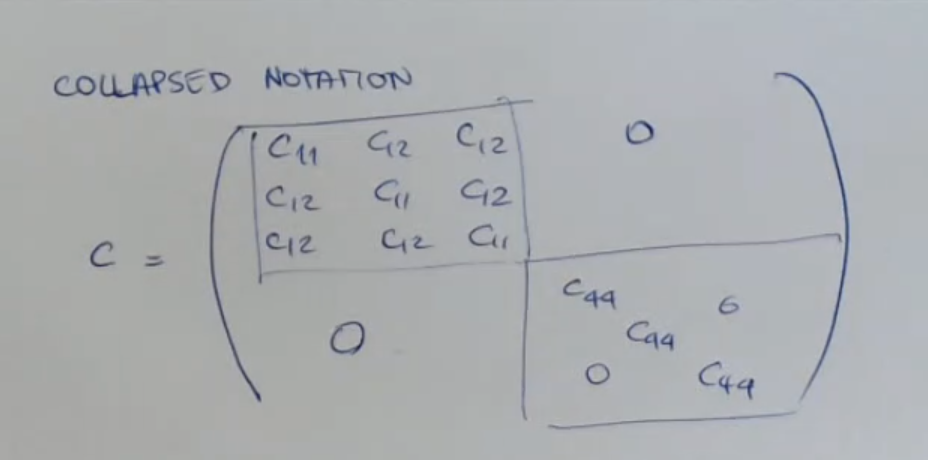 Where as we have said only 2 are independent variables, and for example we can say that:We have also defined , and as:IMPORTANTE
If we expand the collapsed stifness tensor we can find: (NOT IMPORTANT)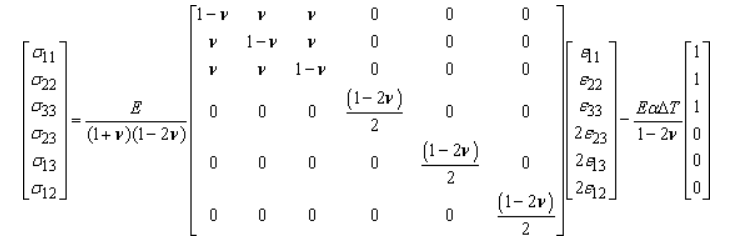 NOTE: _This definition was found on the internet, the professor has made other definitions, that i don’t think are correct.
To get an idea, about what , and , represent:
- : represents the elastic constant associated with the longitudinal (compression or dilatation) deformation of the material.
==It characterizes the material’s resistance to changes in volume due to compression or expansion== along the same direction as the applied stress.
We can see it clearly in the definition of longitudinal wave. - : represents the elastic constant associated with shear deformation.
==It characterizes the material’s resistance to shearing forces== that cause changes in the shape of the material without changing its volume.
We can see it clearly in the definition of transverse wave.
Instead if we consider an anisotropic materials, let’s take Quartz for instance: it has independant components (still very few), however other anisotropic materials can have more.
Professor’s Definition
NOT_SURE_ABOUT_THIS
In the lectures we have found: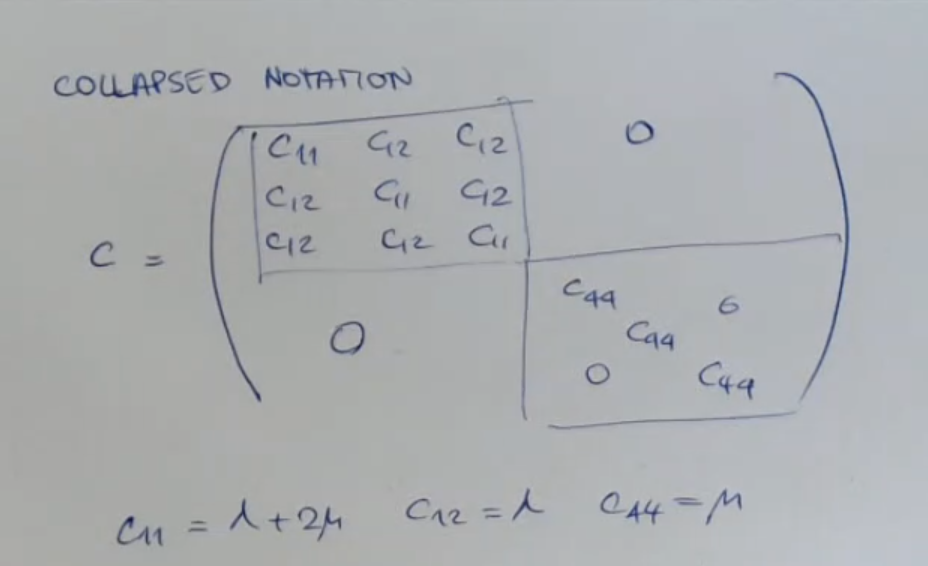 And:
And:
The Young Modulus: And the Poisson Modulus:
But the result is not the same as this matrix:
- Source: Internet