We have seen the quarter bridge, the half brige.
Let’s see how we can design a full bridge with strain sensors, on a cantilever:
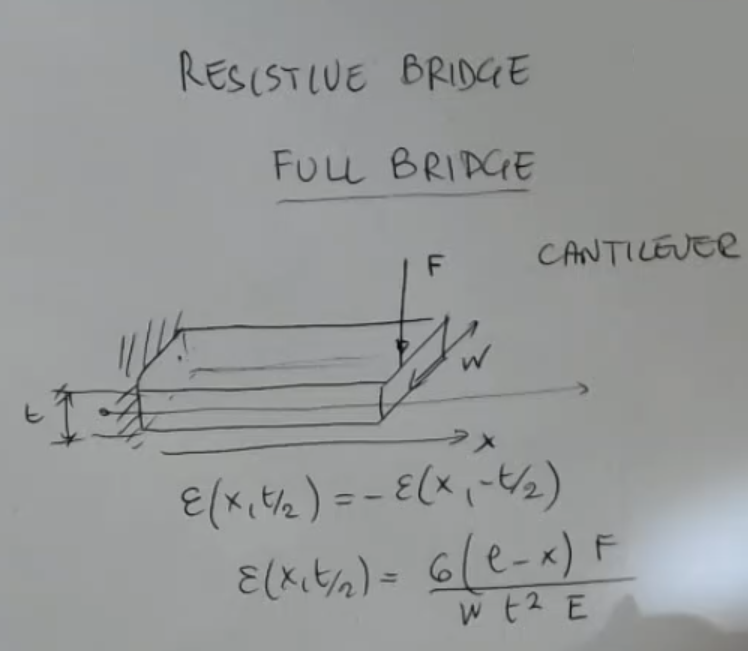
- : strain
- is the width.
- is the Young modulus.
- is the force, the force magnitude.
Design of a full bridge: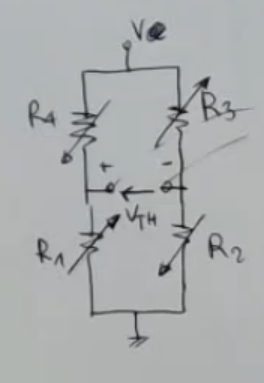
is equal to: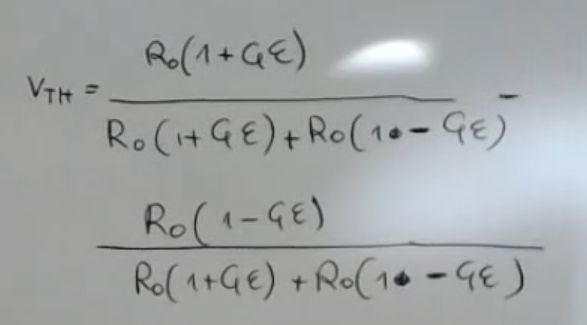
Continuing: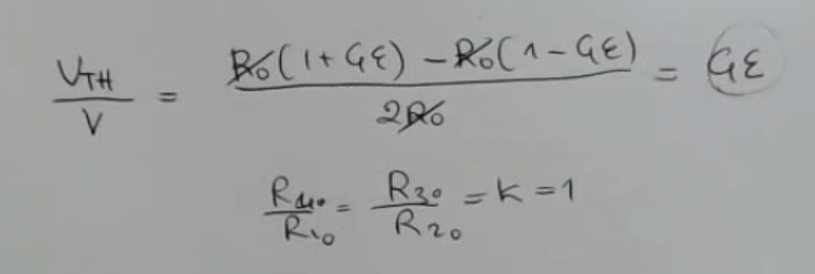
So it is important to remember that:IMPORTANTE Supposing that we have taken , and remember that is defined as:
==So this is a linear circuit, the voltage output is related to the strain in a linear way, always. It’s a differential sensor: that means that if I have variations, which are of the same sign like the ones due to temperature variation, they are cancelled by the structure of the brigdge==.
NOTE: I’ve put a zero in the subscript of the resitances to represent that they are sensors.
So ==the full bridge is always linear and it rejects common mode disturbances==.
What are the gains of using a full bridge instead of a half brige?
- If and the half bridge behaves linearly.
While ==the full bridge always behave linearly==.- It has higher sensitivity than the half bridge.
- However it requires four sensors, so requires more space, and has a higher cost.