Remeber:
Piezoelectric coefficient matrix (in compact notation) for PZT (Lead Zirconate Titanate):The real matrix dimensions are .
==Piezoelectric materials have to be operated under the Curie temperature==.
Curie Temperature: is the temperature at which, usually, there is a phase transition from an asymmetrical to a symmetrical crystal. For PZT this temperature is .
Piezoelectric materials have to be operated under the Curie temperature, which is the temperature at which, usually, there is a phase transition from an asymmetrical to a symmetrical crystal, for PZT this temperature is 250 degrees, and etc.:
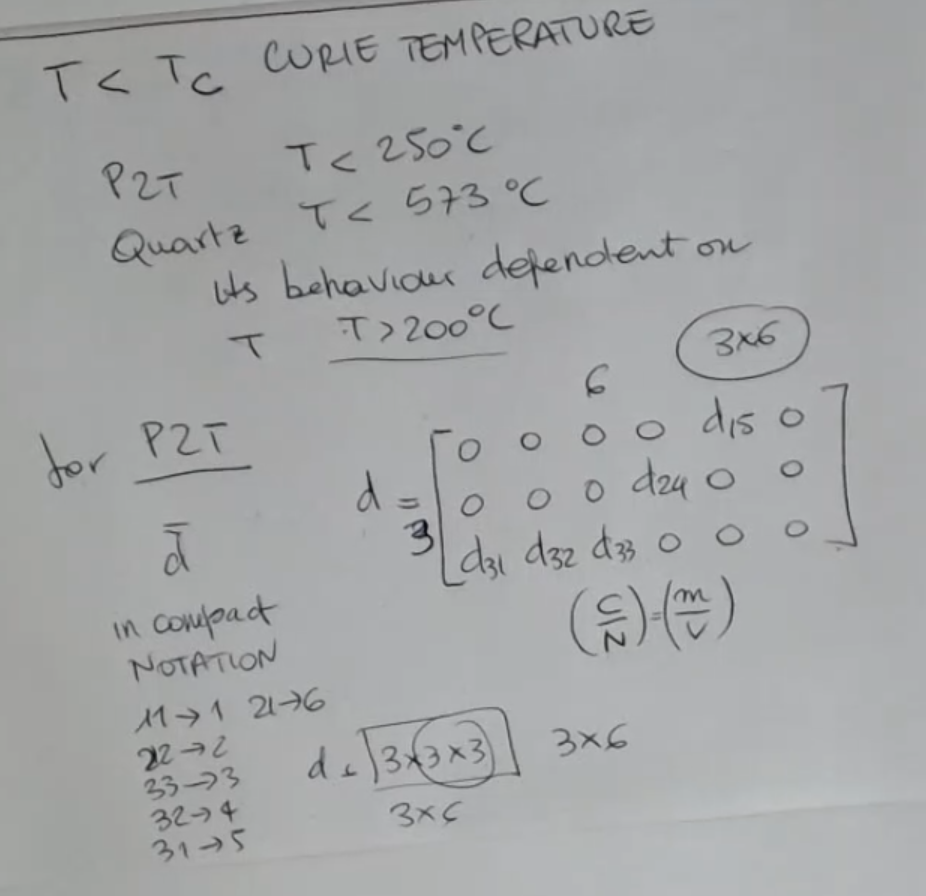
- NOTE: for quartz used at temperature higher than degrees its behavior becomes highly dependent on temperature.
- The last thing is that the structure of the matrix, which is the charge piezoelectric coefficient.
This matrix here actually has a sparse nature. - For instance this is the shape that this matrix takes obviously with respect to the crystallographic axis, for PZT.
- Notice this is a matrix which is , while we defined it as a , because it relates a vector to a tensor (which is a ), so , is the right dimension/size of the matrix, but since everything is symmetrical, the part related to the mechanical behavior, 2 indexes can be collapsed into one so in compact notation we can use for a couple of indexes the same rule that we have used for the elastic matrix.
- And you see here that we have many many zeroes, so only in some specific direction there is really a coupling between the electrical and mechanical response.
(So a sparse matrix)