Remeber:
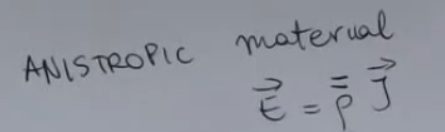
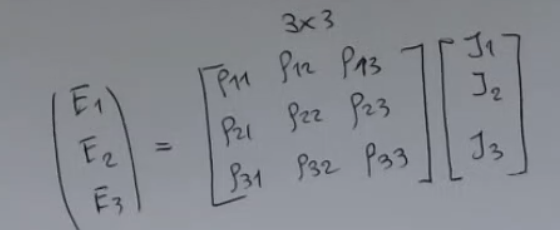
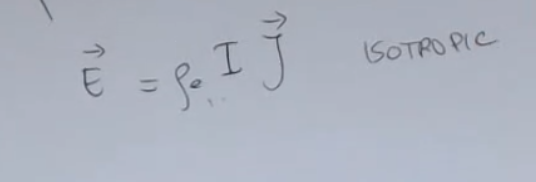
Let’s compare the electric filed generated by an isotropic and an anisotropic material: The difference is that for isotropic material the reisistivity is a scalar (), while for anisotropic material we are talking about a tensor of resisitivity.
More specifically for anisotropic materials:
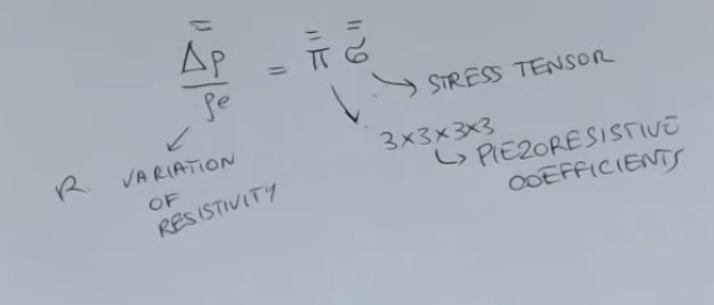
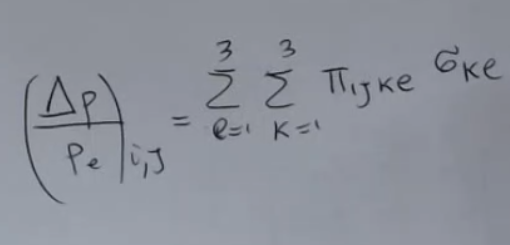
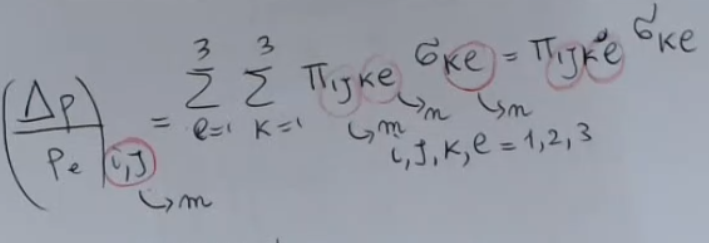
If a material (==both isotropic or anisotropic==) gets deformed, the resulting energy field changes, due to the piezoresistive effect, let’s take for simplicity an isotropic material:Where represents the piezoresistivity effect, and is found as:Where:
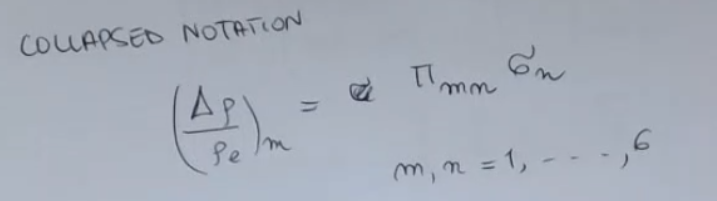
- piezoresisitve coefficient tensor, with , for isotropic materials, we will see that for isotropic materials it can be reduced to a matric .
- stress tensor. (it should be a matrix, but we can compact it to a vector)
Here’s an example of a piezoresisitve coefficient tensor for Silicon (an isotropic material):
- So ==for Silicon==, we can write the special piezoresistive coefficients tensor with only indipendent constants: .
These inidipendent constants depend on the type and doping level.- This is true for all isotropic materials, and we defined it as the “collapsed stifness tensor”.
- Here we have some values for the piezoresisitve coefficients: piezoresistive coefficients values.IMPORTANTE
The energy field generated by the piezoelectric effect depdens on the application of the force, so we need vectors, matricies and tensors:
While for isotropic materials, vector are sufficient:
Now for silicon we have the difference for undeformed and deformed silicon, when the silicon is deformed we need to take into account the piezo-resistive effect:
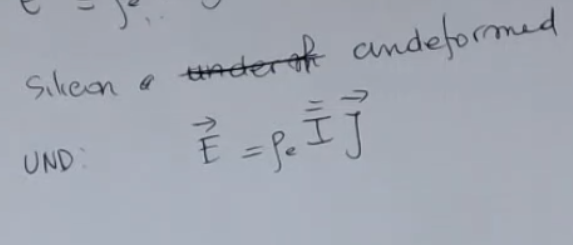

Where the relative variation of resisitivity given by the piezoresisitivity effect is given by:
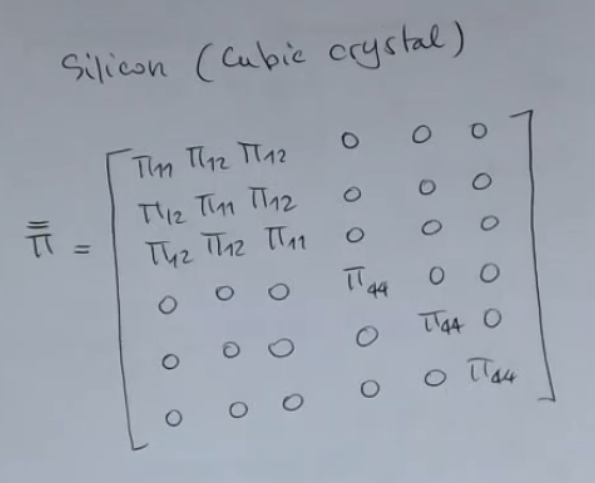
We can write the special piezoresistive coefficients matrix with only indipendent constants: