Remeber:
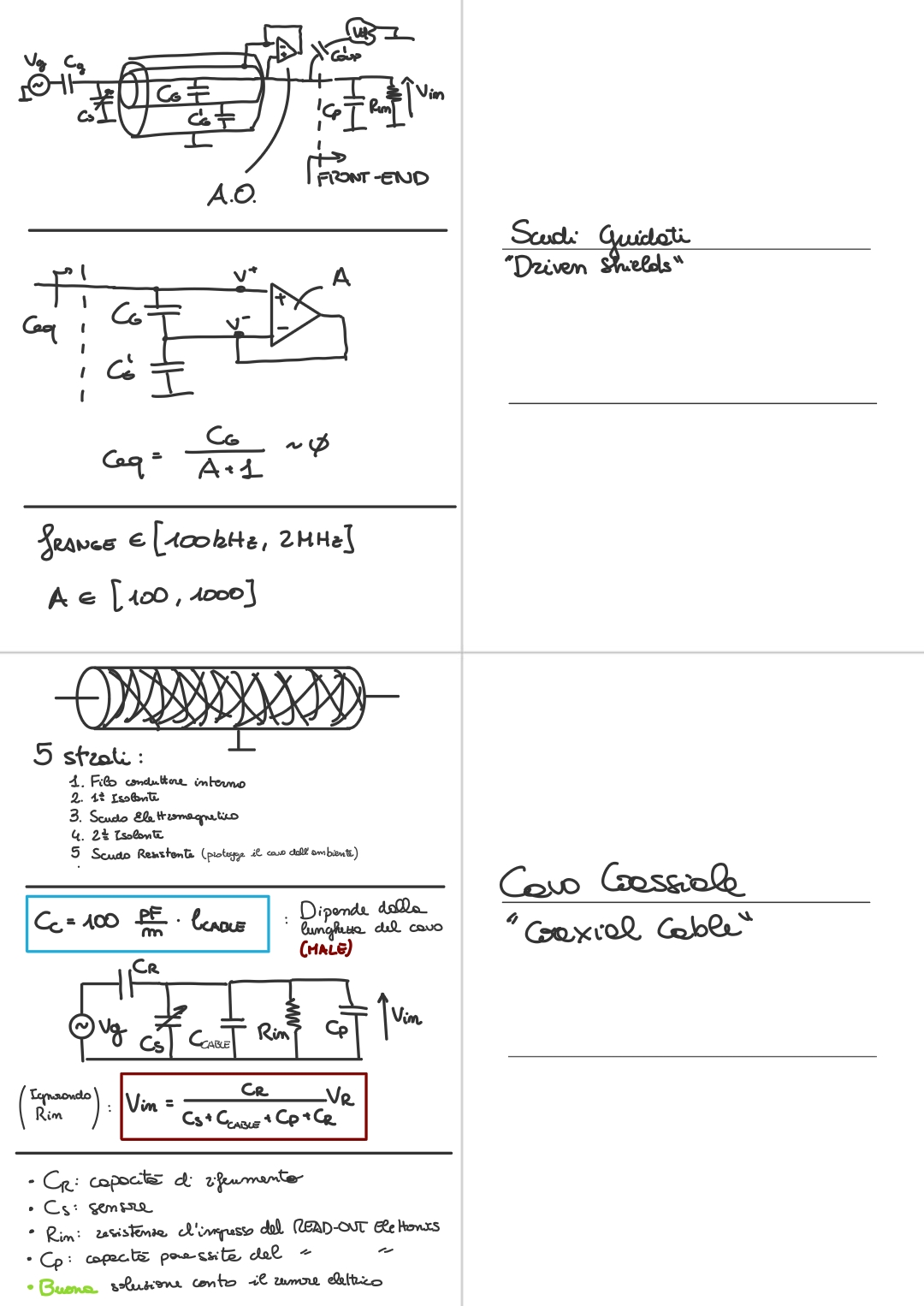
To reduce electrical noise we can shield our circuit, using a coaxial cable However this does not solve the problem of having a long cable. To solve both problems we need a tri-axial cable:
- In this cables we have:
- An internal shield called guard that surrounds the wire.
- An external shield which is usually grounded.
- In this types of cables the guard is kept at the same voltage as the wire.
- The various coupling capacitances of the tri-axial cables are:
- : Guard capacitance between wire and internal shield.
Tho since wire and internal shields are at the same voltage, this capacitance is empty of charge, so the special property of tri-axial cables is that:- : Second shield capacitance, this has charge, so its value is different from .
Let’s draw better the circuit:
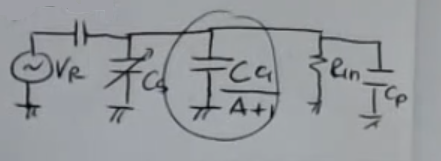
- The sensor will see a capacitance equal to:
- I will need an amplifier which has a large gain.
But remember that now we are operating at AC obviously, so it has to use large frequency because of the small value of the capacitance of the sensor ().
Usually we need to operate, around the operating range (depending on the value of the sensor) of .
⇒ So we need this open loop gain to be or , at around .- So in conjunction to tri-axial cables we need wideband operational amplifiers.
- The last thing we need, since we have a variable signal, is a filter to remove the drifts at low frequency.
I write here the equivalent we find at the end for the tri-axial cable system:
Memory Card
So if we need a long cable, we need to use tri-axial cables:
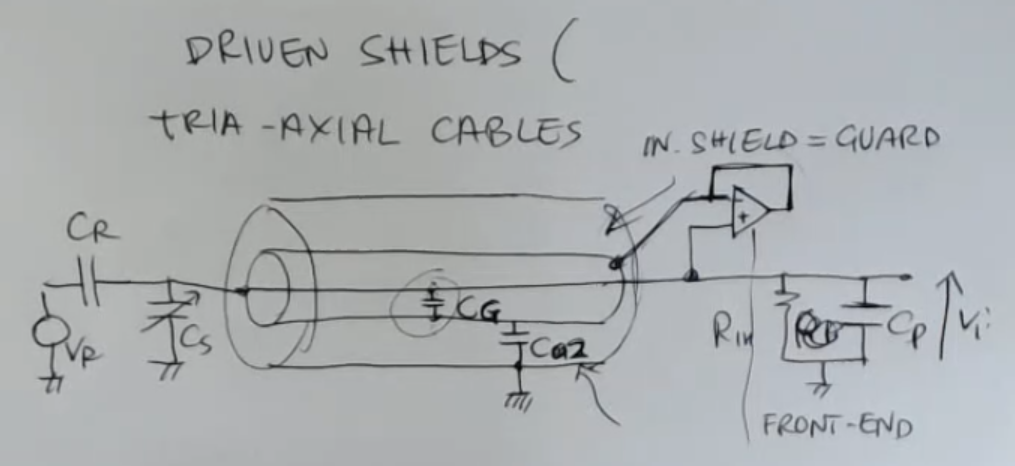
- In this cables we have:
- An internal shield called guard that surrounds the wire.
- An external shield which is usually grounded.
- In this types of cables the guard is kept at the same voltage as the wire.
- The various coupling capacitances of the tri-axial cables are:
- : Guard Capacitance between wire and internal shield.
Tho since wire and internal shields are at the same voltage, this capacitance is empty of charge, so the special property of tri-axial cables is that: - : Second Shield Capacitance, this has charge, so its value is different from .
- : Guard Capacitance between wire and internal shield.
Let’s draw better the circuit:
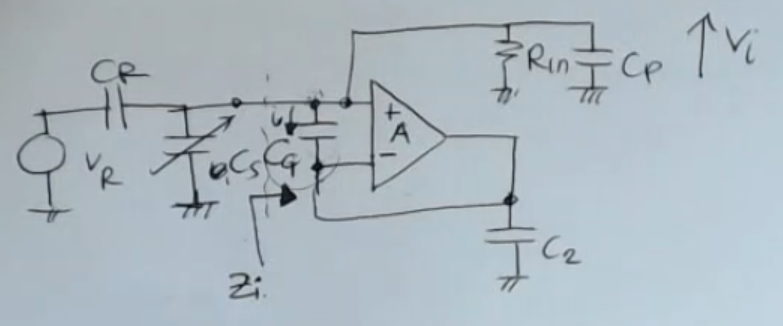
- is the guard capacitance.
- is the outer shield capacitance.
- So the idea is to have changed this input resistance here (), so to have a reduced the effect of the capacitance of the cable.
- You see that the feedback, keeps the two terminal and at a very very close voltage with respect of one to the other, so almost a short circuit, no current flowing there.
So we don’t have any effect in this case of loading and reduced sensitivity on the voltage divider in this part.
So:
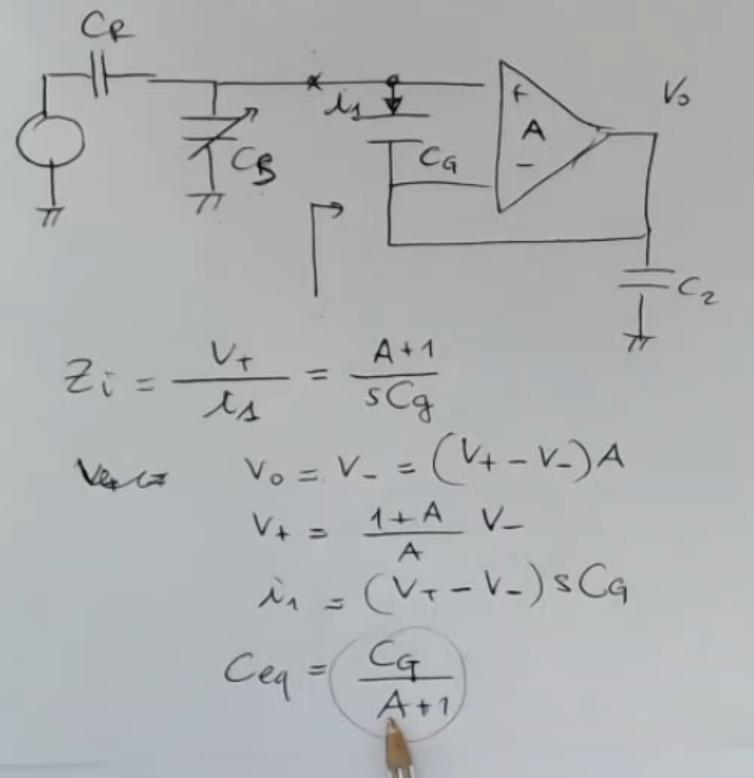
- is the capacitance seen by the sensor.
- I will need an amplifier which has a large gain.
But remember that now we are operating at AC obviously, so it has to use large frequency because of the small value of the capacitance of the sensor ().
Usually we need to operate, around the operating range (depending on the value of the sensor) of .
⇒ So we need this open loop gain to be, I don’t know, or , at around .
So in conjunction to tri-axial cables we need wideband operational amplifiers.
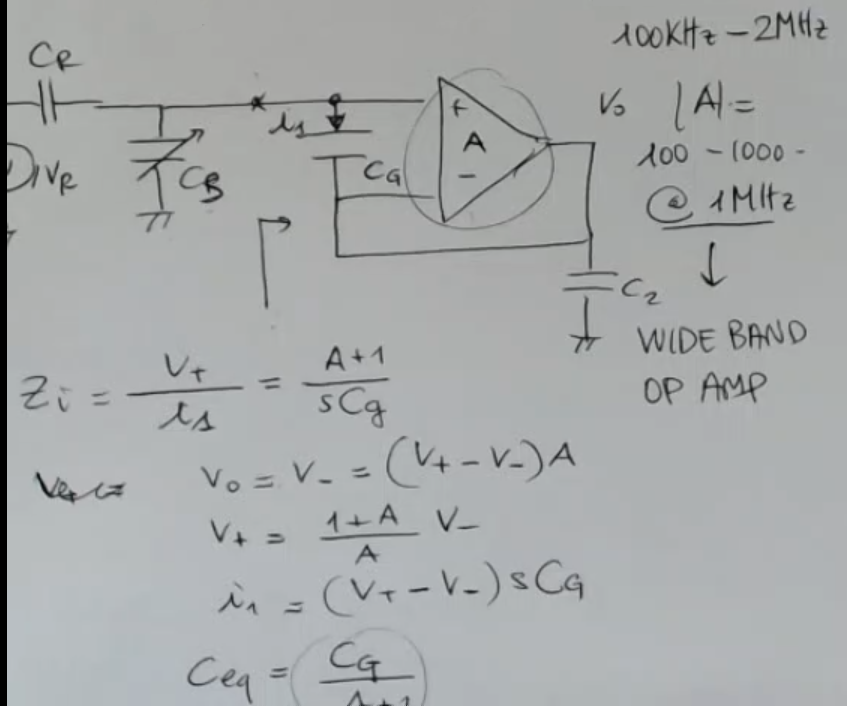
The last thing we need, since we have a variable signal, is a filter to remove the drifts at low frequency. There are still other problem, but at least we can the sensor even if we have a long cable.
I write here the equivalent we find at the end for the tri-axial cable system: