Remeber:
If the ==displacement of the particles are parallel to the propagation of the wave==, then it is called a longitudinal wave:
Using the definition wave formula, we have found previously:We have that a logitudinal wave has:Where:
- direction in which the wave propagates.
- direction in which the material or particles that form the wave move.NOT_SURE_ABOUT_THIS
==For longitudinal waves we have ==.
Memory Card
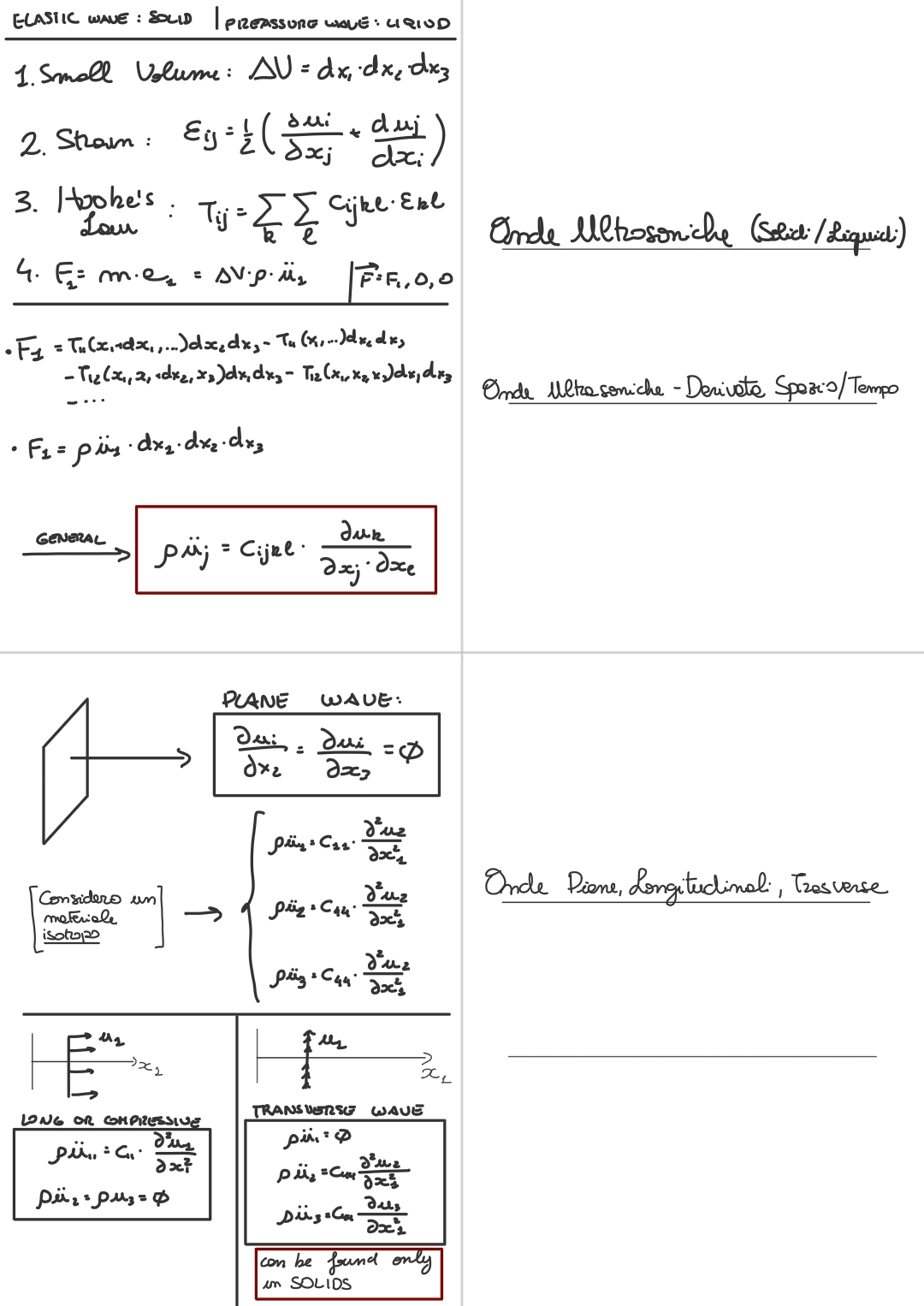
If the displacement of the particles are parallel to the propagation of the wave, then it is called a longitudinal wave, and we can write it in the collapsed notation:
- So the collapsed notation takes , so the condition for a longitudial wave, and writes it as a single index.
- NOTE: The complete extended notation would be NOT_SURE_ABOUT_THIS
- So this means that you have a wave, which travels/propagates along and all the particles are displaced along this direction.
- So these are longitudinal waves or compressive waves or waves of pressure because what changes is a pressure because you have molecules which pushes other on contact.
- And this kind of wave can propagate through solid and liquids and fluids in general (air is considered a fluid).
- Remeber to not look, or try to make sense of the indecies for the compressed notation for , since for example does not refer to 4th dimension
- What is a Longitudinal Wave? (ChatGPT):
- A longitudinal wave is a type of mechanical wave in which the particles of the medium vibrate back and forth in the direction parallel to the direction of energy transfer.
- This is in contrast to transverse waves, where the particles of the medium move perpendicular to the direction of energy transfer