Remeber:
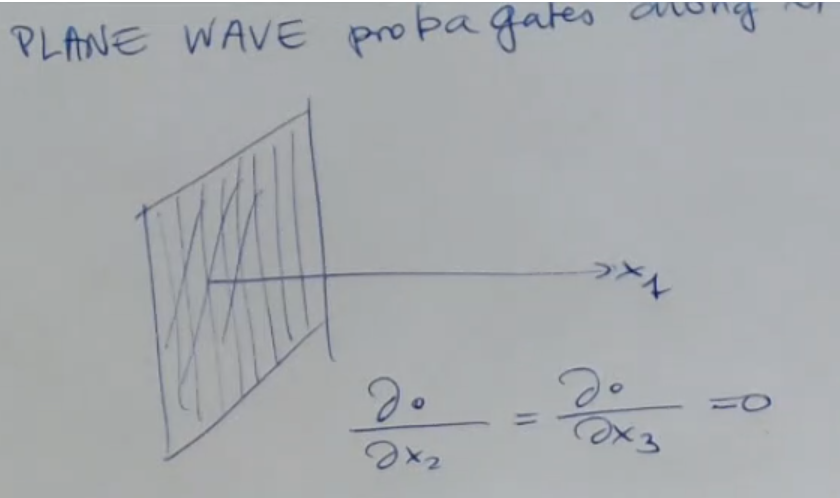
A plane wave propagates only in a single direction, let’s call it , and all the variables which describes the waves are constant on planes perpendicular to .
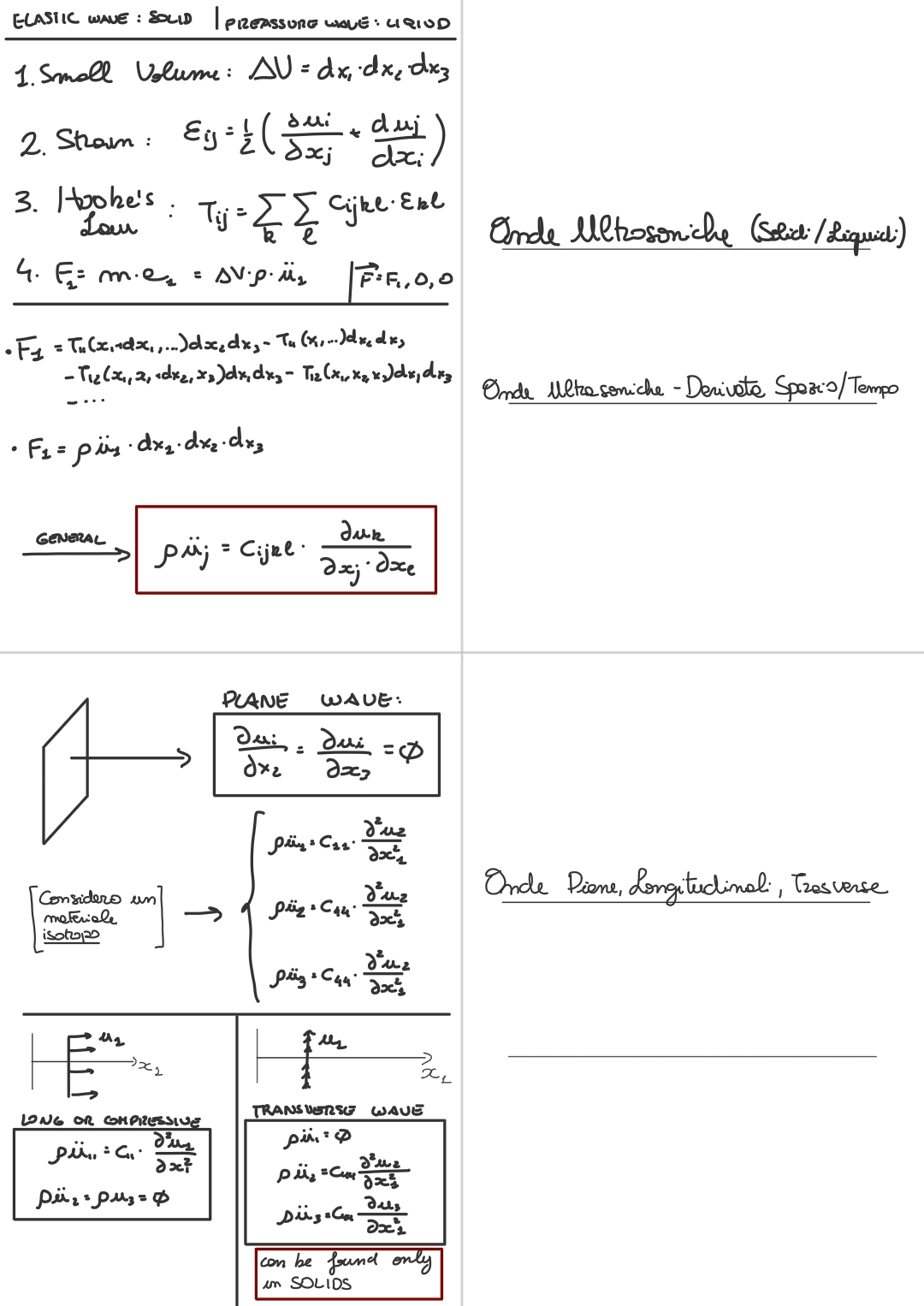
When we perform the derivative on and , both will result in a , so rememberIMPORTANTE :Using the wave equation:For a planar wave we find (specifically for isotropic materials, so that we can use the collapsed stifness tensor):IMPORTANTE Where:
- direction in which the wave propagates.
- direction in which the material or particles that form the wave move.NOT_SURE_ABOUT_THIS
If we look at the definitions of longitudinal wave and transverse wave, we can say that the planar wave is a combination of the two.NOT_SURE_ABOUT_THIS
Memory Card
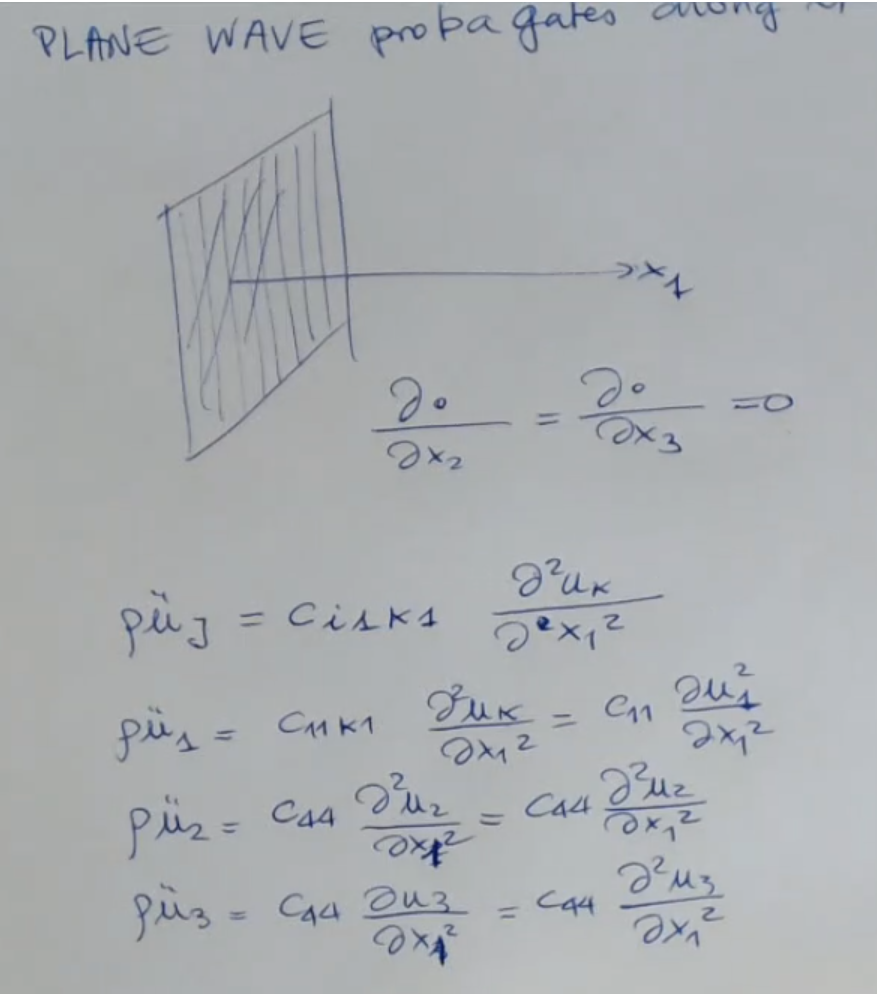
We take into account a plane wave, which propagates along .
- What is a Planar Wave?
- A planar wave, also known as a plane wave, is a type of electromagnetic or acoustic wave characterized by the property that the wavefronts, which are surfaces of constant phase, are flat and planar.
In other words, a plane wave’s wavefronts are parallel planes, and the wave propagates uniformly in a single direction without spreading out as it travels.
- A planar wave, also known as a plane wave, is a type of electromagnetic or acoustic wave characterized by the property that the wavefronts, which are surfaces of constant phase, are flat and planar.
- What is a Planar Wave? (Professor’s Explenation)
- All the variables which describes the waves are constant on plates perpendicular to .
- So the Hooke’s formula is much more compact, since we have to evalutated only for , where and are referning tho this part: and using the symmetry of , we end up with only 3 formulas (that are not equal to ).
- Remeber to not look, or try to make sense of the indecies for the compressed notation for , since for example does not refer to 4th dimension.
- NOTE: In the first formula we use and in the other two we use this is because