Remeber:
Suppose we take an ultrasonic transducer made of PZT and we attach it to another undefined material called, their acustic impedances have this values:
- The unit of measure is called a .
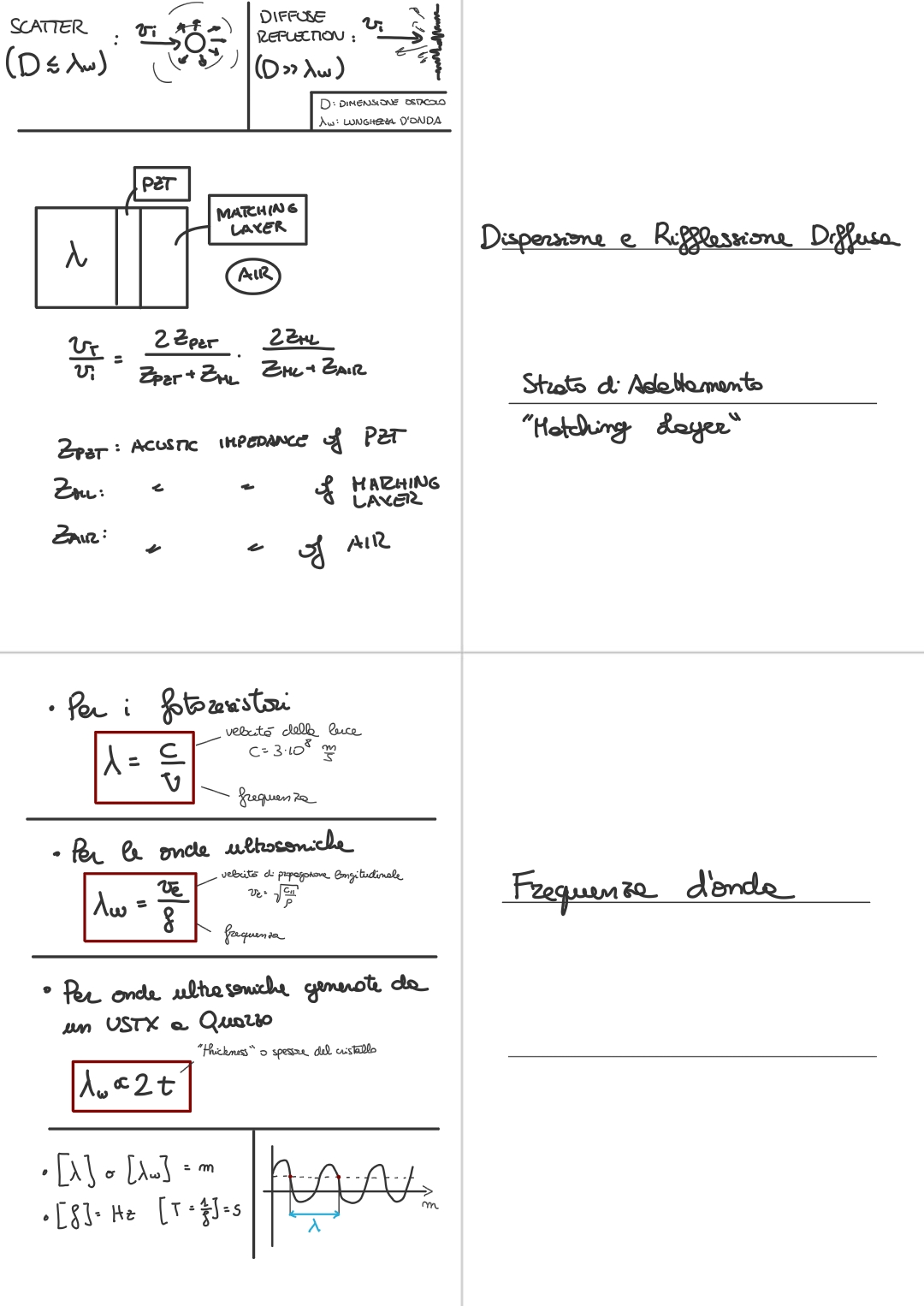
Since we know that the wavelength has this formula:And that given an intial value for (the longitudinal velocity of the wave), we have the ratio with the resulting transmitted wave is:The same ratio is true for the wavelength. ==So for this particular example the resulting wavelength and velocity are only about of the initial values==.
If we wish to increase this ratio, we could consider inserting a matching layer, with an acustic impedance of , between the PZT and the other material ”?”, like so:
- So the formula, now becomes (ignoring the reflections, only the transmitted parts):Where:
- : acustic impedance of the matching layer
- : acustic impedance of the PZT layer .
- : acustic impedance of the other material, or outside material .
- ==If we suppose we obtain that the ratio becomes of the intial value, so we have increased it==.
Without the matching layer: , with the matching layer .- As a rule of thumb we can consider a single acustic impedance , that combines the impedances of the material+matching layer:
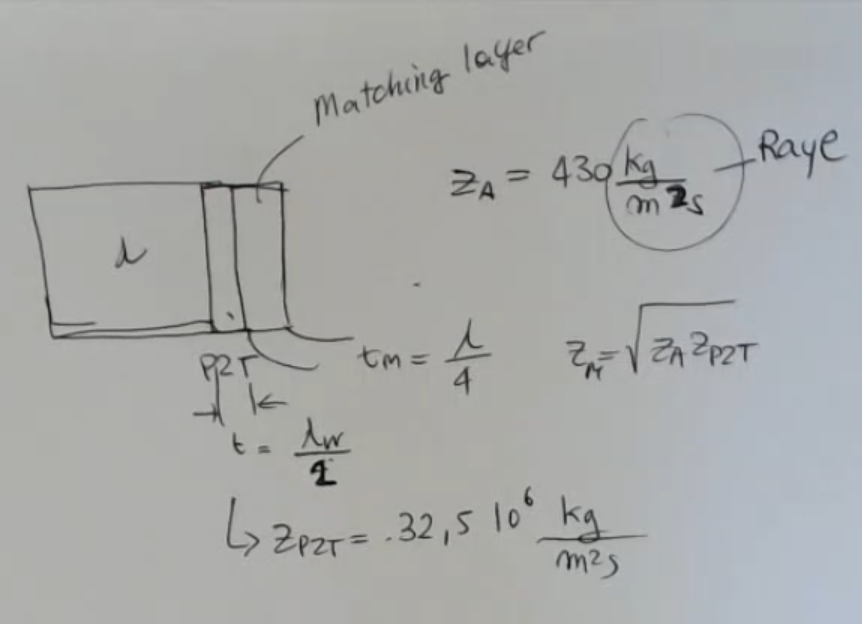
- Given the thickness of the PZT layer: suppose , we usually take the thickness of the matching layer as , so half of the PZT thickness (in the figure = ).NOT_SURE_ABOUT_THIS

Memory Card
So keeping in mind that the wavelength is an important parameter, since it decides how the wave reacts to the medium.
W go back for a moment to our transducer, to the structure that we have described at the beginning:
- So we have said that the transducer is based on a piezoelectric slice, which is usually PZT.
- A backing which is used to enhance the damping called damper.
- then we have a matching layer, and now we will explain how, and why, this matching layer is needed it.
- acustic impedance of PZT.
- acustic impedance of the target material (for example air).
- acustic impedance of the matching layer.
- If we select a matching layer with a certain acustic impedance we will have that the propagation speed, so also the wavelenght can be changed (reduced) at will.
- So transmit a wave to the matching layer then to the target material (example air), so the final wavelength, propagating inside the target material will be:NOT_SURE_ABOUT_THIS
- NOTE: This opearation redcues the wavelength, it cannot increase it.NOT_SURE_ABOUT_THIS
- There is a name for acustic impeadance unit of measure: “Rayl”.
- Professor’s note:
“We have very different acoustical impedance between the PZT and air, a large part if the wave is reflected back instead of being transmitted to the air.
The a matching layer reduces the phenomena of reflection, and the matching layer is a material with an impedance which is selected according to this rule here:”