Remeber:
Let’s take into consideration a one-quarter resistive bridge, and add the wire resistance to the sensor, like so:
The output formula will become:So we have an offset equal and sensitivity equal to:NOT_SURE_ABOUT_THIS (redo the sensitivity calculations)The offset in theory could be corrected. However the sensitivity is different from the nominal one. And both offset and sensitivity depend on the wire resisitance, so both value can change, a variable offset and a variable gain, are errors that I cannot correct.
If we use a current supply, and we cople the read-out, like so:
We have that the sensitivity (also called “gain” if we consider instead of ) now is fixed, however we still have a variable offset:Since we have an AC-coupled read-out, if for a single measurement the offset remains the same (so it is a DC offset), we will discard it. ==This is a good solution for AC measurements==.
Instead if we have space to add another cable, we can use a 3 wires layout, and still use a voltage supply, like so:
By adding another cable we can compleately remove the offset:NOT_SURE_ABOUT_THIS (redo the sensitivity calculations)However, the sensitivity still depends on .
Memory Card
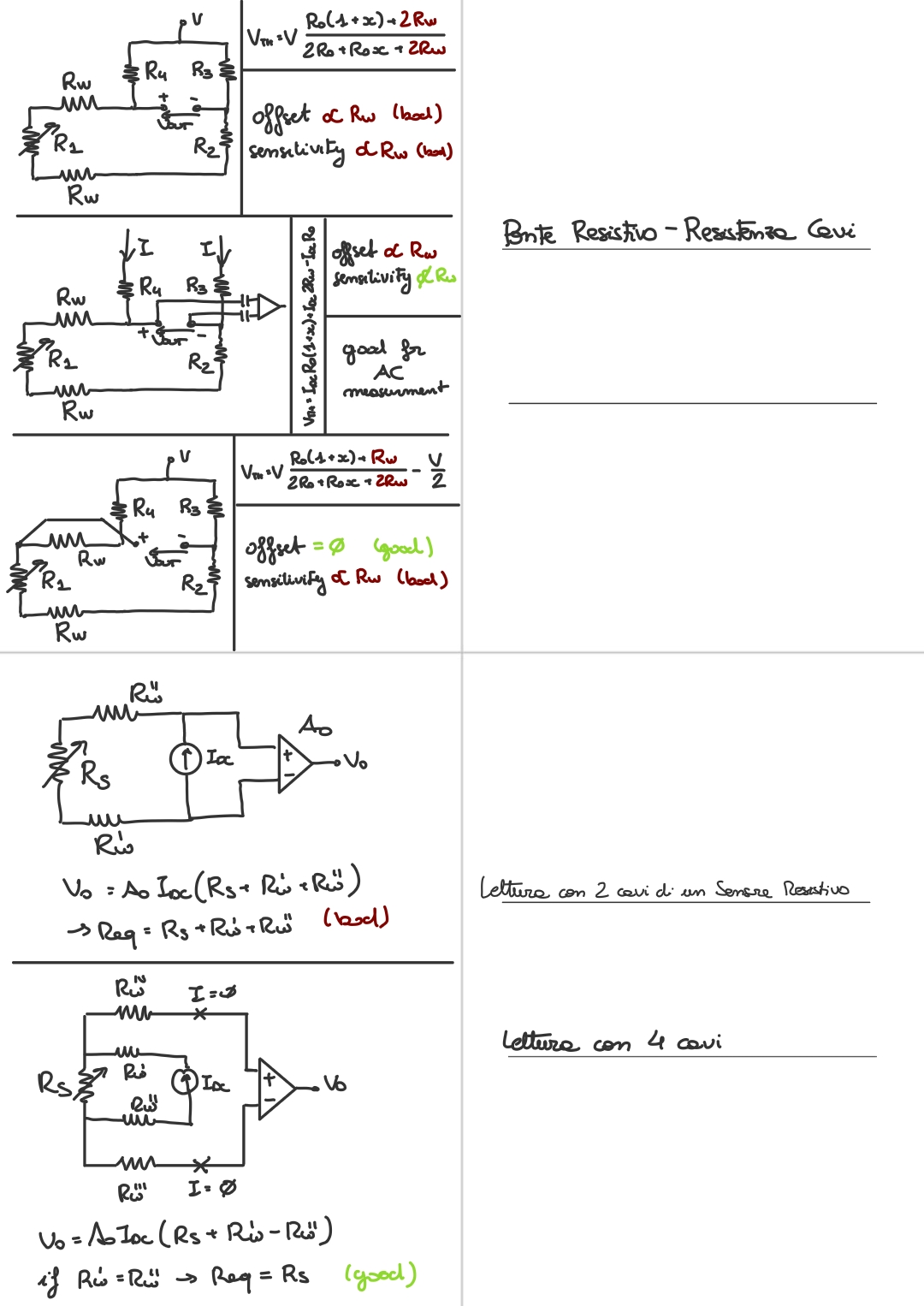
2 Wires Layout
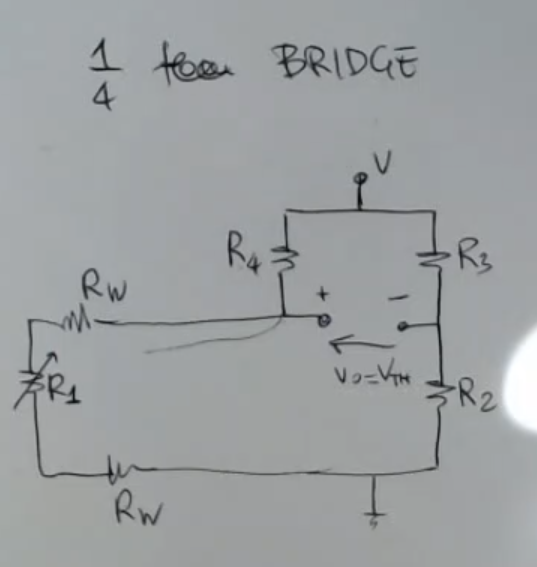
Calculating it is equal to: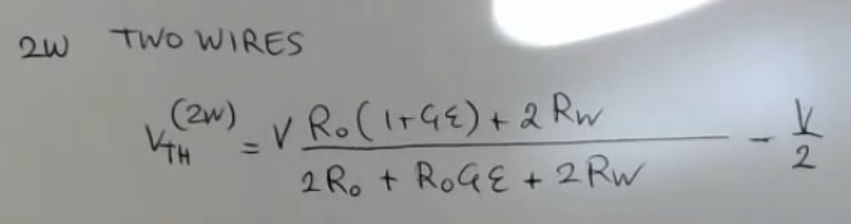
So we have an offset equal and gain to:
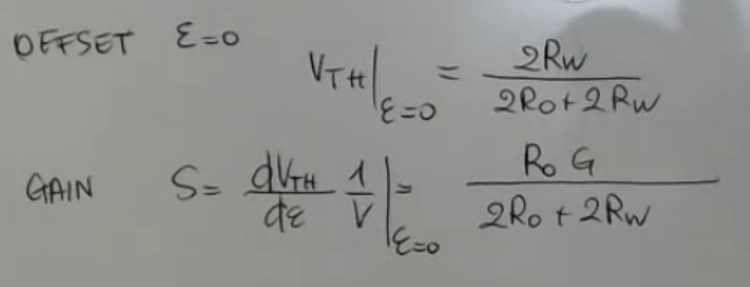
- ==And so what happens is that, I have an offset, which in theory could be corrected==.
- ==I have a sensitivity, which is different from the nominal one==.
- But the most, problematic aspect is that these values may vary, so I have both a variable offset and a variable gain, and this is an error that I cannot correct.
If I use a current supply instead of a voltage supply: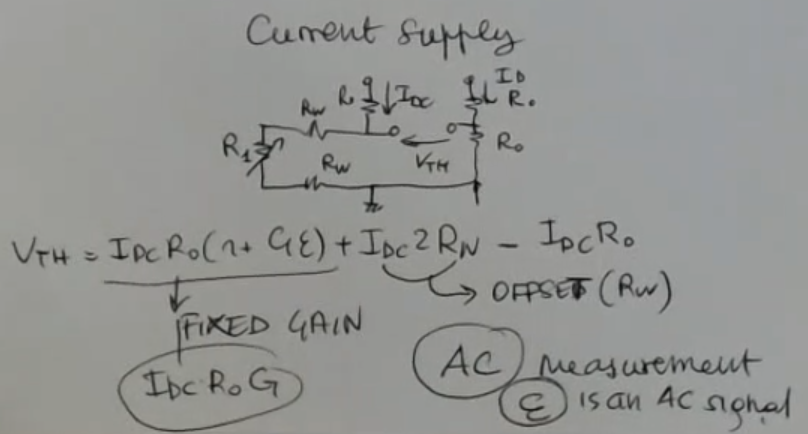
- I will have a variable offset.
- The offset will depend on the parasitic resistances, but the gain is fixed.
- ==So the gain will NOT depend on what happens in the cables==.
So this is a good solution for AC measurements: when we use strain gauges for AC measurement (for vibrations signal), then this is a good solution, because by coupling the output of the bridge in an AC way to a differential amplifier: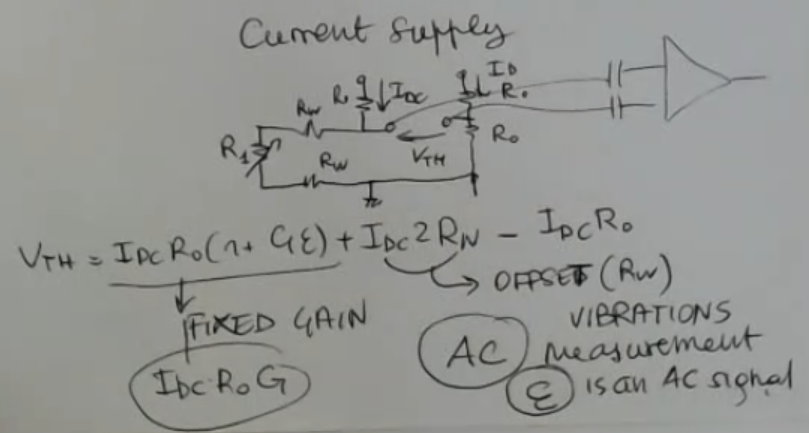 - ==The part will be neglected==.
3 Wires Layout
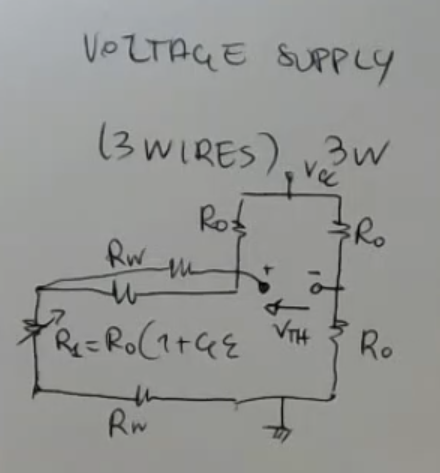
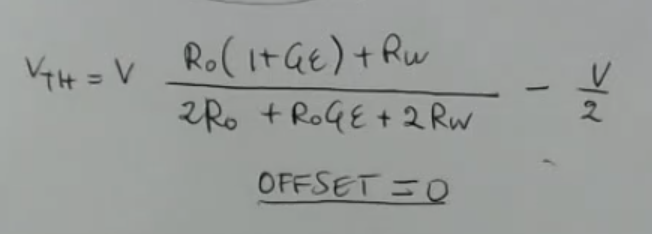
- ==So in this case, you don’t have offset==.
- ==So you cancel the offset, but you still have a small variation of the of the gain of the bridge==.