CMRR: “Common Mode Rejection Ratio”.
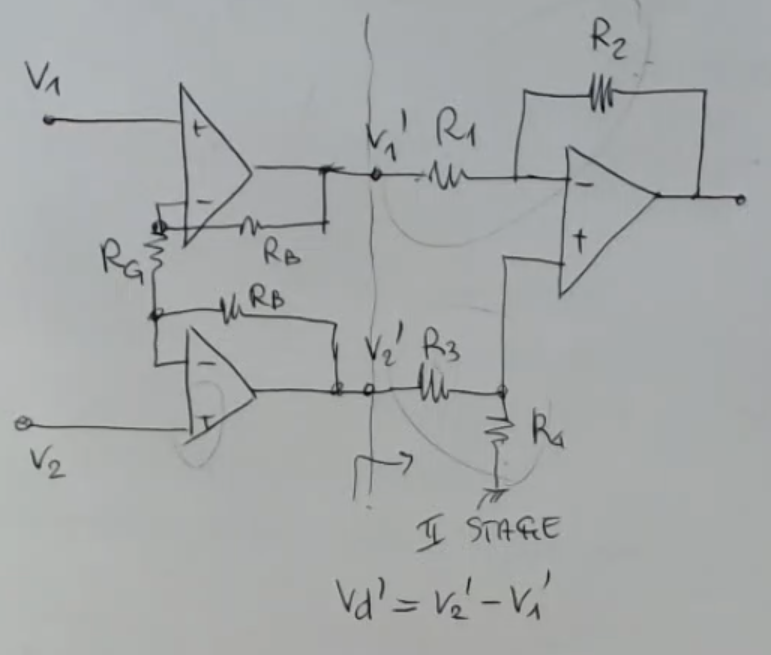
CMRR (Stage II):
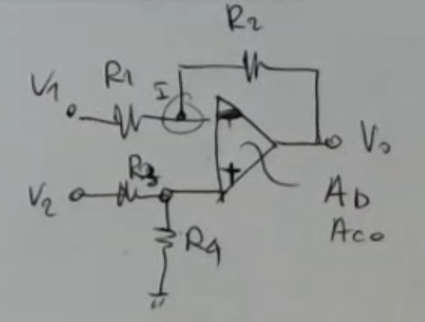
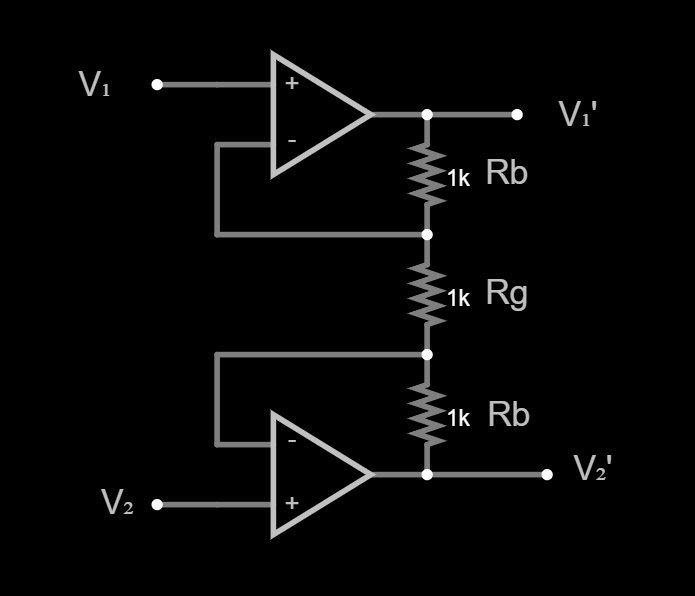
& \text{CMRR}_{TOT} = \\[5px] & = \frac{1}{\frac{(2R_B + R_G)}{R_G}}\cdot \text{CMRR}_{II} \\[5px] & = \frac{R_G}{2R_B+R_G}\cdot \text{CMRR}_{II}\end{matrix}$$ --- [[SaM - CMRR • Design Rules for Resistance Values of an Instrumentational Amplifier|Design rules]]: non ideal [[SaM - Operational Amplifier|amplfier]], specifically $A \neq \infty$. $$\begin{array}{l} A_{1_{II}} = {\huge{-\frac{R_2}{R_1}\frac{\beta A}{1 + \beta A}}} \\[3px] A_{2_{II}} = {\huge{\frac{R_4}{R_3+R_4}\frac{A}{1 + \beta A}}} \end{array}$$Where:$$\beta = {R_1 \over R_1 + R_2}$$ Design rules: 1. $A_1 = -A_2$ $\kern10px$ (So that we obtain an **infinite [[SaM - CMRR (Common Mode Rejection Ratio)|CMRR]]**) 2. $\large \frac{R_4}{R_3} = \frac{R_2}{R_1} = \normalsize K$ $\kern10px$ (like for a [[SaM - Definition of a Resistive Bridge • Balanced Bridge • Thevenim Equivalent of the Resisitive Bridge|balanced bridge]]) $$\frac{R_2}{R_1} = \frac{R_4}{R_3+R_4}\frac{R_2 + R_1}{R_1}$$ $$K = \frac{K}{1+K}(K+1)$$ --- [[SaM - CMRR • Calculation of the CMRR (Stage II) based on Resistance Tollerances|CMRR (Resistance Tollerances)]] $$\begin{array}{l} {\large {R_2 \over R_1}} = K \\[3px] {\large {R_4 \over R_3}} = K' \end{array}$$ $$K' - K \triangleq 2\Delta K_{\max}$$ $$\large \varepsilon_{\small \kern-2px R} \normalsize \triangleq \frac{\Delta R_{\max}}{R} = \frac{\Delta K_{\max}}{K}$$ $$\text{CMRR}_R = {2 K (1 + K) \over K'-K}$$ $$\text{CMRR}_{R} = \frac{1+K}{4 \kern2px \large \varepsilon_{\small \kern-2px R}}$$ $$\text{CMRR}_{R}(K=1) = \frac{1}{2 \kern2px \large \varepsilon_{\small R}}$$ > **NOTE**: #IMPORTANTE > Usually we find: $\large \varepsilon_{\small R} \normalsize = \frac{10^{-4}}{2}$ > So the $\text{CMRR} \simeq 10^{4}$ $${1 \over \text{CMRR}_{II_\text{(R+OP.AMP.)}}} = {1 \over \text{CMRR}_{II_\text{R}}} + {1 \over \text{CMRR}_{II_\text{OP.AMP.}}}$$ $$\text{CMRR}_{\text{TOT}} = \text{CMRR}_{II_\text{(R+OP.AMP.)}} \cdot \text{CMRR}_{I}$$Where: $$\text{CMRR}_{I} = \frac{R_G}{2R_B+R_G}$$ --- [[SaM - CMRR due to the Circuit Topology|CMRR (Topology)]]:<br>![[Pasted image 20240124171936.png|500]] - $R_{C1} ,\ R_{C2} \neq 0$, for semplicity let's say $R_{C1} = R_{C2} = R_C$ - $R_D = \infty$ - $\Delta R$ is the resisitve variation, due to the sensor. - $R_{C1} = R_{C2} = R_C$. - $R_C \gg R_{TH}$. - For this circuit given these resistance values, we have: $V_{CC} \approx V_{c}$. #NOT_SURE_ABOUT_THIS - $A_{d_{\text{topology}}} = A$. $$A_{c_{\text{topology}}} = \left.{V_{D}\over V_{c}}\right|_{V_{TH}=0}$$ $$A_{c_{\text{topology}}} = A_d\frac{\Delta R}{R_C}$$ $$\text{CMRR}_{\text{topology}} = \frac{A_d}{A_{c_{\text{topology}}}}$$ $$\frac{1}{\text{CMRR}} = \frac{1}{\text{CMRR}_{\text{topology}}} + \frac{1}{\text{CMRR}_{\text{R}}}$$NOTE:IMPORTANTE