Remeber:
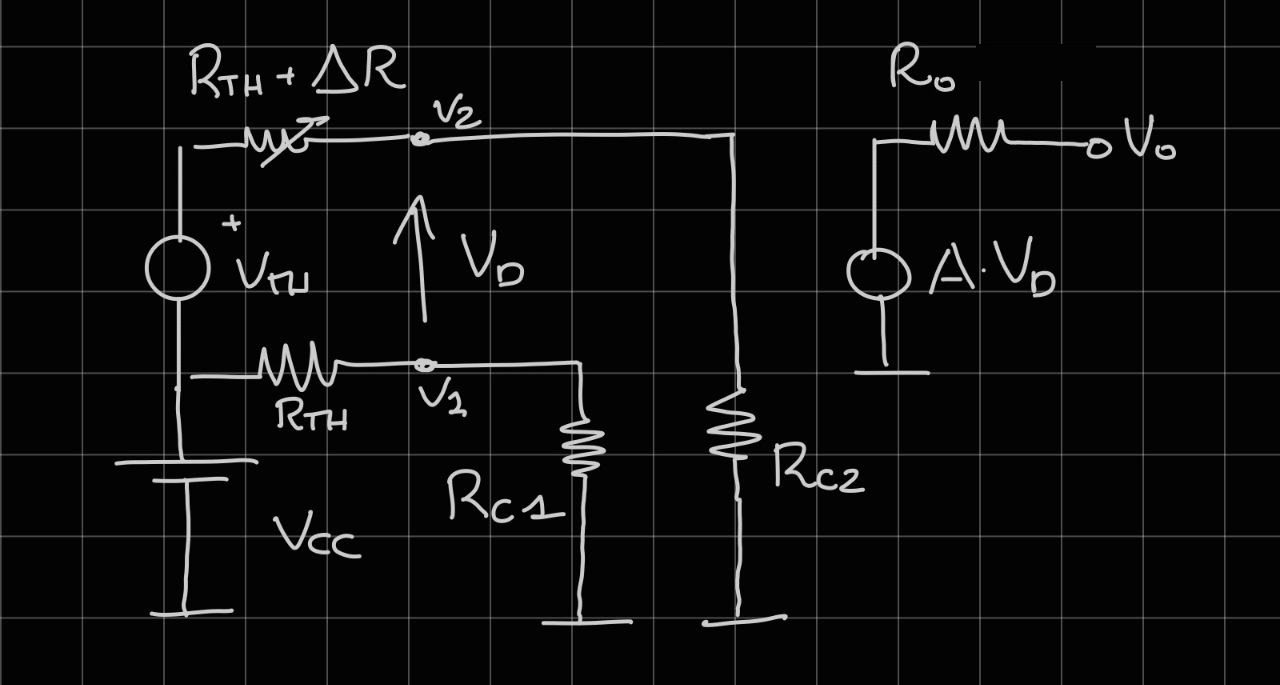
Now let’s consider the “common mode resistances” of an amplifier, so , for semplicity let’s say , and attached to it a resistive bridge, like we have seen before (Thevenim Equivalent):
- is the resisitve variation, due to the sensor.
- .
- .
- NOT_SURE_ABOUT_THIS
For this circuit given these resistance values, we have: .
Where: .- .
- To find we calculate:NOT_SURE_ABOUT_THIS (Why can we define it like this?)
Resulting in:Here’s the calculations.- If we consider this ciruit topology even if the Amplifier is ideal, the CMRR will not be equal to infinity.
The CMRR only due to circuit topology will be given by:Since:So the Complete CMRR (also considering the resistance tollerances) is given by:Similar to how we found the CMRR due to resistance tollerances
Memory Card
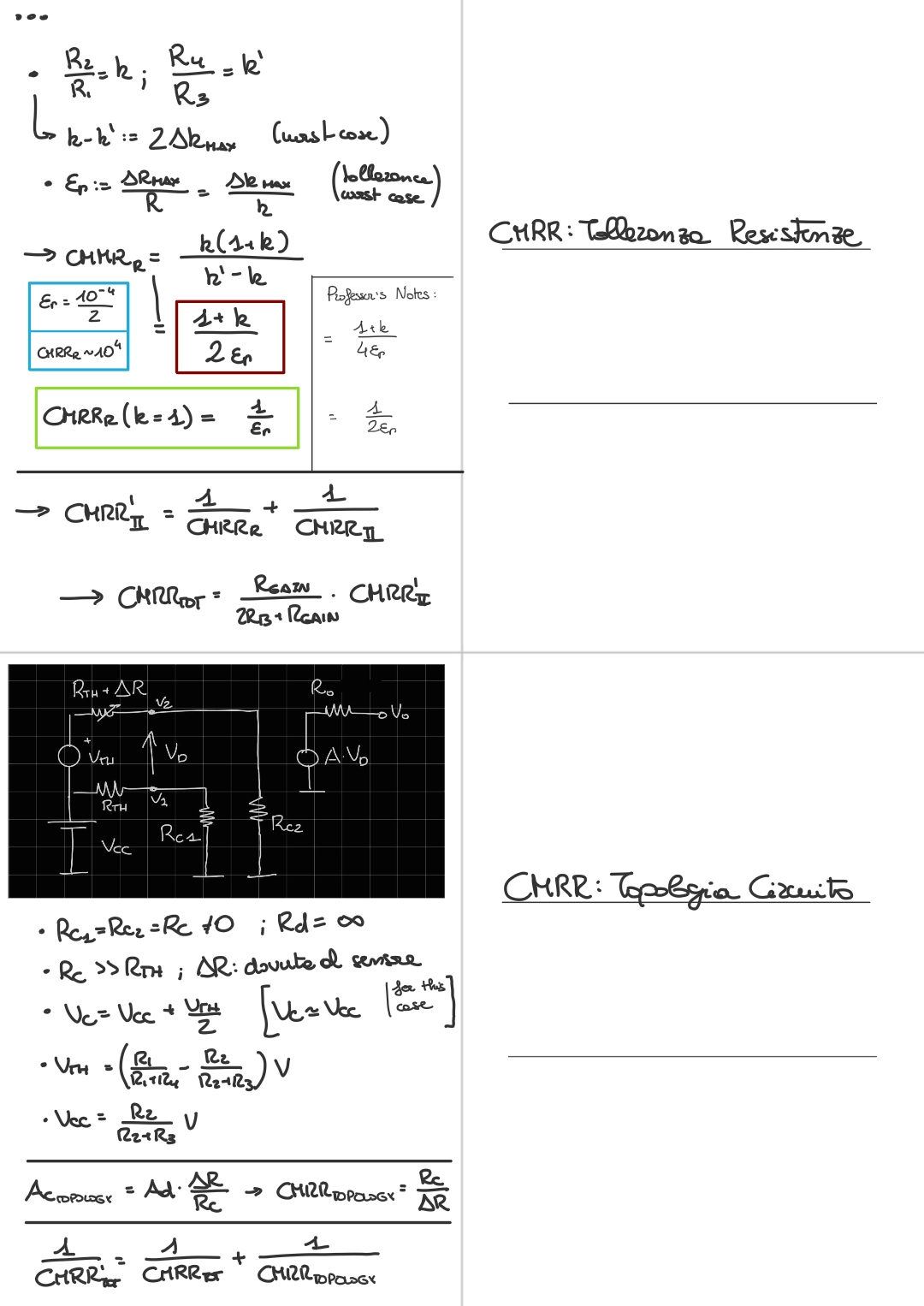
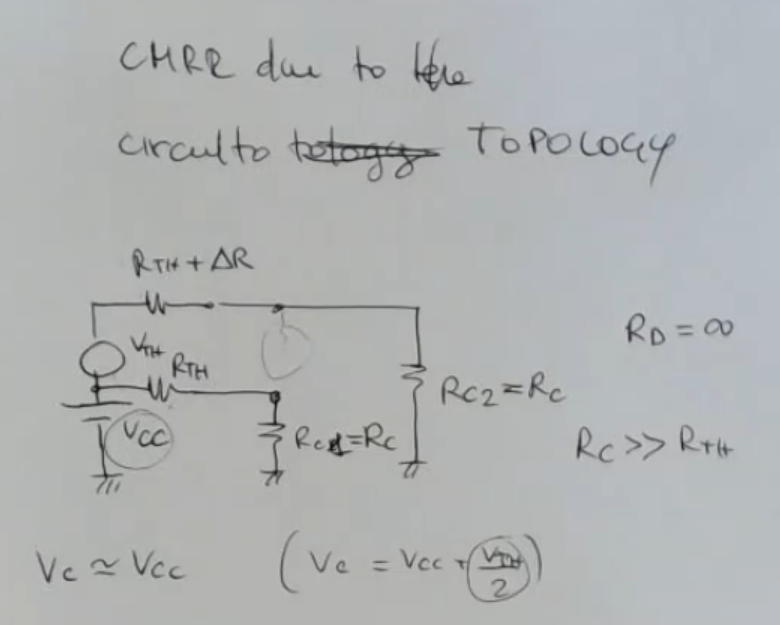
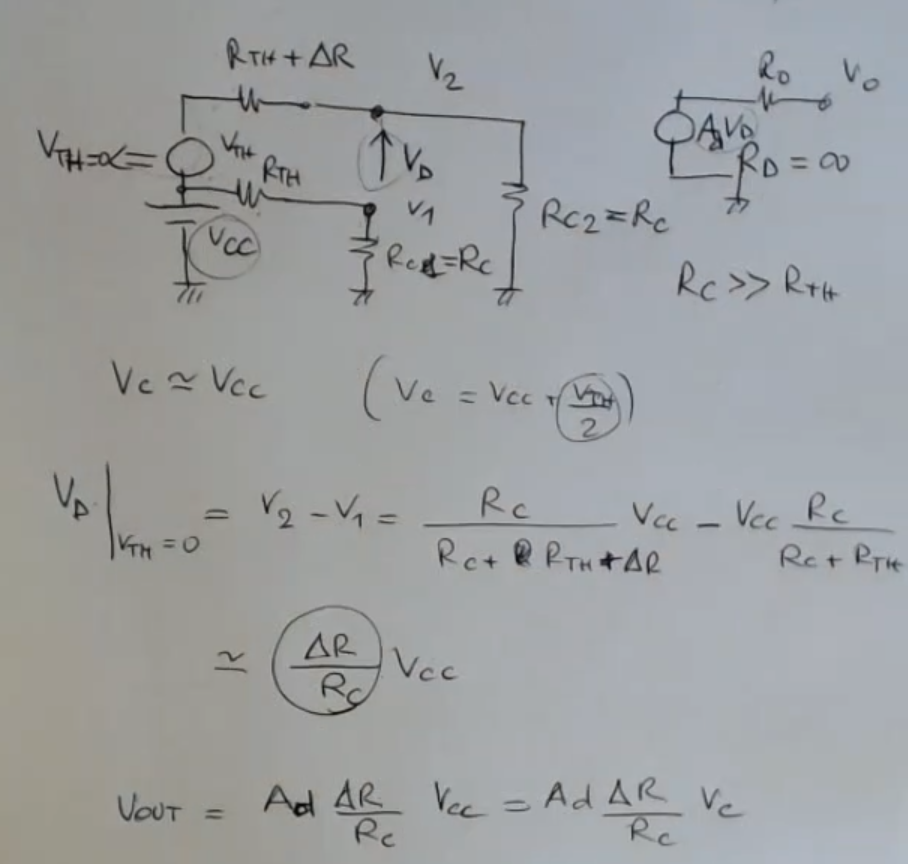
And the last thing that I want to take into account is the effect of the topology. So the CMRR do to the circuit topology. What do I mean? I suppose to have a perfect differential instrumentation amplifier. So it has a CMRR which is infinite. That could be the effect of the common mode voltage at the input of the circuit. Even in this case, do simply to the circuit topology. So we go back to our source-equivalent circuit:
- is essentially the main source of common mode voltage, so we can approximate the common mode voltage with .
Because actually would be (and we know that is small): - I take .
- You see that I didn’t put here the differential resistance, meaning that I consider to be infinite.
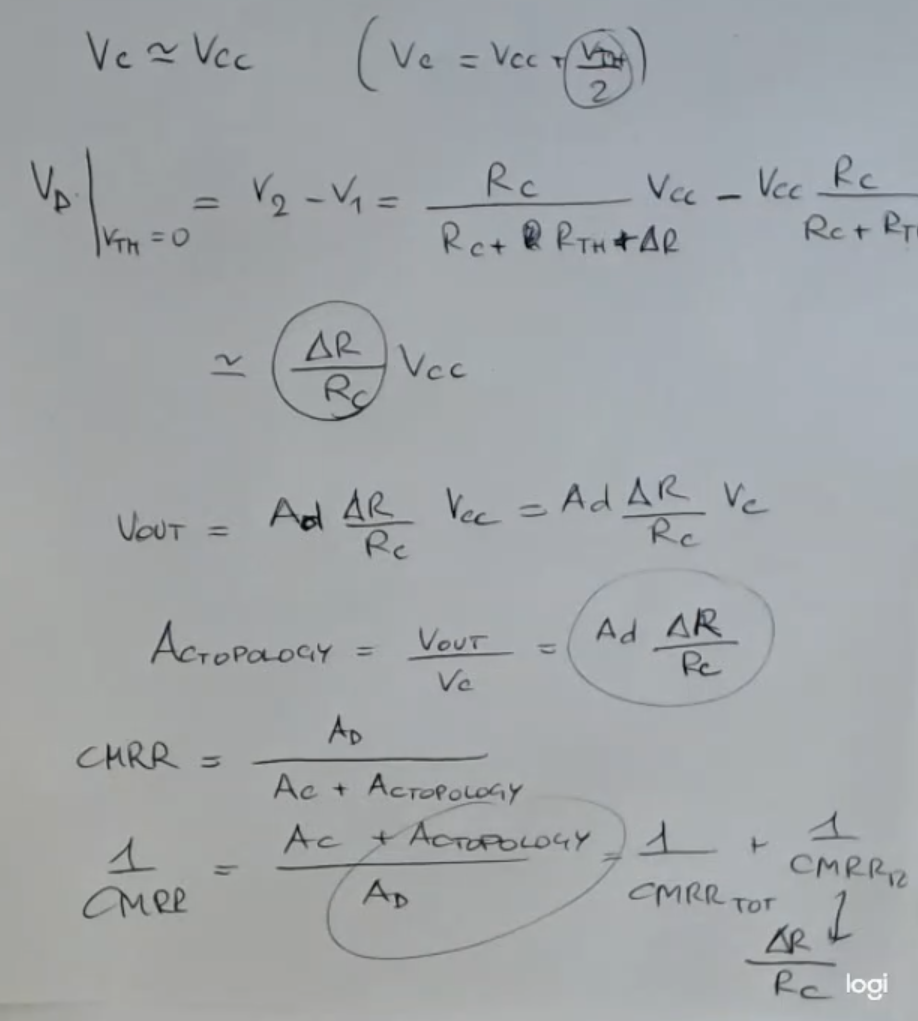 And at the end I can write the overall CMRR:
: of the overall structure.
: of the overall structure.
And at the end I can write the overall CMRR:
: of the overall structure.
: of the overall structure.