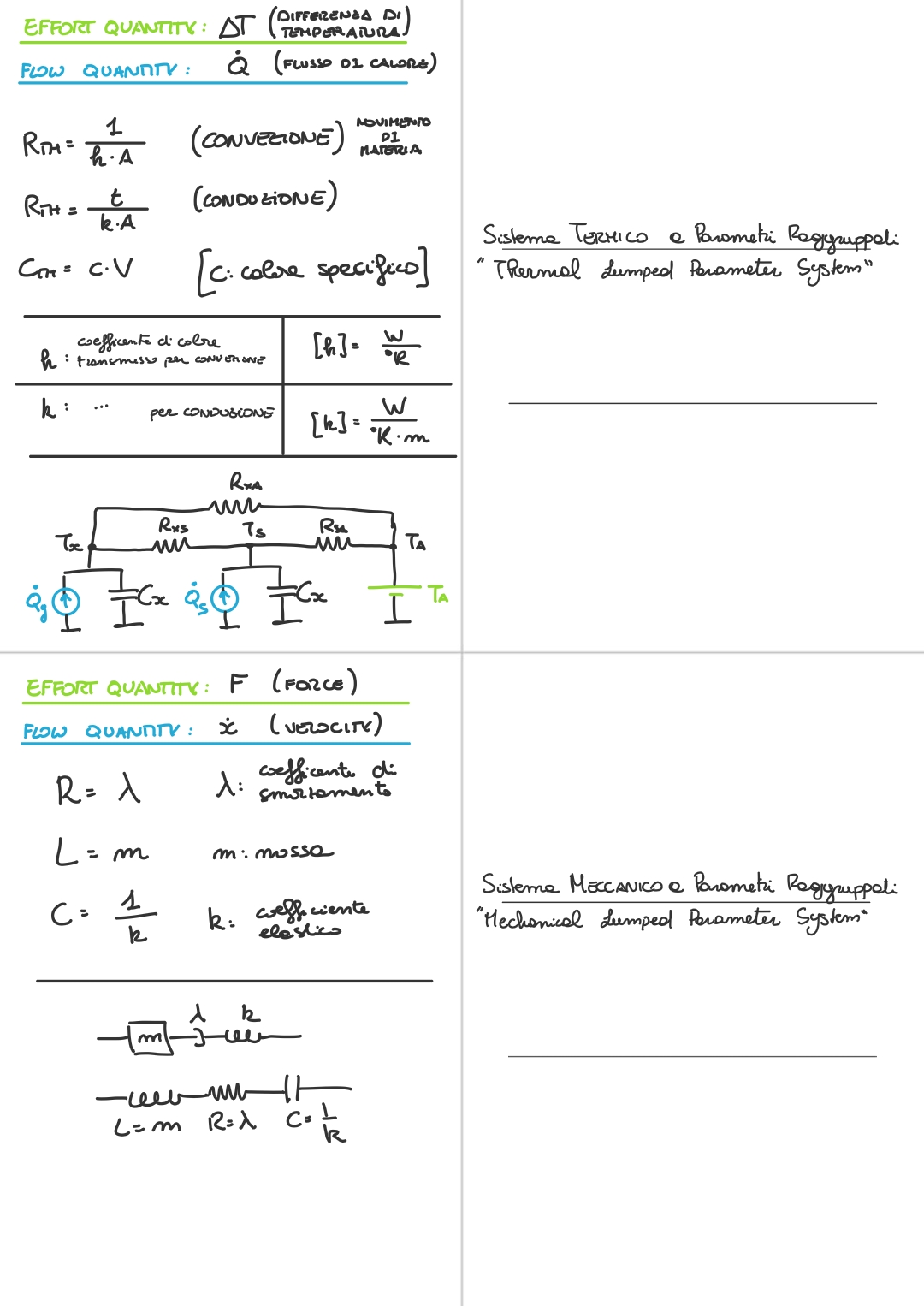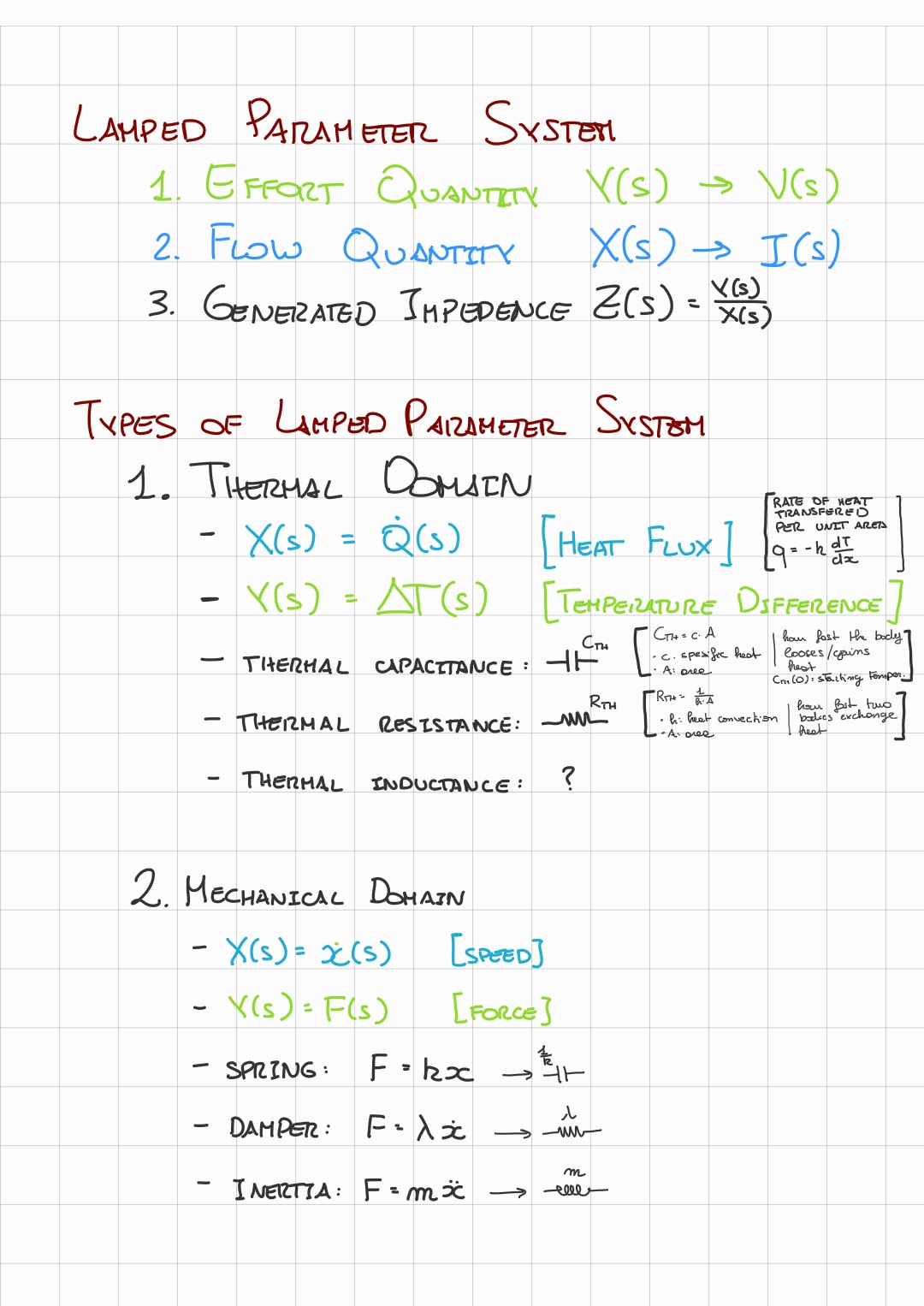
For Thermal Domain, the Lumped parameter System is given by these three factors:
- Heat convection (placed as a Thermal Resistance)
- Heat conduction (placed as a Thermal Resistance)
- Heat stored in a body (placed as a Thermal Capacitance)
- Both heat convection and heat conduction represent the thermal resistance between two bodies, which one of the two formulas we use to define the thermal reistance, depends on the way the two bodies exchange heat:
- Via “motion of matter” (such as air or water): we are talking about heat convection.
- Otherwise we are talking about heat conduction.
- Here is an example for thermal lumped parameter systems.
- To better understand what the heat flux or flow quantity means, we have seen in a lecture that it is refered to the power of the system.
- The effort quantity instead is intutitive since it is a temperature difference ().
For Mechanical Domain:
- The lumed parameter equivalent is simply a mass-spring-dumper system:
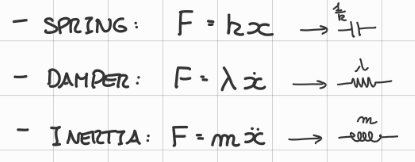
- A Spring is placed in the system as a Capacitance.
- A Damper as a Resistance.
- A Mass as an Inductance.
- Also we have seen this example.
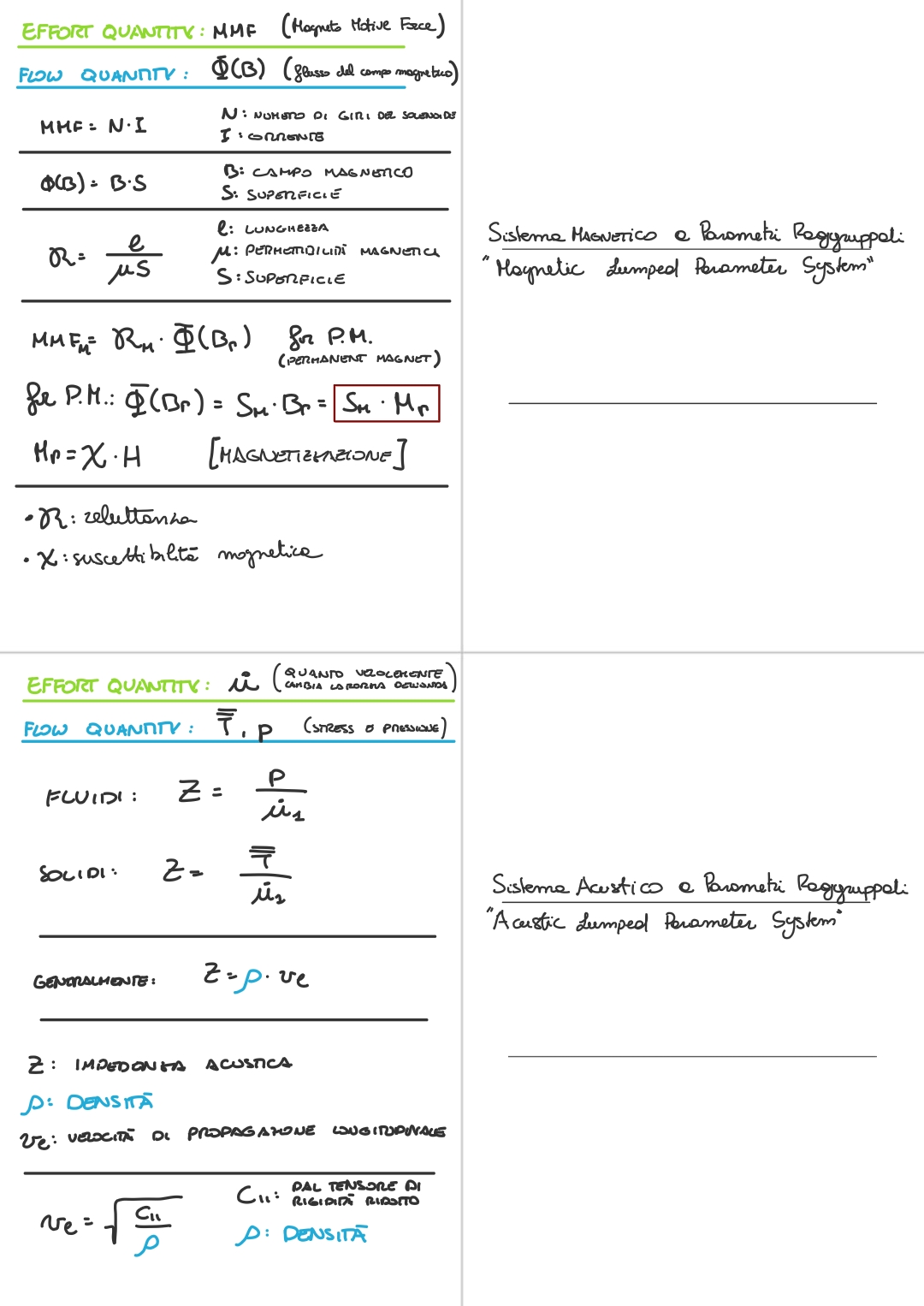
For the Magnetic Domain:
- We always consider the magnetic circuit formed by a core of ferromagnetic material, with a gap.
Optionally there could also be a permanent magnet built in the core: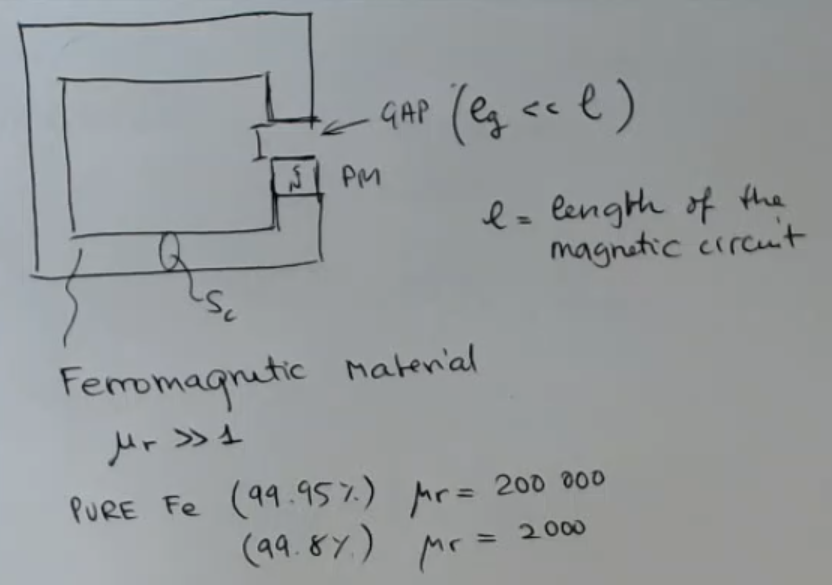
- For this domain we represent:
- Effort quantity: (Magneto Motive Force) (ampere turns, since it is found multipling the current per the number of turns of a inductance).
Usually we find a coil with turns, and powered by a current used to create the magnetic field in the core. - Flow quantity: (Flux of the Magnetic Field) (volt seconds).
- Effort quantity: (Magneto Motive Force) (ampere turns, since it is found multipling the current per the number of turns of a inductance).
- A permanent magnet (PM) is represented in the lumped parameter equivalent system as a series of an effor quantity and a generated impedance (voltage generator + resistance).
- Also for good measure we need to mention that we will also study an ultrasonic system, but its lumped parameter system is only a coarse approximation.