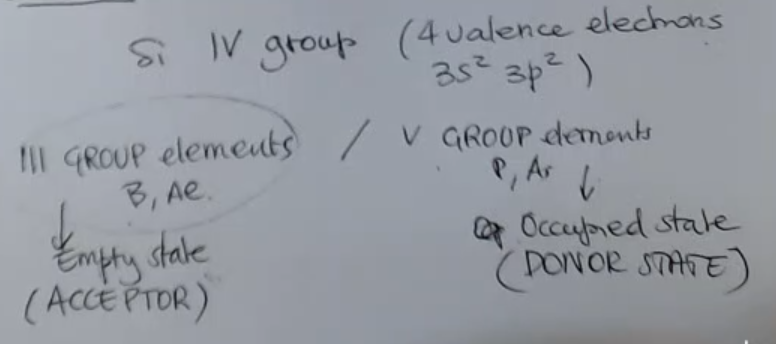
- In particular, since silicon is an atom of the fourth group, so it has 4 valence electrons.
- We can put inside silicon in place of some silicon atom either third group element or fifth group element.
So we can dope it with either third group element or fifth group element. - So in case of addition of empty state, it is used the term acceptor (or -type doping), so an acceptor state is an empty state ready to take an electron.
- Instead an occupied state is a donor state (or -type doping), so it’s a state which is ready to give an electron to donate an electron.
~Ex.: Doped Silicon at
Let’s see how doped Silicon behaves at different temperatures, at :
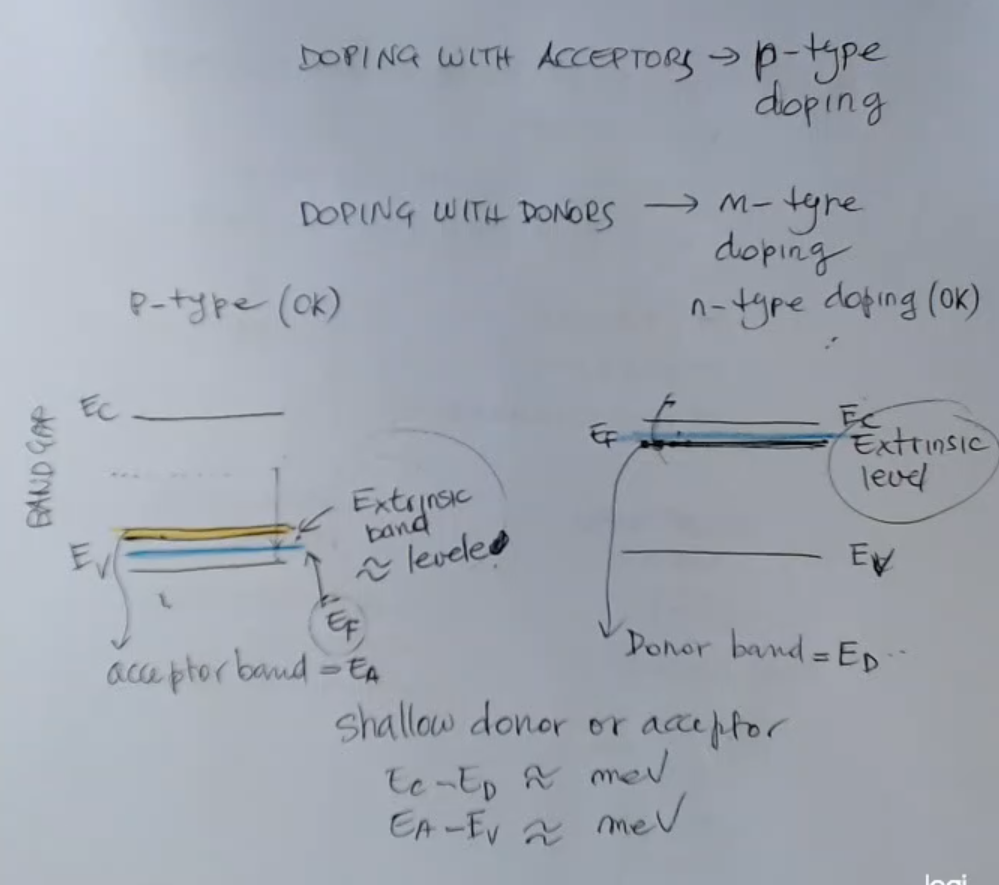
- The Fermi Energy changes a lot, with respect to intrinsic Silicon.
- We can model the doping (donor or accepetor) with an added energy level, or extrinsinc band, near the valence (for p-type) or conductance band (for n-type).
The difference between the new energy level added with doping and the “closest” band is in the order of , very small. - n-type doped Silicon will have an increase to the value of its Fermi Enerrgy (since it has more electrons).
- p-type doped Silicon will have a decrese to the value of its Fermi Enerrgy (since it has more holes).
~Ex.: Doped Silicon at
What happens at ?
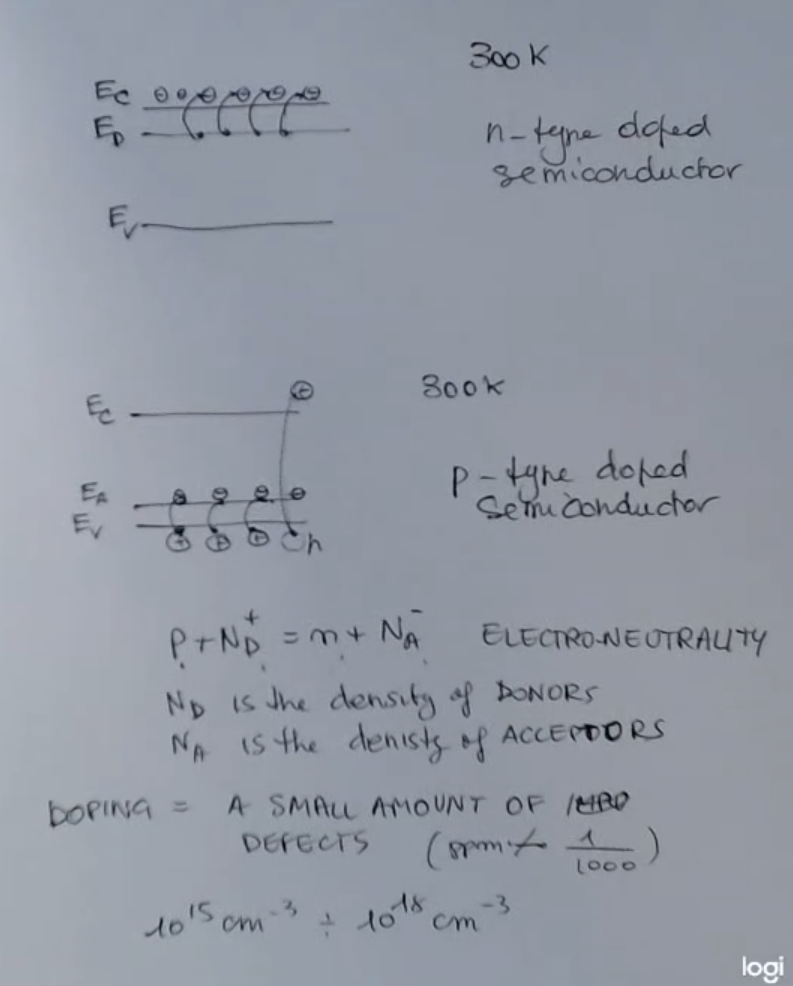
- Since this is a very small energy jump, the electrons have enough energy from/to the extrinsic band (depending on the doping type).
- Doping means add a small number of defect, to alter (not compleately change) the lattice of a regular material, ==we usually add “density of dopants” to dope a material==.
- So the creation of free charge is due to two factors:
- The intrinsic jump that could happen, the same as in intrinsic Silicon.
There are a not much, but because you need a larger jump and so a larger energy.
So it’s less probable. - And then we have the ionization of the impurities, of the dopants.
In case of acceptor, this ionization creates a negative ion, instead in case of donors, the ionization creates a positive ion because the donors lose their electron.
- The intrinsic jump that could happen, the same as in intrinsic Silicon.
- So given these two factors we define a rule known as Electro-Neutrality:Where:
- : density of “free holes”.
- : density of “free electrons”.
- : density of “ionazied” donors.
- : density of “ionazied” acceptors.
- NOTE: The ionazied term means the dopants that contribuite to conduction, so the “active” dopants.
~Ex.: in case of donors the electron that from the “donors extrinsix band” () have gone to the condution band.
~Ex.: And n case of acceptors the holes that from the “acceptor extrinsix band” () have gone to the valance band.