Remeber:
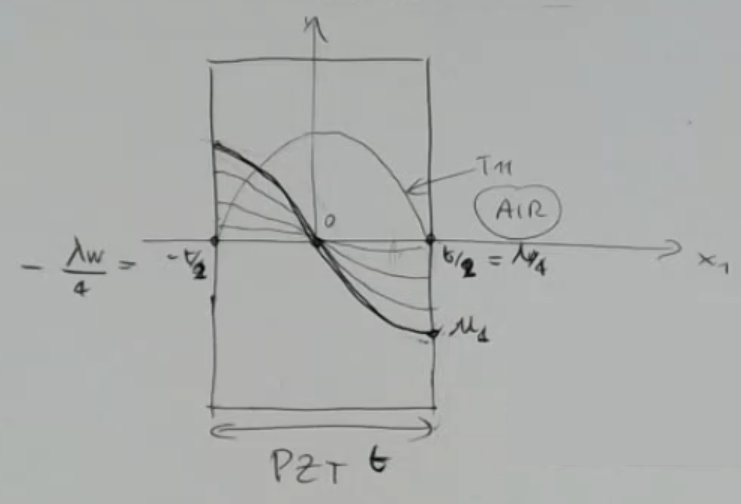
The reason ultrasonic transducer vibrates is beacuse a standing wave resonates inside of the piezoelectric cristal. ~ For example let’s take a slice of PZT, in contact with air (which as a high acustic impedance). We can imagine a standing wave like so:
- A standing wave is a resonance.
- We can represent it with a formula, and we have that the forward part of the wave () and backward part () assume:Where:
- is the wavelength.
- is the time, in the picture there is also another there it means thickness.
- is the direction of propagation of the wave: we have limited it between , here means thickness.
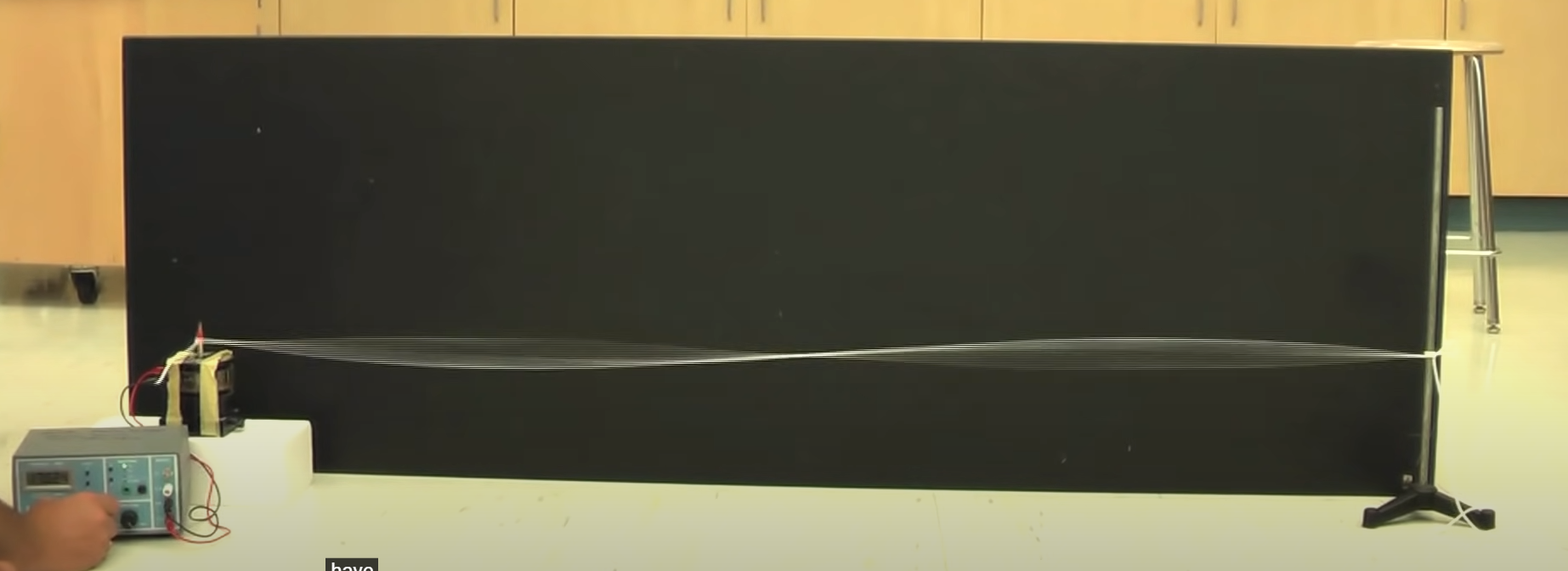
~Ex: Here a real world example of a standing wave:
You can see how it is described by the formula:
And what happens actually is that we have in the PZT a standing wave is created, and the frequency of the standing wave is corresponding to the resonance that we have found in our simple analysis:
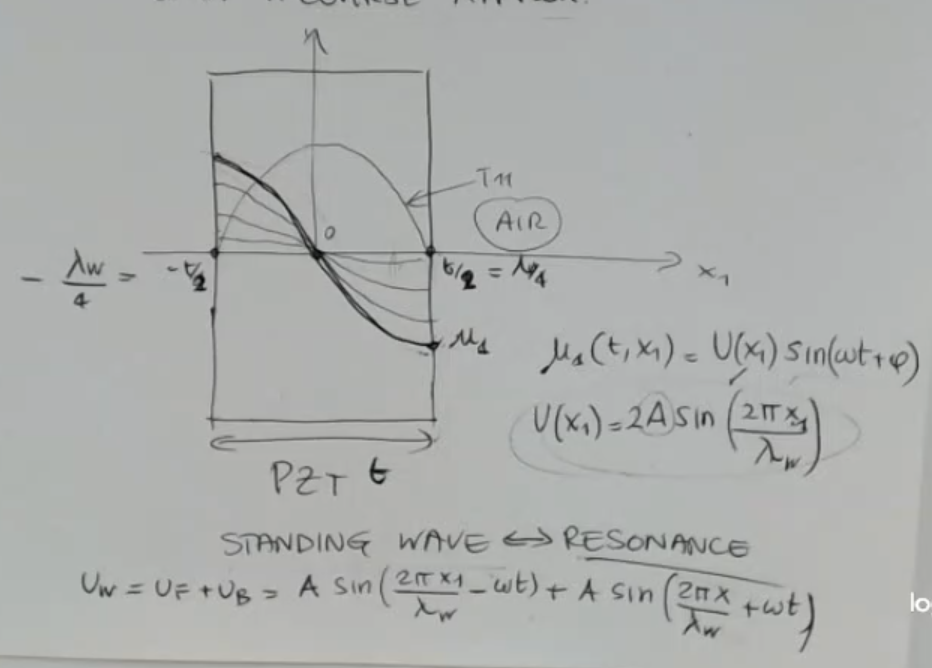
- The vibration of the surface is given by this standing wave.
- The standing wave comes from waves which propagate in the piezoelectric material, and it is the reusult of their superimposition.
- If you consider to have air as the surrounding material, the stress transmitted to the air is approximately .
- I have also written the formula for a standing wave in case of a planar sine wave.
- What I see from outside is that this surface vibrating in time.
- So our coarse approximation can be used in order to understand what happens but taking to account that we have actually this small complex situation inside we don’t have a slice which simply moves something which is related to a field inside it.
- What is a Standing Wave?
- A standing wave is a type of wave pattern that occurs when two waves of the same frequency and amplitude traveling in opposite directions superpose (combine) in such a way that they interfere with each other, creating a stationary or “standing” pattern.
- Example of Standing Wave:
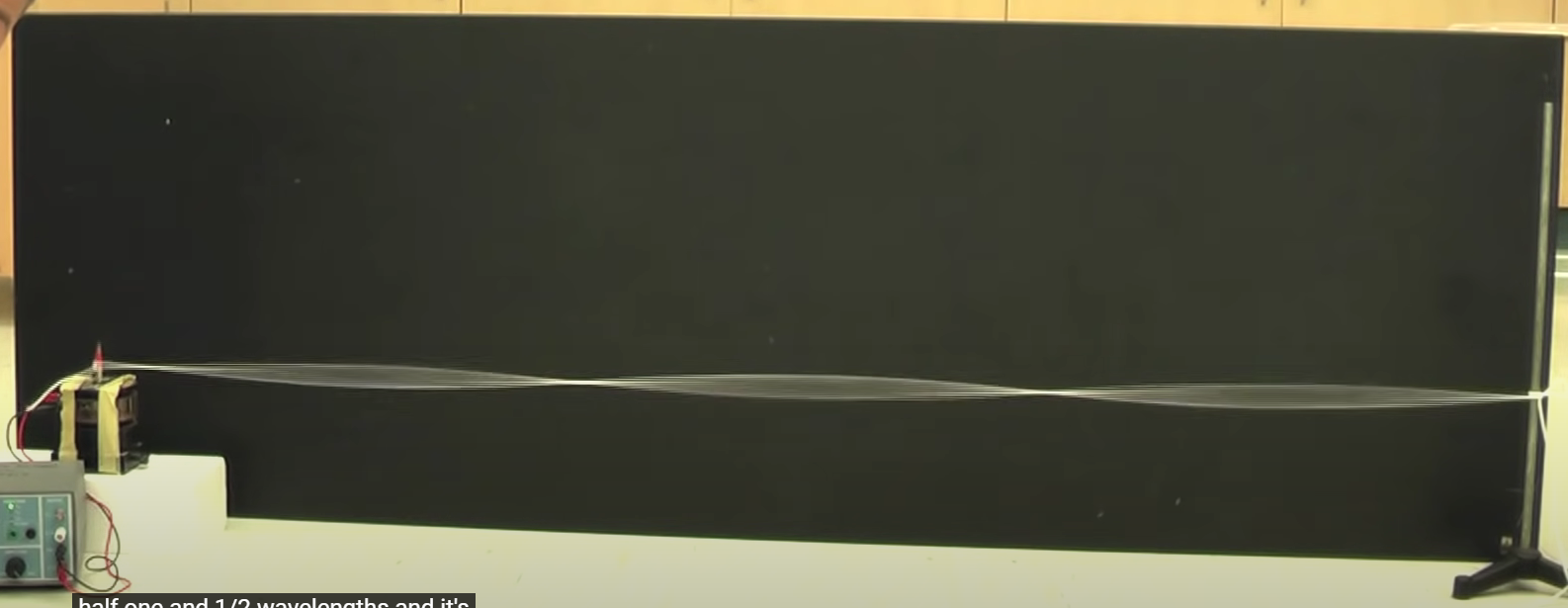
- Here is a simple demonstration of a standing wave formed at different specific frequencies, here we have the 2nd 3rd and 4th armonics:
- Source: Youtube
- Here is a simple demonstration of a standing wave formed at different specific frequencies, here we have the 2nd 3rd and 4th armonics: