So instead of using a piezoelectric material, we can construct a capacitance with a fixed and a vibrating membrane, and making it vibrate via a simple AC exitation:
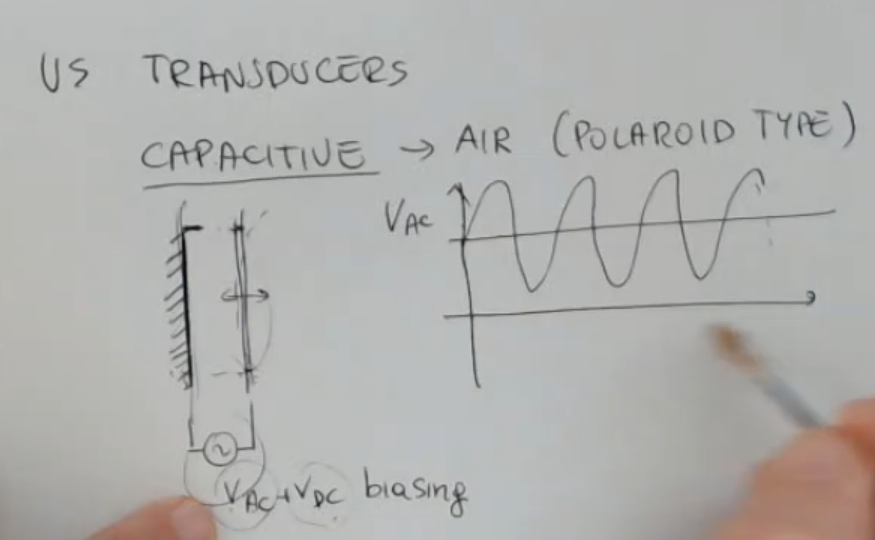
- So capacitive sensors were especially used in air and they were of the “polaroid type”.
- We also need a DC exatation value which was called “the biasing”.
- You need to excite at the right frequency which is in accordance to the resonance of the structure.
- And you should provide many periods in order to get enough signals, so the excitation was a burst of many large 50 Volts-signals.
Now a special type of capacitive sensor which are called “CMUT” which is same structure as I show you but in MEMS technology. It allows to use an capacitive US transducer for many different applications, because they succeeded in making a very small structure, and are used for obtaining arrays. So you have many of these capacitive US transducer in a chip, in a single chip, which form an array. We will see how and why the array can be considered very useful.
We have considered everything ideal up till now, that means that the medium is a perfect elastic medium without any losses.
Obviously you always have some losses due to friction due to viscose behavior and therefore you have to take into account that we have also an attenuation in propagation, we can measure the attenuation like so:
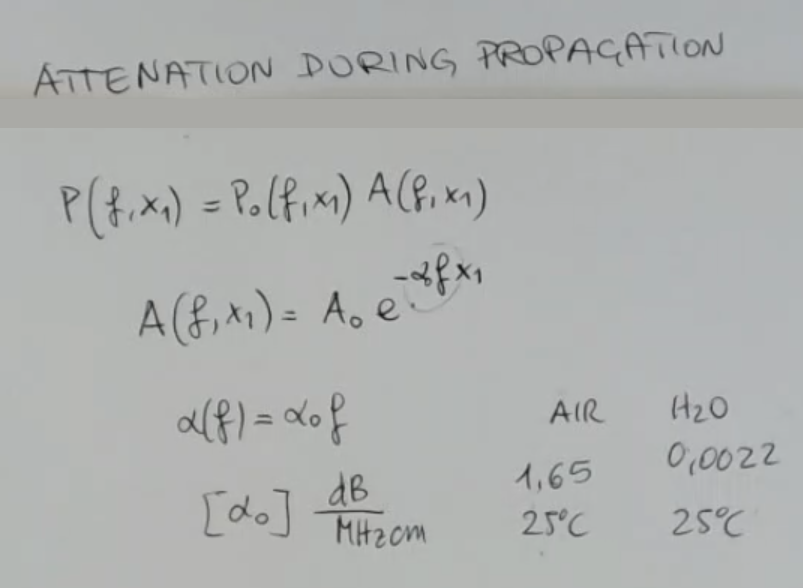
- So you need a function which describes the attenuation:This function here is an exponential function of the frequency and of the direction of propagation of the wave
- The “attenuation coefficient” changes a lot in different materials, in solid it is the smallestIMPORTANTE
==A smaller means less attenuation==.
IMPORTANTE So the higher is the frequency the smaller is the wavelength ⇒ the less we have strange phenomena (like scattering), instead we tend to have simple reflections. This is because if the wavelength becomes small it is like having a small scale of observation of the medium. But ==the higher is the frequency the shorter is the penetration depth of the wave==.