Remeber:
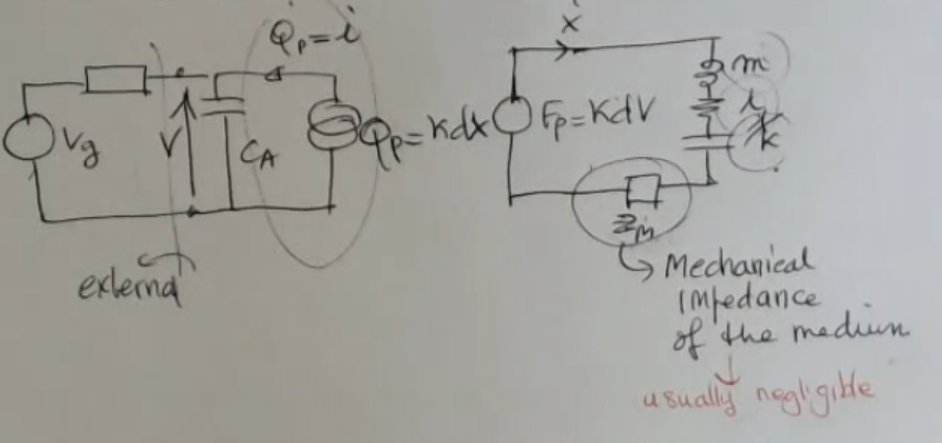
We can represent a quartz oscillator in a lumped parameter system like this:
- is a novelty and is the mechanical impedance of the medium.
This is somenthing added to the piezoelectric slice, when we talked about the ultrasonic transducer we said that it used an “added damper”, in that case would represent this added dumper.
It is usually negligible.- is the force created by exciting the quartz, and depending on the usage of the quartz (actuator or sensor), we need to account for it, or we can ingore it:
- If we excite it via a voltage, so the quartz is used as an acutator, is not negligible.
- Otherwise this force is really low, if we use the quartz as a sensor (measuring an external force ), we will measure the charge , that means that was charged via a voltage and the quartz has exerted a force , however this force will be really small, compared to .
- is the charge created (stored) in the crystal, via the direct piezoelectric effect.
- is exerted by the crystal via the inverse piezoelectric effect.
Suppose, for instance, that our piezoelectric medium is surrounded by air. Air is like vacuum approximately with respect to PZT, so its motion is not affected by anything else. This time we consider a special device which is the “quartz oscillator”. A device which is actually a slice of quartz, for instance, circular, with a very small thickness . We already know that thickness will be related to a wavelength by this:We’ll use this oscillator as a sensor, so we ingore the , and define , , in relation to , like so:
- So we have that:
- If we want to, we can consider the impedance, so in our new (simplified) lumped parameter system we add the impedance
- For a quartz oscillator we have a metal layer above the quartz disk and also a metal layer below it, forming a capacitance.
- The piezoelectric behavior of this structure depends on the surface orientation with respect to the crystallographic axis.
==We know every piezo material is an anisotropic crystal, because we know that piezoelectricity lies its roots in the anisotropic nature of the crystal==.
Therefore, depending of the placement of these two electrodes, the electrical field will have at direction with respect to the lattice.
And therefore, we will have a different piezoelectric coefficient which is involved in the description of the phenomena.
Memory Card
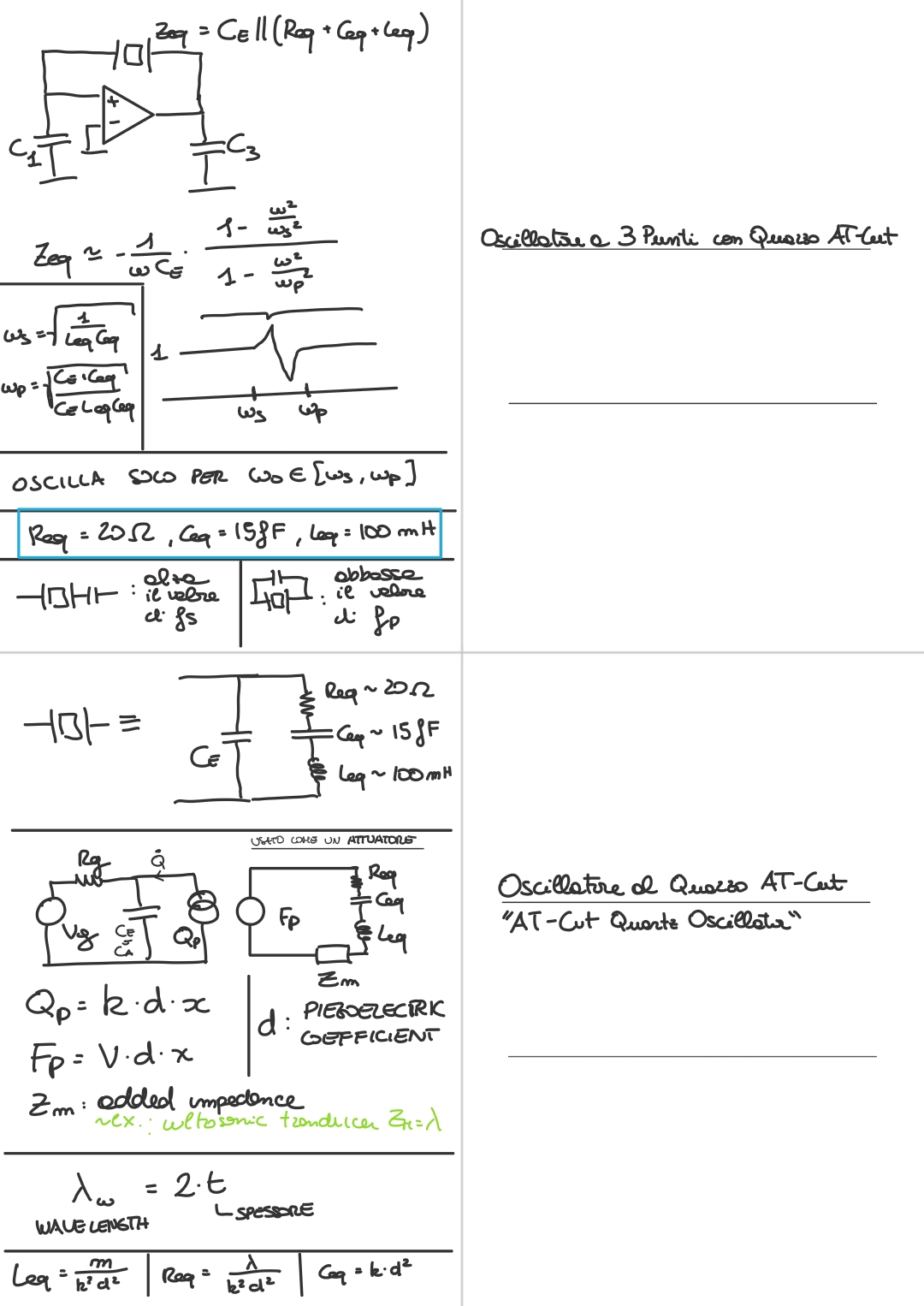
So now we go back to the last application for piezoelectric materials.
In this case, I will speak about quartz oscillator.
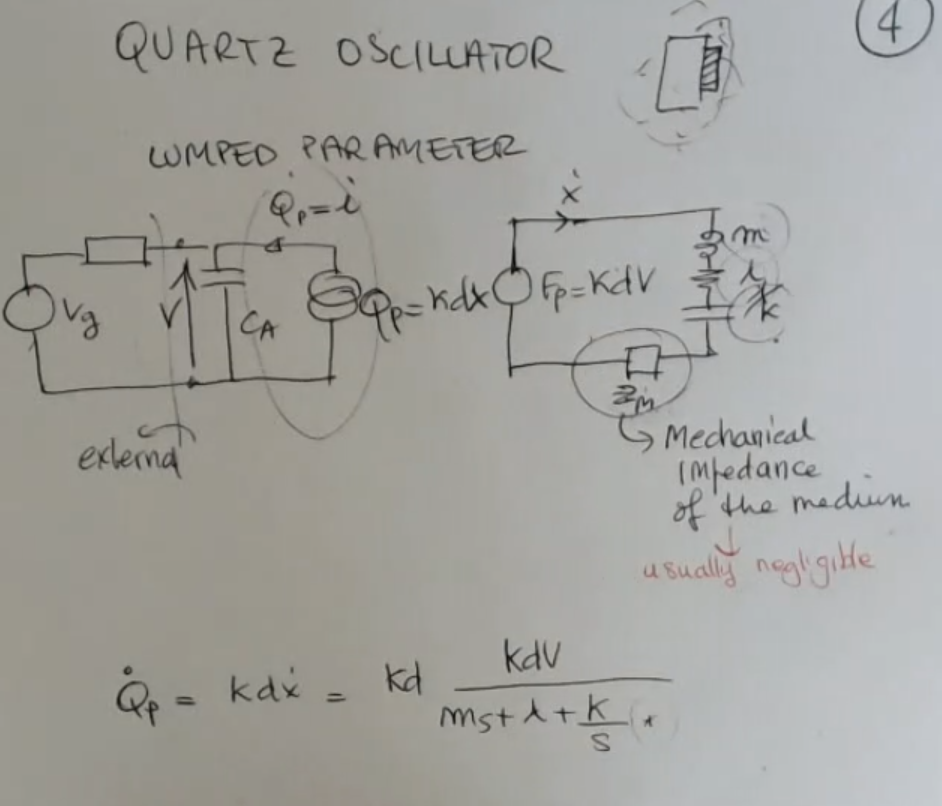
- is a novelty and is the mechanical impedance of the medium (usually negligible).
- The mass could be the mass of the quartz (really small) or as we have seen for the piezoelectric accelerometer and the charge accelerometer, it could be equal to the sismic mass.
- Similar for (elastic coefficient) and (dumping coefficient).
- is the force created by exciting the quartz, if we excite it via a voltage, this is not negligible, otherwise this force is really low and can be ingored.
In this case we are using it as an actuator, more specifically as an oscillator, so it should not be ingored however it is, why???NOT_SURE_ABOUT_THIS - is the charge created (stored) in the crystal, via the direct piezoelectric effect.
We ingore and define , , in relation to .
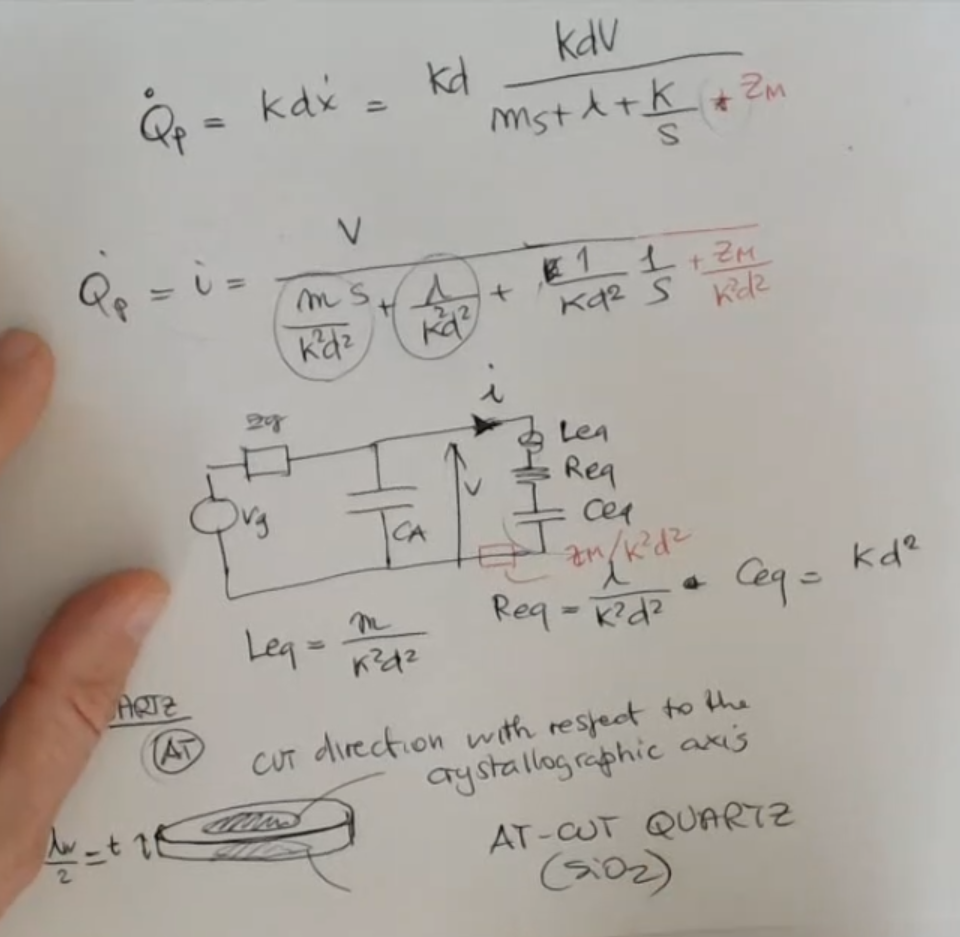
- So we suppose, for instance, that our piezo is surrounded by air, and air is like vacuum approximately with respect to PZT.
So its motion is not affected by anything else. - We can consider a special device which is a quartz oscillator.
- So this time we consider to have a device which is actually a slice of quartz, for instance, circular, with a very small thickness , we know already that thickness will be related to a wavelength by this:
- Then we have a metal layer above this quartz disk and also a metal layer below it, forming a capacitance.
- The piezoelectric behavior of this structure depends on the surface orientation with respect to the crystallographic axis.
We know every piezo material is an anisotropic crystal, because we know that piezoelectricity lies its roots in the anisotropic nature of the crystal.
Therefore, depending of the placement of these two electrodes, the electrical field will have at direction with respect to the lattice.
And therefore, we will have a different piezoelectric coefficient which is involved in the description of the phenomena.