Remeber:
- Cold junction: we keep one of junctions of a thermocouple at a controlled temperature, which we know the value of:
- This way we have that the voltage measured is equal to:And we perform some calculations, we will obtain:Where: depends on both and , and on and .
- ==Also since we know the temperature of , or we can fix it at , then we can calculate the absolute temperature ==.
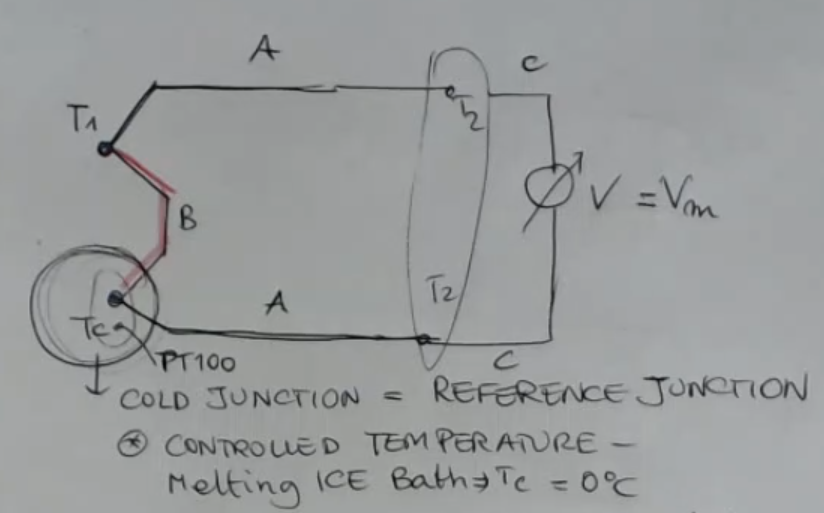
- We talk about Cold Junction Compensation, if we know at priori the temperature of the “cold junction”.
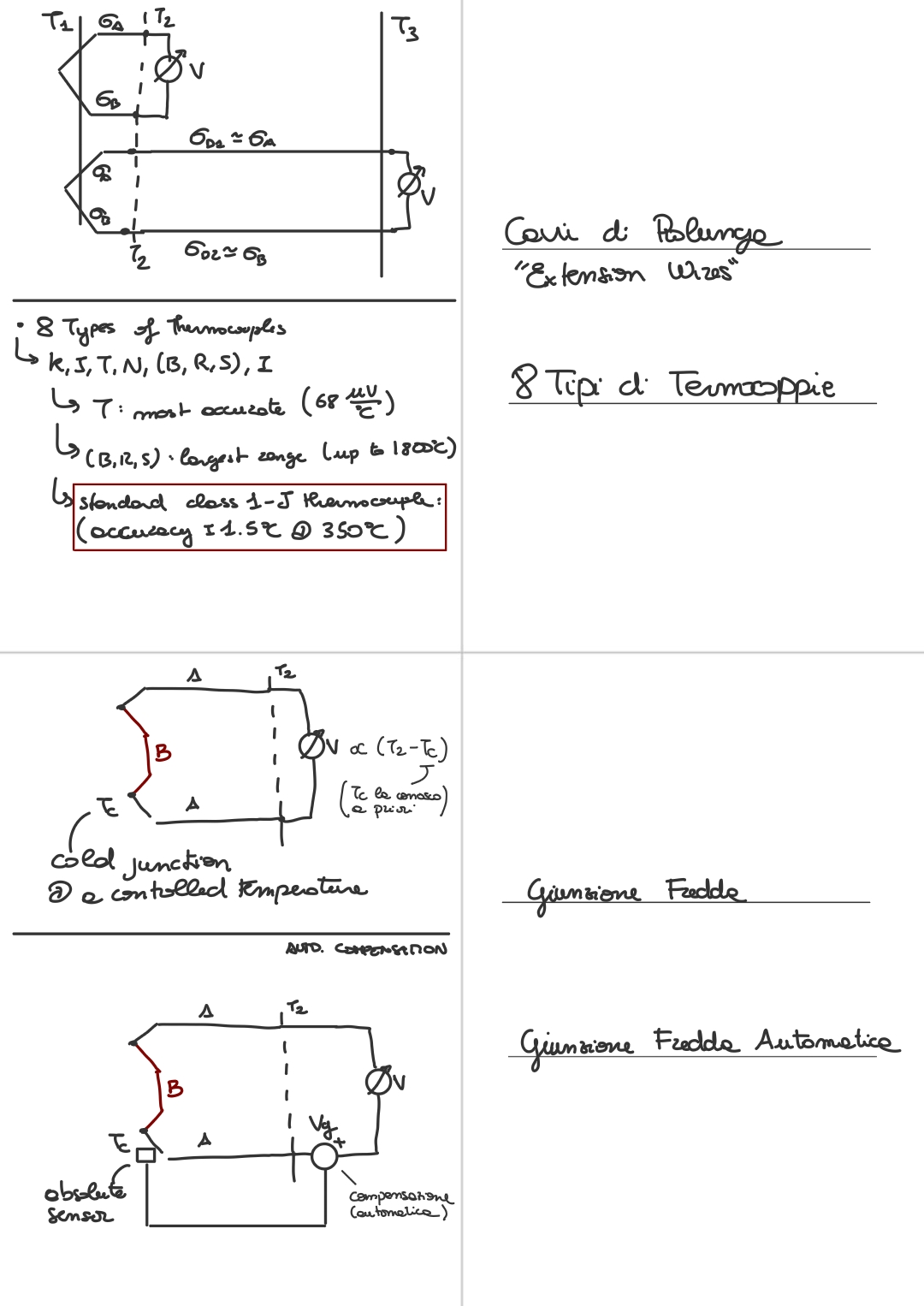
- Instead we talk about Automatic Cold Junction Compensation, if we measure the temperature of the “cold junction”, like in this example:
- We can measure the temperature with a PT100 absolute temperature sensor, for example.
- NOTE: Both the PT100 sensor, and a thermocouple with cold junction compensation, are absolute temperature sensors.
In many cases, thermocouples are preferred (instead of just a P100 sensor) for certain applications due to their wide temperature range and durability in harsh conditions.
Memory Card
Index
Cold Junction
We said that a thermocouple measures only the difference in temperature, so if we fix one of the two, with a cold junction, I can make a thermocouple into an absolute sensor:
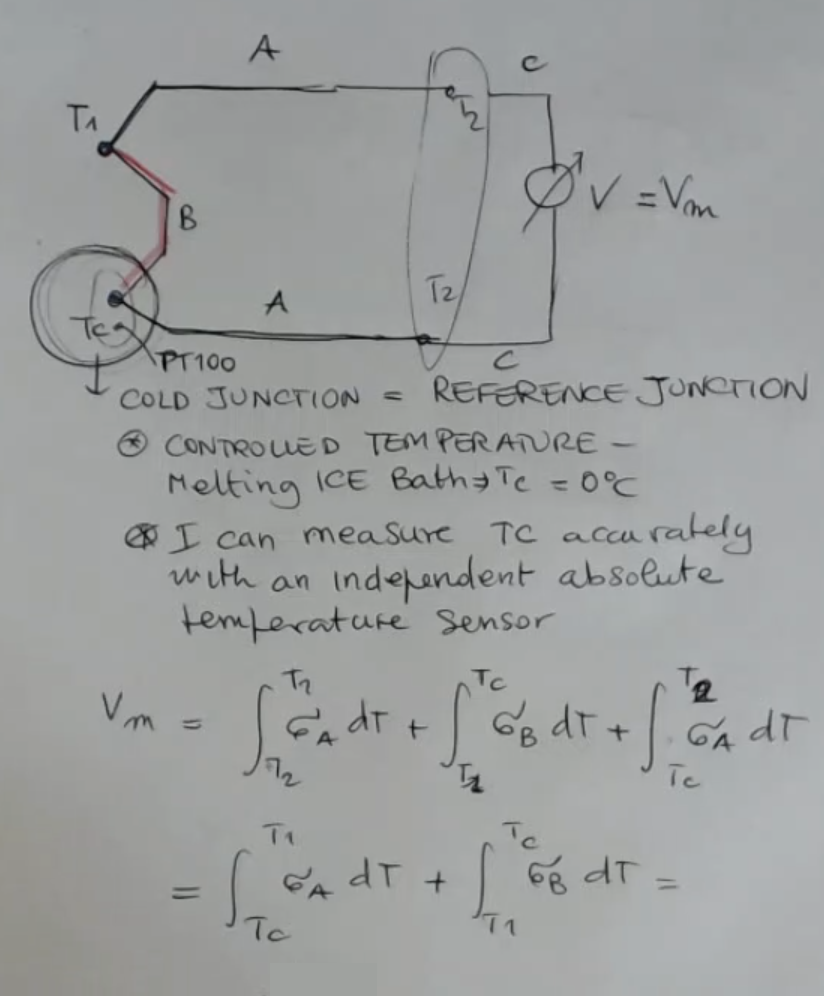
- So I can measure accurately, with an independent absolute temperature sensor.
- What is the PT100 Device?
- The PT100 device, also known as a PT100 sensor or PT100 resistance thermometer, is a type of temperature sensor widely used in industrial and scientific applications for precise temperature measurement.
It is based on the principle of electrical resistance variation with temperature. - The “PT” in PT100 stands for “Platinum Temperature,” indicating that the sensor is made of platinum, which is the primary material used in PT100 devices.
The "" represents the nominal resistance value of the sensor at degrees Celsius (32 degrees Fahrenheit).
- The PT100 device, also known as a PT100 sensor or PT100 resistance thermometer, is a type of temperature sensor widely used in industrial and scientific applications for precise temperature measurement.
Automatic Cold Junction Compensation
There is a more convenient way to solve this problem, and make the thermocouple into an absolute temperature sensor, which is all electric and automatic and this is called “reference junction”.
And we speak about methods which are called “automatic cold junction compensation”.
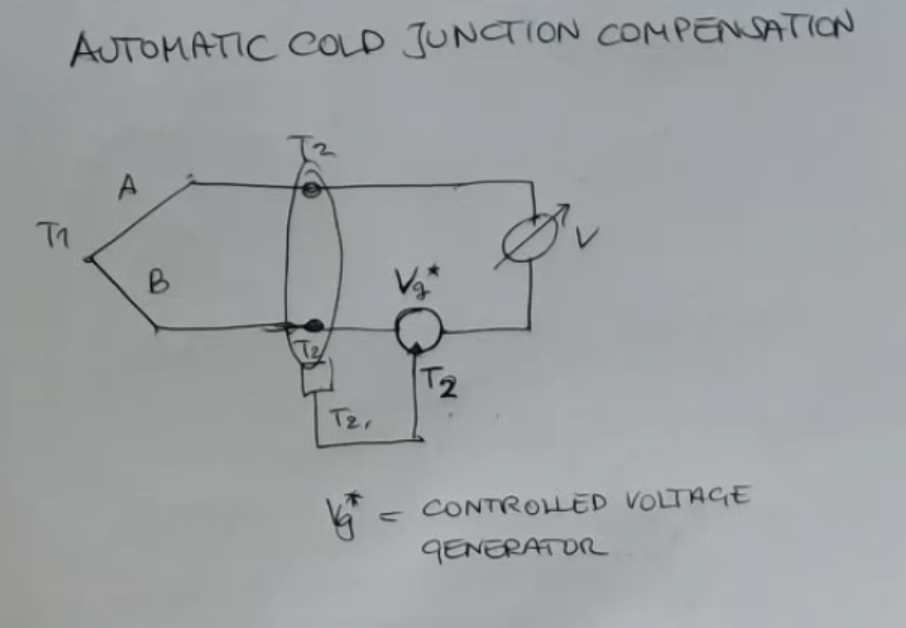
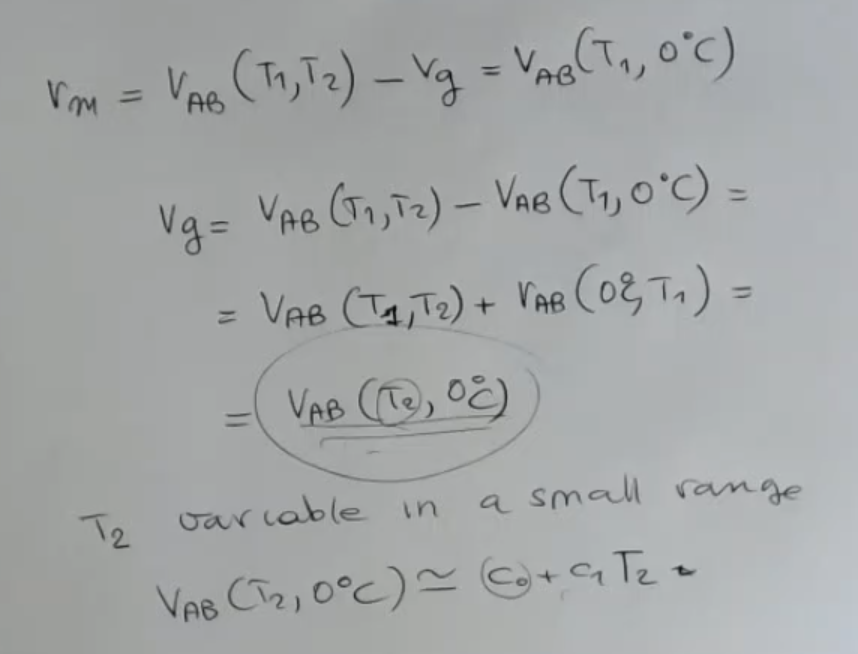
- Measure the temperature at the junction with a thermometer and add the value to the difference, so we obtain .
- is a controlled voltage generator depending on , so that will be equal to
- So it’s linearly related to the temperature , so usually I can simply build a voltage generator which transforms the temperature measurement into a voltage using the right sensitivity, the right coefficient, and then by putting it in series with my thermocouple I can obtain the compensation for the temperature of the cold junction.