Remeber:
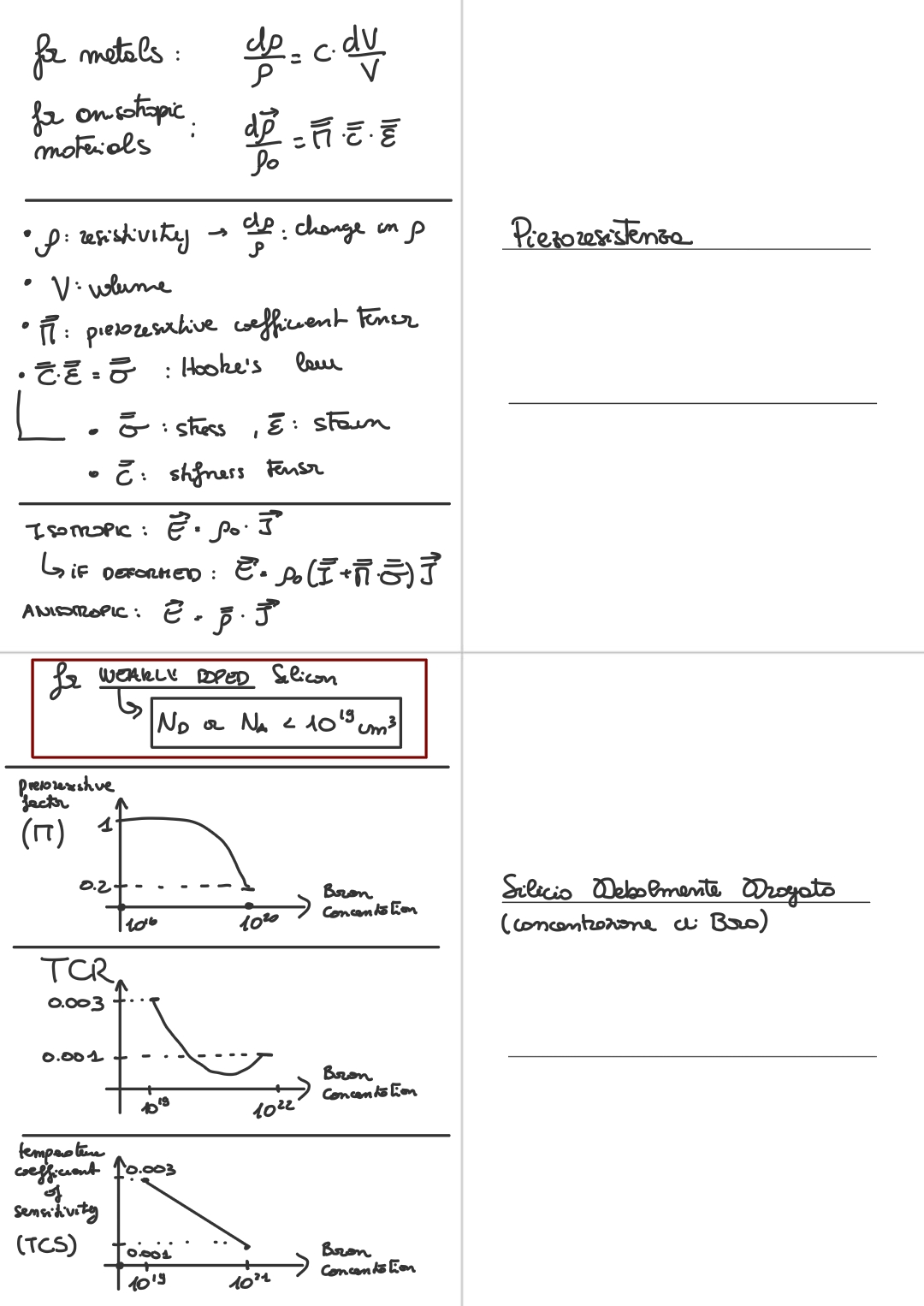
We find that for weekly doped silicon, meaning that the density of dopants is:The piezoresisitvity of the silicon starts to depend also on its doping concentration. Meaning that the piezoresisitivity of weakly doped silicon has a weak dependance on the doping concentration. While heavely doped silicon will have a strong dependance on the doping concentration.
We take for example the -type doped silicon, and as acceptor we choose Boron , and we can plot this graph:
- As the concentration of Boron increases the piezoresistance factor decreases.
- The piezoresistance factor of silicon can be influenced by the presence of dopants, including Boron.
The concentration of Boron atoms in the silicon lattice can affect the material's electrical properties, including its resistivity and piezoresistive behavior.
The doping level can also change the temperature coefficient of resistivity:
- We know that this is not something good for a strain gauge, actually it is not good in general.
- It should be independent in temperature, instead as you can see it has a large value.
- TCR (Temperature Coefficient of Resitance).
And here for temperature coefficient of sensitivity:
- It has a better behavior for larger concentration of boron.
Memory Card
Memory Card
We find that for weekly doped silicon, suppose of -type, where the density of donors is smaller than this density here: We have also a weak dependence on the doping level.
Whereas for heavily doped silicon, you have a large and strong dependence on doping:
We have also a weak dependence on the doping level.
Whereas for heavily doped silicon, you have a large and strong dependence on doping:
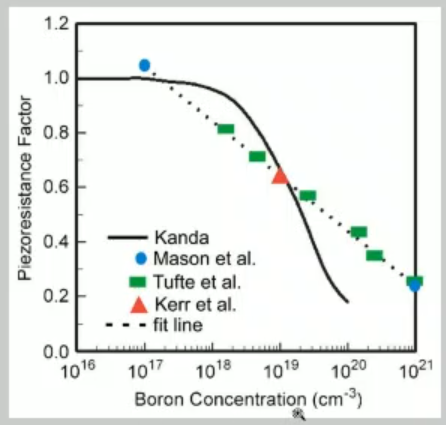
- ==As the concentration of Boron increases (an acceptor, p-type doped silicon, more holes) the piezoresistance factor decreases==
- The piezoresistance factor of silicon can be influenced by the presence of dopants, including Boron.
The concentration of Boron atoms in the silicon lattice can affect the material's electrical properties, including its resistivity and piezoresistive behavior.
Higher Boron concentrations can lead to increased scattering of charge carriers, which can impact the piezoresistive response.
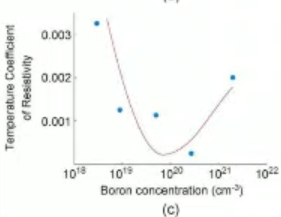 You can see that the doping level, which is concentration of dopants can change also the temperature coefficient of resistivity.
We know that this is not something good for a strain gauge.
It should be independent in temperature, instead as you can see it has a large value, actually.
You can see that the doping level, which is concentration of dopants can change also the temperature coefficient of resistivity.
We know that this is not something good for a strain gauge.
It should be independent in temperature, instead as you can see it has a large value, actually.
And here for temperature coefficient of sensitivity
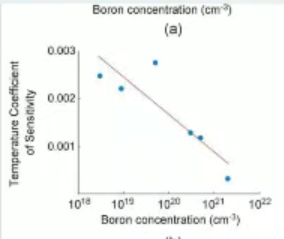 ⇒ So better behavior for larger concentration of boron.