Remeber:
A magnetic sensor with a different principle with respect to eddy currents, LVDT sensors and variable transformers.
For hall sensors ==we are not speaking about magnetic induction==. Here’s a basic structure of an hall sensor:
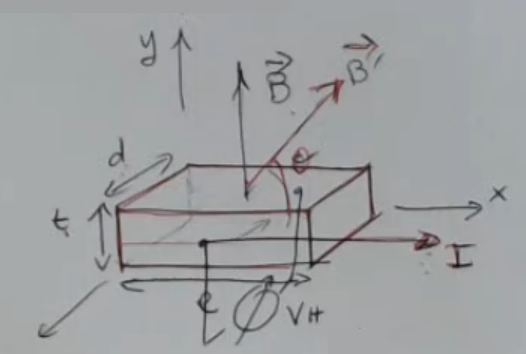
- We consider to have a slice of conductive material, the slice has thickness , width and length , immerged in a magnetic field .
could be easily genereated by current in a solenoid.- We let a current flow through this conductive material, and define the angle as the angle between and .
- The ==Lorentz force== will act on the charge carriers which are moving due to the electrical field.
So due to this current , then we will have, a force acting on the free charge which is given by:Where:
- : is the velocity, the speed of the free charge moving due to the current.
- This force acting in the direction (in general perpendicular to and ), and it will give an accumulation of electrons on one of these sides of the conductive slice.
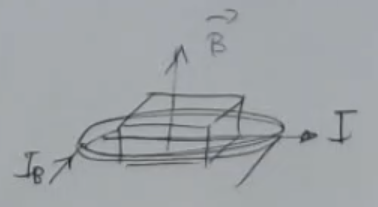
Let’s make a scheme of what we have said:
- The last thing to do is “measure the Lorentz force”:
If we measure the voltage difference between the two “perpendicular” ends of the conductive slice (“perpendicular” with respect to the current and field ), with a voltmeter, we will find a voltage which increases at the beginning, until it reaches an equilibrium voltage, a fixed voltage.- This “steady state voltage” is due to the equilibrium between:
- The force due to the action of the magnetic field.
- And the force which is instead due to the presence of the electrical field related to the accumulation of charge.
- So when:We can define , where is the steady state voltage.
- And we’ll end up with:
If we perform some calculation we will find that:IMPORTANTE Where:
- is the “Hall coefficient”.
And since it directly affects the sensitivity and is defined by the material used, we need to choose the right ones, we usually use germanium or copper.IMPORTANTE- is the thickness of the conductive slice.
And how can I use such a device?
(Read the notes)
Advantages of the Hall Sensor:
- “The package can be sealed”, so they don’t need to be in contact with the environment before measurement, and so they become insensitive to contaminants in the environment.
- They have large ranges for B and quite large bandwidths.
- They are also low cost devices.
Memory Card
Memory Card
Index
Hall Sensor
Now we go to the last sensor which can be placed in the magnetic field.
And the principle is different because we are not speaking about magnetic induction.
This is a magnetic sensor and it is the hall sensor:
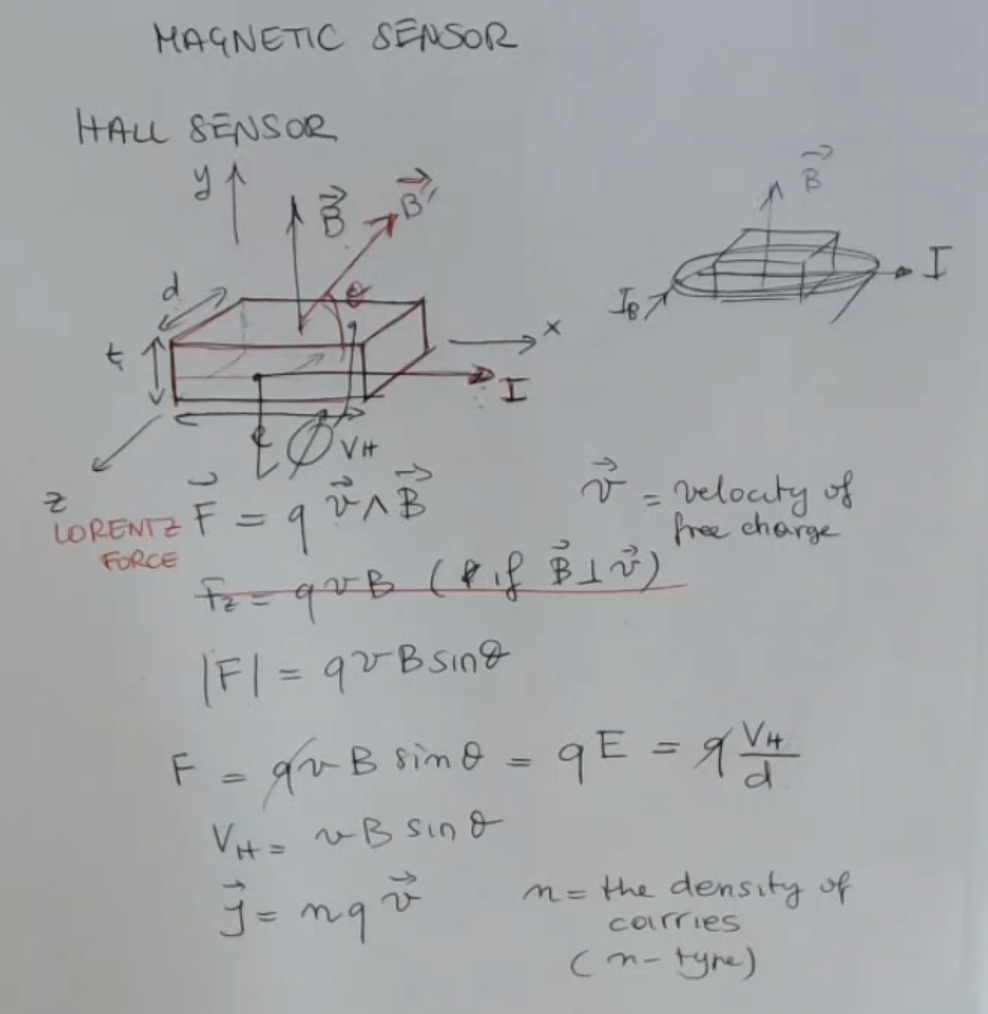
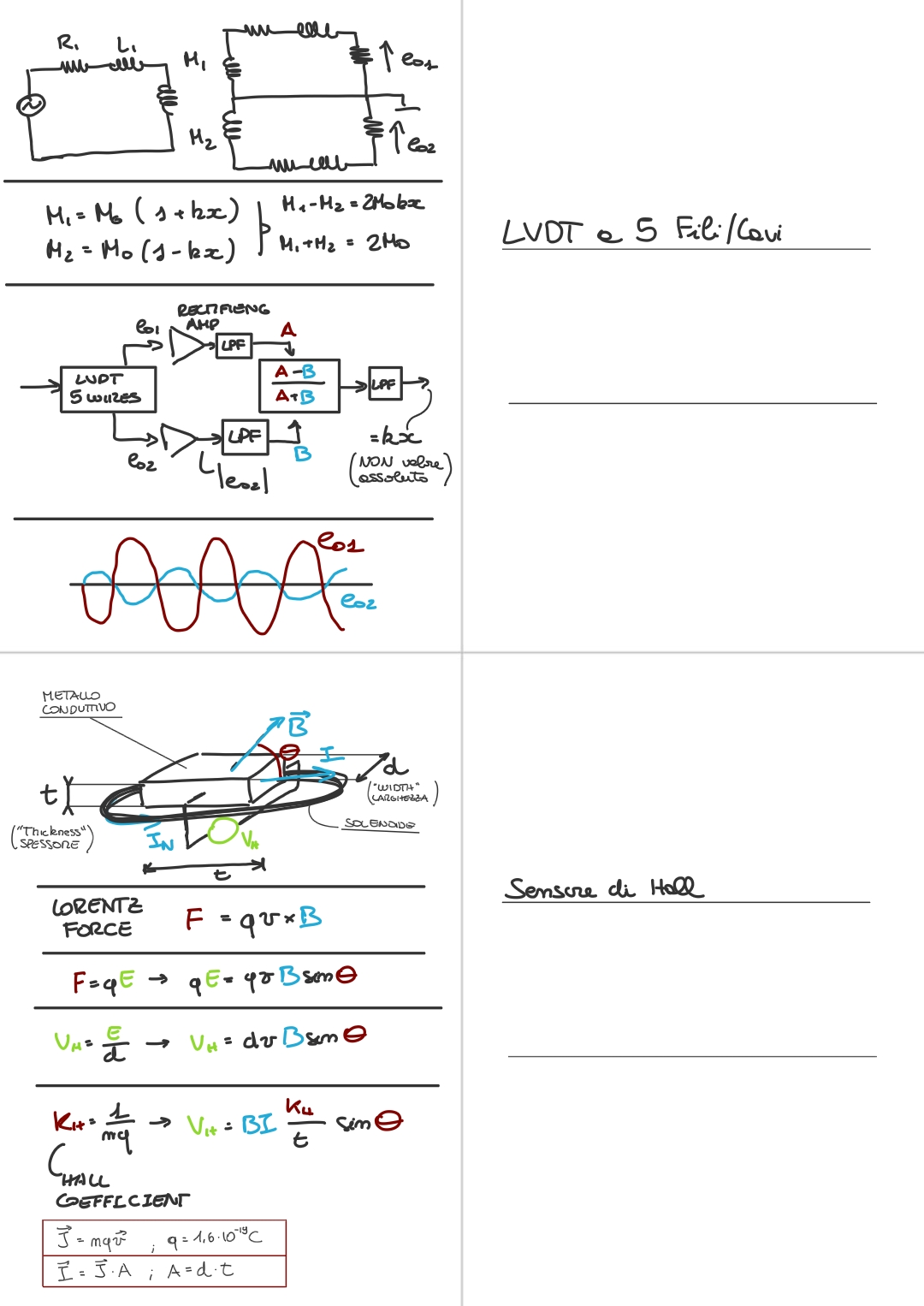
- So we consider to have a slice of conductive material, the slice has thickness , width and length .
- Then we consider to let a current flow through this conductive material, which in principle can be any conductive material.
- We also consider to have a magnetic field , in which the material is immerged.
- We define as the angle between and .
- The Lorentz force will act on the charge carriers which are moving due to the electrical field.
So due to this current , then we will have, a force acting on the free charge which is given by:Where:- : is the velocity, the speed of the free charge moving due to the current.
- This force acting in the direction (in general perpendicular to and ).
- And this force gives an accumulation of electrons on one of these sides of the conductive slice.
⇒ Therefore you have a non-uniform distribution of charge. - If we measure the voltage difference between this two ends of the conductive slice with a voltmeter, so along the surface perpendicular to the axis, then we will find a voltage which increases at the beginning, until it reaches an equilibrium voltage, a fixed voltage.
This “steady state voltage” is due to the equilibrium between:- The force due to the action of the magnetic field and the force which is instead due to the presence of the electrical field related to the accumulation of charge are equal, so when:
- We can define , where is the steady state voltage.
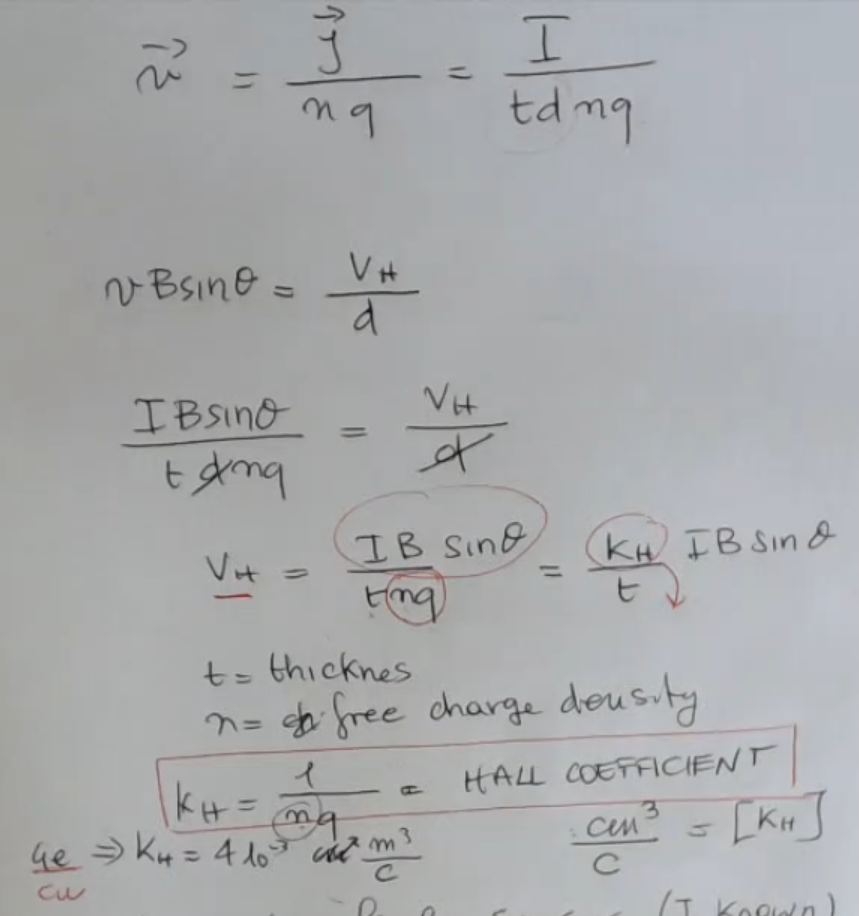
- So we end up with (in the note the is missing):
Continuing:
- Remember:
- in this case
- And the most important the hall coefficient:
- As you can see the larger is the density of the carrier (), the smaller is the sensitivity of the device, so we have to choose the right material.
Usually we use germanium or copper.
Use Cases of the Hall Sensor
- In this device I can force the current, so my sensor is this slice of semiconductor, a current generator which keeps this current constant, and then I measure the voltage.
So becomes a part of the sensor itself, and is known, I measure , and so I can either find or , or if I know , i can find . - in conjunction with a permanent magnet, it could be used to measure the displacement, so you have to think about a target where you place a permanent magnet, and then your hall sensor will measure the intensity of the PM’s magnetic field, proportional to the displacement.
⇒ When the target moves the magnetic field, in front of the sensor changes, and the sensor sends that position of the target. - This kind of device is likely used in industrial environment, more as a detector actually than as a sensor, that means that what is needed is to sense the presence or the absence of the target, not the very accurate distance measurement, and in fact many hall sensors are logical sensors.
Inside a single integrated circuit you have the hall sensor, the current generator, a front end which has a threshold (a comparator), therefore you sense if there is a magnetic field or not, that means the target is in the neighborhood or you don’t have any target. - It could be used for instance to sense the passing of materials in an industrial plant on a rolling device, so to count for instance things which are passing in front of the hall sensor.
Also they can be used as current detectors/sensors: in this case here instead of sensing the magnetic field or generating the magnetic field with a permanent magnet, this magnetic field is generated by a current:
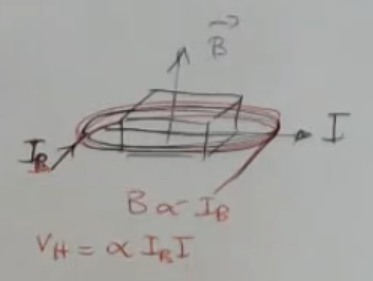
- If I place here a coil all around our slice of conductive material, if a current flows through the coil.
- A current flowing through a coil will generate a filed, which will be the field we use to immerge our hall sensor in.
- We will measure the voltage across the slice, and it will depend on both and .
- One of these two current can be fixed (usually ) and the other one can be measured.
Advantages of the Hall Sensor

- “The package can be sealed”, so they don’t need to be in contact with the environment before measurement, and so they become insensitive to contaminants in the environment.
- They have large ranges for B and quite large bandwidths.
- They are also low cost devices.