List of things to memorize:
SaM - Piezoelectricity
Link to original
- SaM - Piezoelectric Effect
- SaM - Piezoelectric Effect in Details • Direct and Inverse Piezoelectric Effect
- SaM - Complete Piezoelectric Device (Actuator + Sensor)
- SaM - Compact Piezoelectric Coefficient Matrix for PZT • Dependence of Piezoelectricity on Temperature • Curie Temperature
- SaM - Piezoelectric Accelerometer
- SaM - Ultrasonic Transducers (Piezoelectric Device)
- SaM - Quartz Oscillator
- SaM - AT-Cut Quartz
- SaM - Quartz in a 3 Point Oscillator
- SaM - Quartz as a Sensor • QCM (Quartz Crystal Microbalance)
SaM - Piezoelectric Effect
- Piezoelectric effect formula:
- Terminology:
- , , : displacement of the electric field, electric permittitivity matrix, electric field.
- , : stres and strain
- : piezoelectric coefficient matrix.
- : inverse piezoelectric coefficient matrix, or yieldness coefficient matrix.
SaM - Piezoelectric Effect in Details • Direct and Inverse Piezoelectric Effect
- Piezoelectric effect formula:Inverse piezoelectric effect : even if there is no stress applied to a piezoelectric material, but it is present an external electrical field ⇒ then we will see a deformation, or strain of the material itself.
- Different material with piezoelectric property:
- Quartz : small losses, almost a perfect dielectic, , .
- PZT (Lead Zirconate Titanate, polycrystal) : large piezo-coefficients
- PVDF (polymer) : low cost
- Acutally:NOT_SURE_ABOUT_THIS (this is my reasoning)
- The quartz has: and .
- The PZT has: and .
- Their complex electric permettivity ratio is almost the same but the PZT has higher value, meaning if we take into the direct and inverse piezoelectric effect formual, it will result in a higer response given the same electric field and the same stress value .
The same is true for the capacitance value and charge output , the PZT will have higher value for both.
==So for “raw performance” the PZT is better==. - However we have studied how we can vary some characteristics of the quartz, if we cut it in a different way.
Also we have seen how the AT-cut quartz has a linear relationship between its thickness and the wavelength : .
So the quartz give us "more flexibility".
SaM - Complete Piezoelectric Device (Actuator + Sensor)
-
Actuator structure:
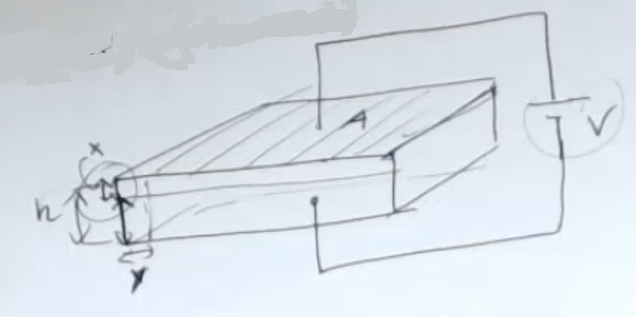
- A slice of piezo-material in between of two slices of conductive material, like a capacitance.
-
Direct piezoelectric effect formula with no external mechanical forces:
-
Sensor structure:
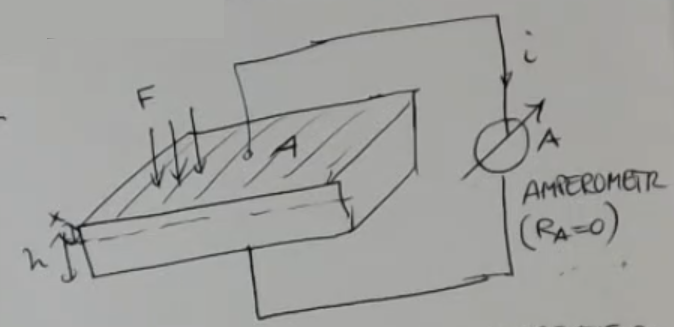
- Acts again as a capacitance.
-
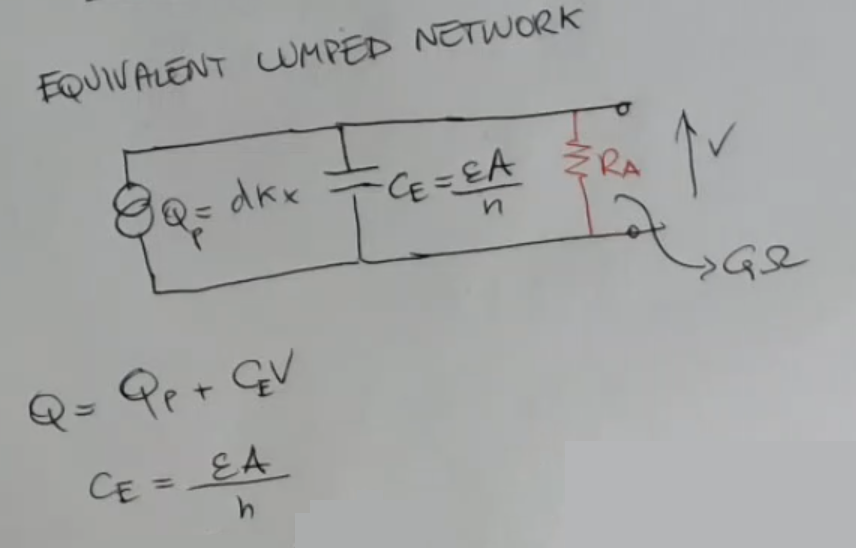
Charge enclosed in the volume of the sensor:
-
Equivalent lumped parameter system of the sensor:
-
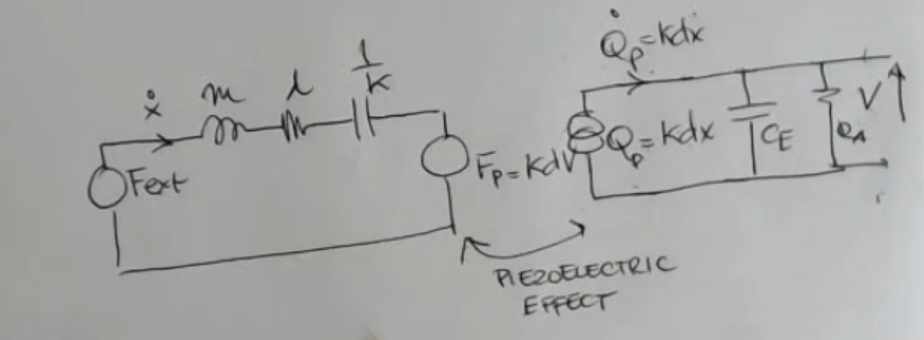
Complete equivalent lumped parameter system:
-
Different material with piezoelectric property:
- Quartz : small losses, almost a perfect dielectic, , .
- PZT (Lead Zirconate Titanate, polycrystal) : large piezo-coefficients
- PVDF (polymer) : low cost
-
Terminology:
- , : piezoelectric coefficient.
- : force, elastic coefficient and displacement.
SaM - Compact Piezoelectric Coefficient Matrix for PZT • Dependence of Piezoelectricity on Temperature • Curie Temperature
- Piezoelectric coefficient matrix in compact notation for PZT:
- ==Piezoelectric materials have to be operated under the Curie temperature==.
- Curie Temperature: is the temperature at which, usually, there is a phase transition from an asymmetrical to a symmetrical crystal.
- For PZT this temperature is .
SaM - Piezoelectric Accelerometer
- Structure:
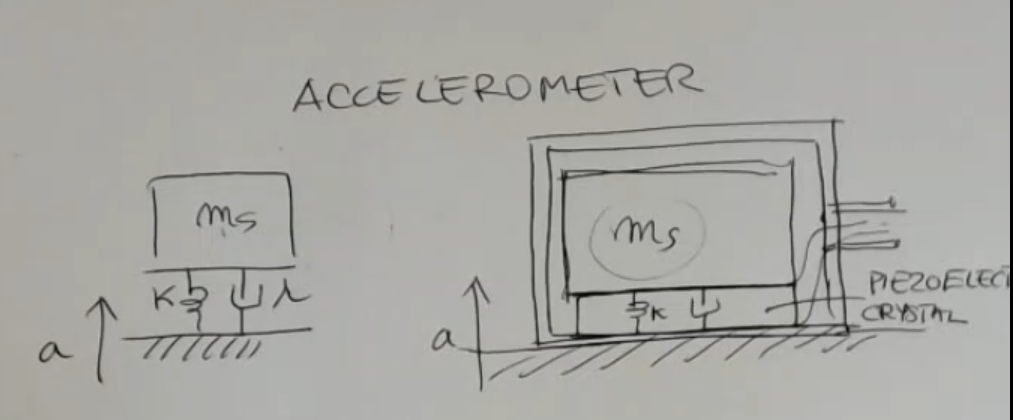
- Equivalent Circuit:
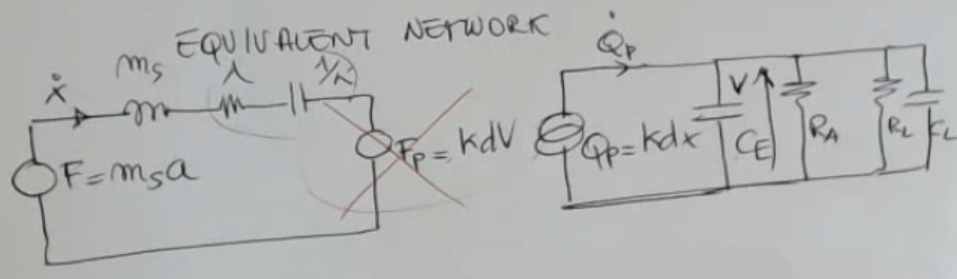
- Output formula:
- Terminology:
- : natural frequency
- is the spring consntant of our accelerometer, and the sismic mass.
- == and depend on the wire’s lenght (bad)==.
- : laplace transform of the acceleration .
- : accelerometer’s transient function
- : natural frequency
- Bode Plot:
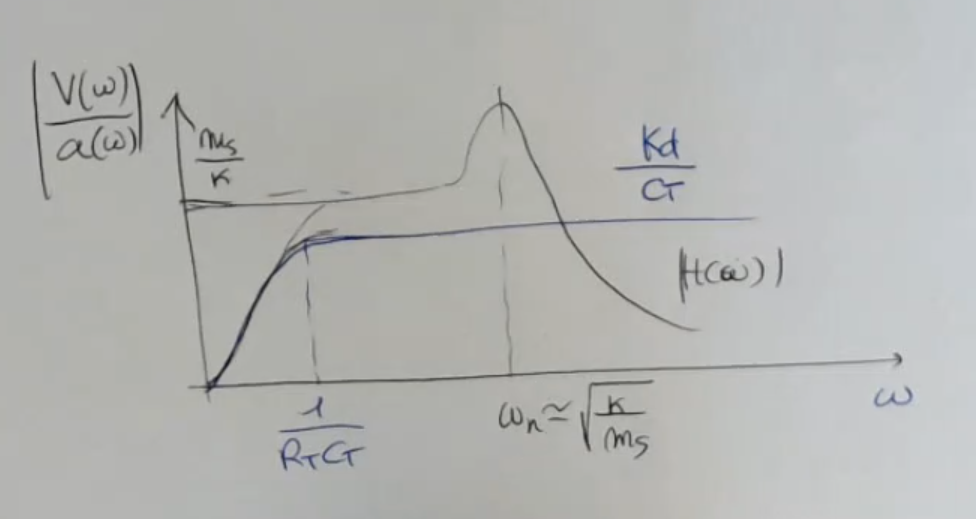
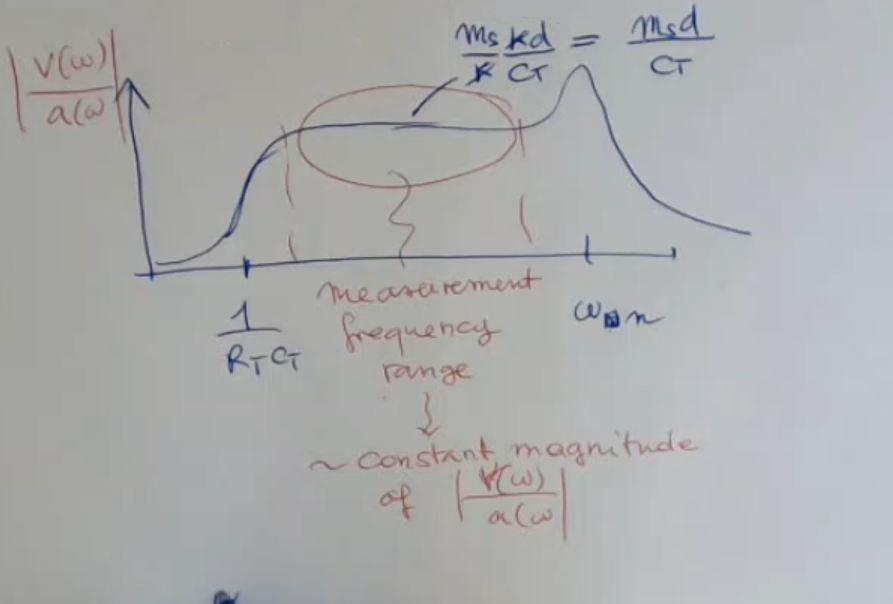
- Frequency range:
- The overall system is AC-coupled. ⇒ ==You cannot sense static acelerations==.
- Lower cutoff frequency:NOT_SURE_ABOUT_THIS
The professor wrote
This is probably wrong, since we have already defined - Constant sensitivity inside the frequency range:
- Problem: the sensitivity depends the capacitance , wich depends on the cable capacitance.
Solution: make the amplifier (read-out electronics) a part of the sensor itself: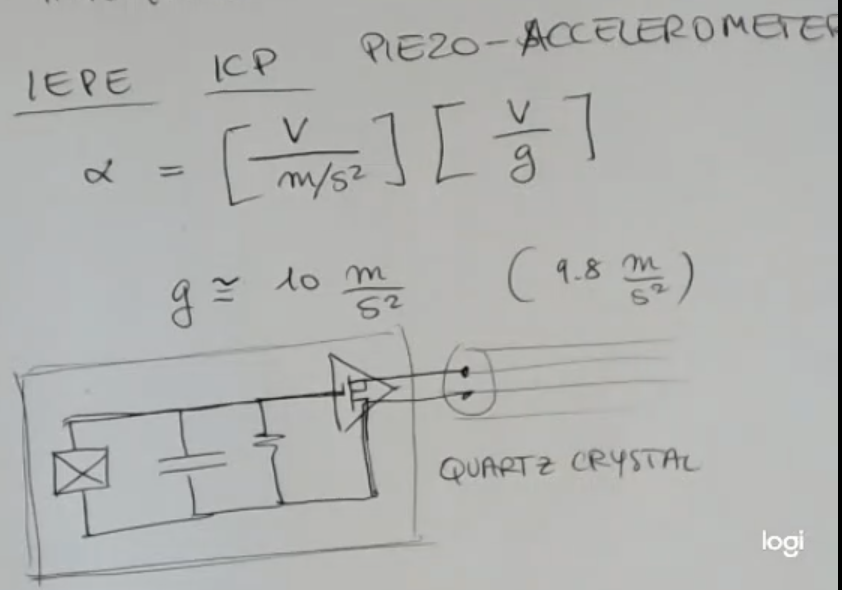
- This particular kind of piezo-accelerometer are called IEPE or ICP.
SaM - Ultrasonic Transducers (Piezoelectric Device)
- Structure:
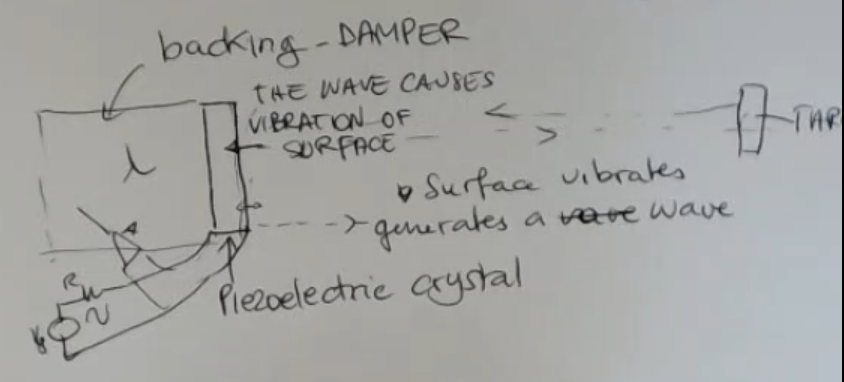
- Structure:
- A piezoelectric slice of material (like quartz).
- An added dumper .
- A source voltage for exiting the piezoelectric.
- A read-out (an amplifier) to read the output from the piezolectric.
- Workings:
- We exite the piezoelectric, which is deformed inverse piezoelectric effect, and we make it vibrate.
- The vibration generates a wave.
- The wave bounces off the target, and returns to the piezoelectric, make it vibrate again.
- We measure the new vibration with the read-out.
- and output graph:
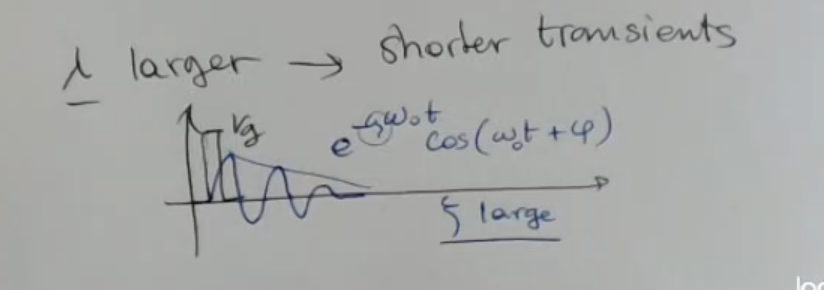
- Electrical circuit for actuator and sensor:
(This is a coarse approximation)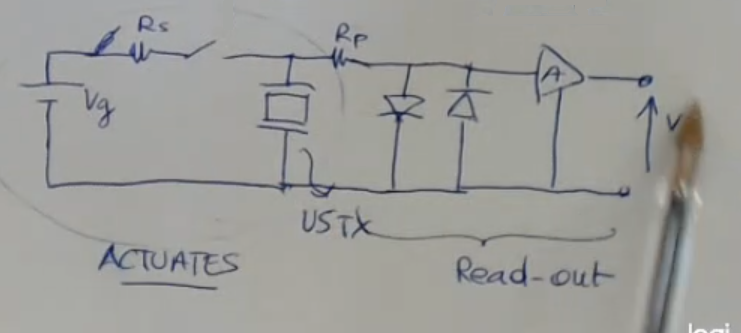
- The two diodes are a protection circuit, for read-out part, it protects the amplifier when using the device as a transducer.
- Used as an actuator (both diodes are ON):
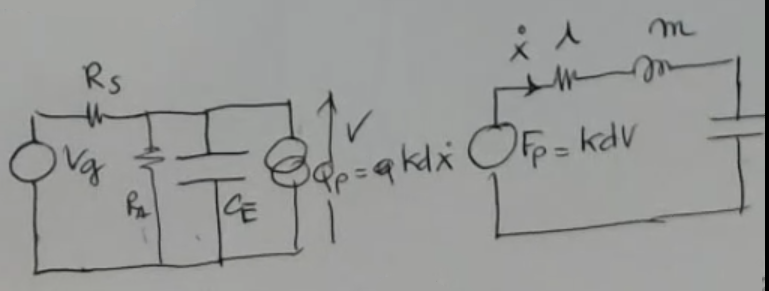
- Output graph of
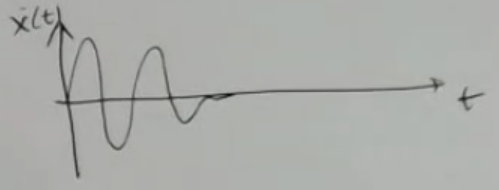
- Relative output graph:
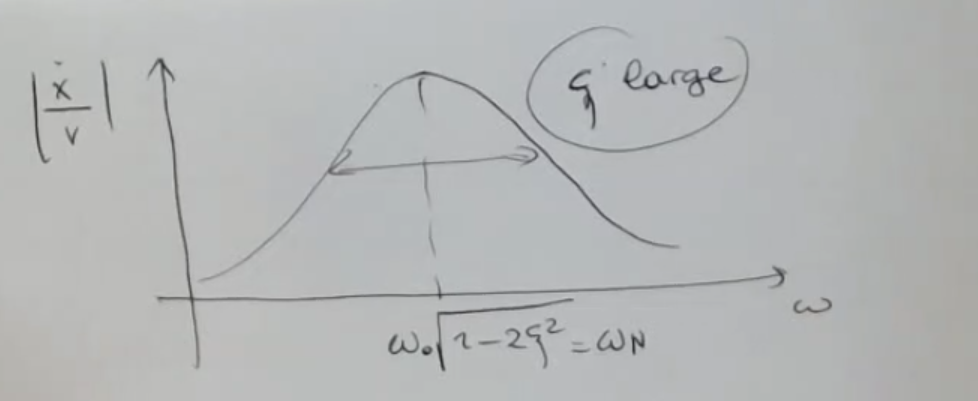
- Output graph of
- Used as a sensor (both diodes are OFF):
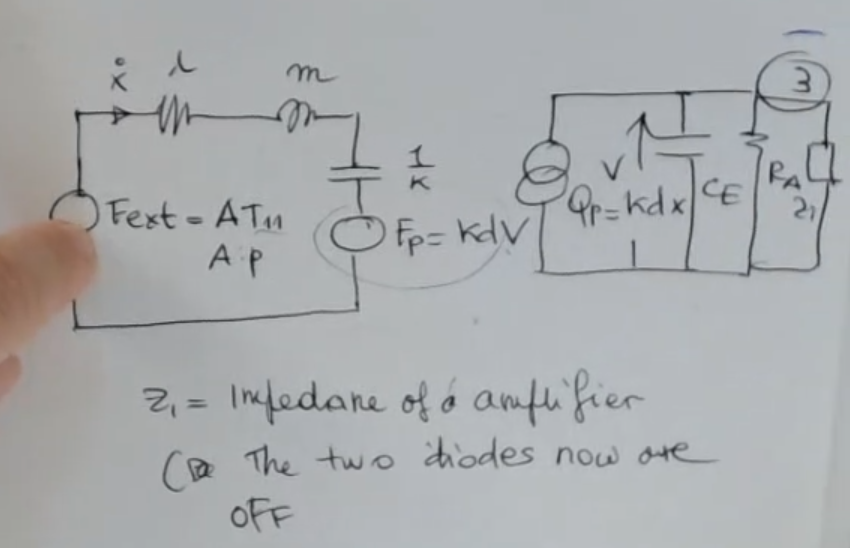
- Output charge formula:
- Transfer function:Where:Please note the difference with the transfer function of the acceleroemeter, do not confuse them.
- Plot of and , the complete output graph is their multiplication:
(This device should be excited with a frequency )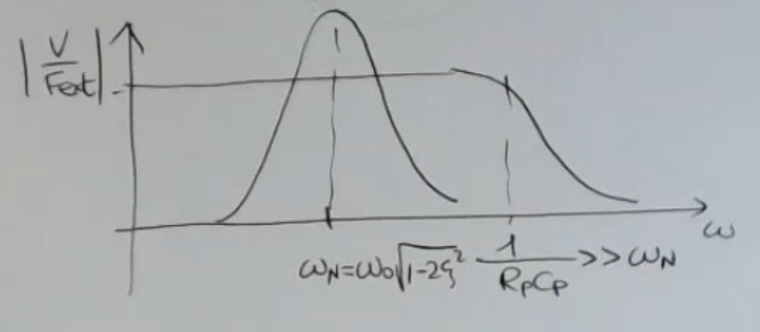
SaM - Coarse Approximation of the Lumped Parameter Model of an Ultrasonic Transducer
- “The lumped parameter approximation of this device is an extreamely coarse approximation, since the the wavelenght is NOT larger than the dimension of the crystal ()“.
- So ⇒ coarse approximation.
SaM - Quartz Oscillator
- Lumped parameter system:
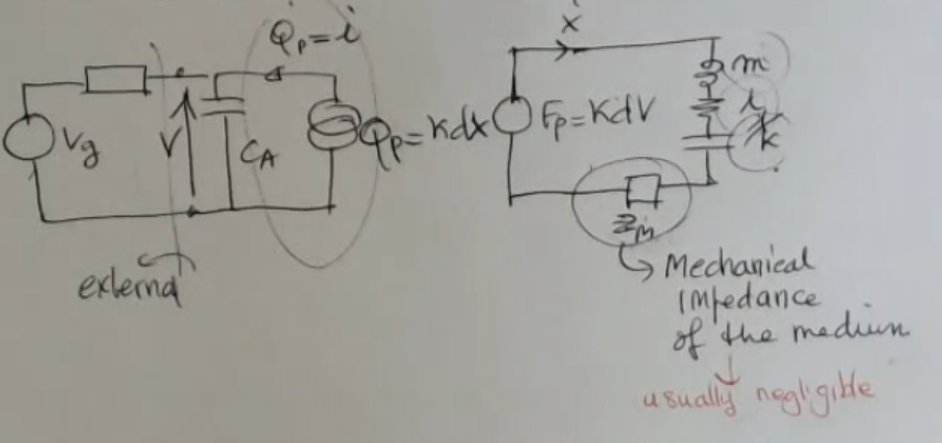
- Wavelenght-thickness real world relationship:
- AT-cut quartz as a sensor, equivalent electrical circuit:
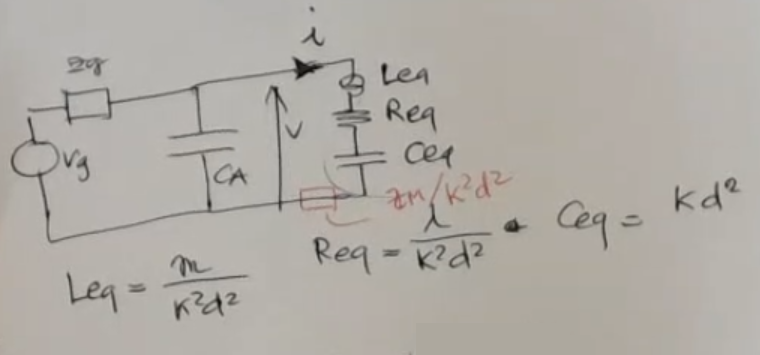
- Formulas:
- If we want to consider the added “mechanical impedance of the medium”:Usually negligible.
- The piezoelectric behavior of this structure depends on the surface orientation with respect to the crystallographic axis.
- Terminology:
- : mass, dumping coefficient, elastic coefficient of the piezoelectric slice.
- is the piezoelectric coefficient.
- : mechanical impedance of the medium, as an example when we talked about the ultrasonic transducer we said that it used an “added damper”, in that case would represent this added dumper.
SaM - AT-Cut Quartz
- Lumped parameter system:
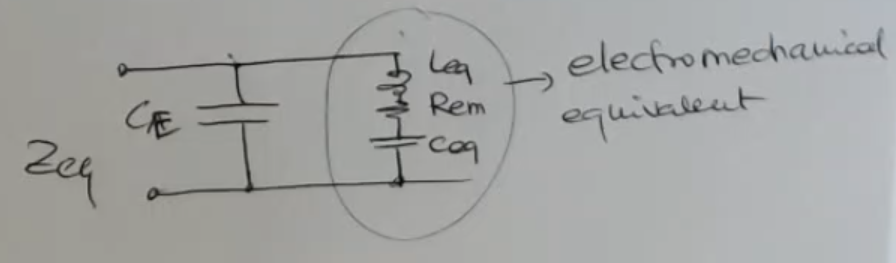
- Real world values for :Remember: .
- Reactance , given: and :
- If we consider that , and low frequencies:
- Frequencies to remember:
- We have also seen the previous formula written as:
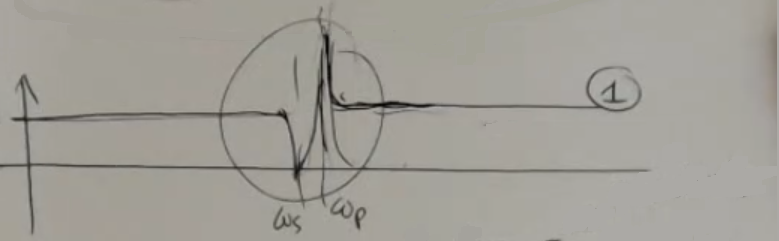
- Plot of :
- Plot of :
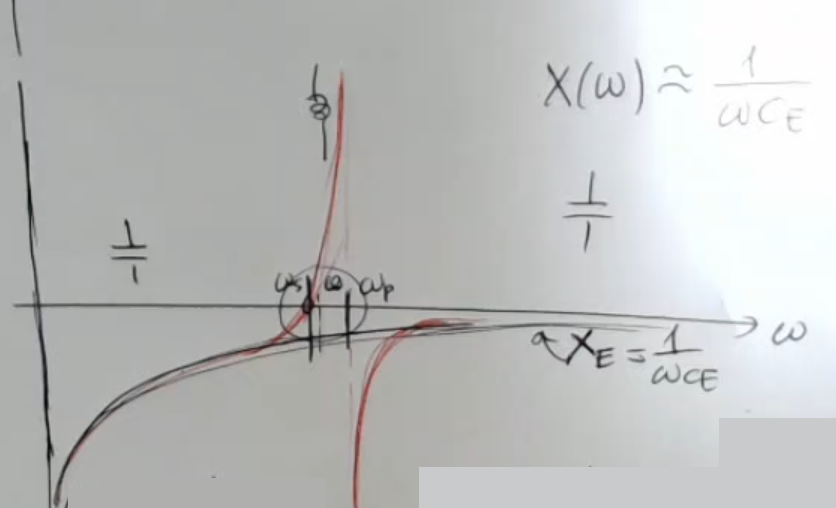
- ==There is a really small range in which the quartz acts as an inductance==.
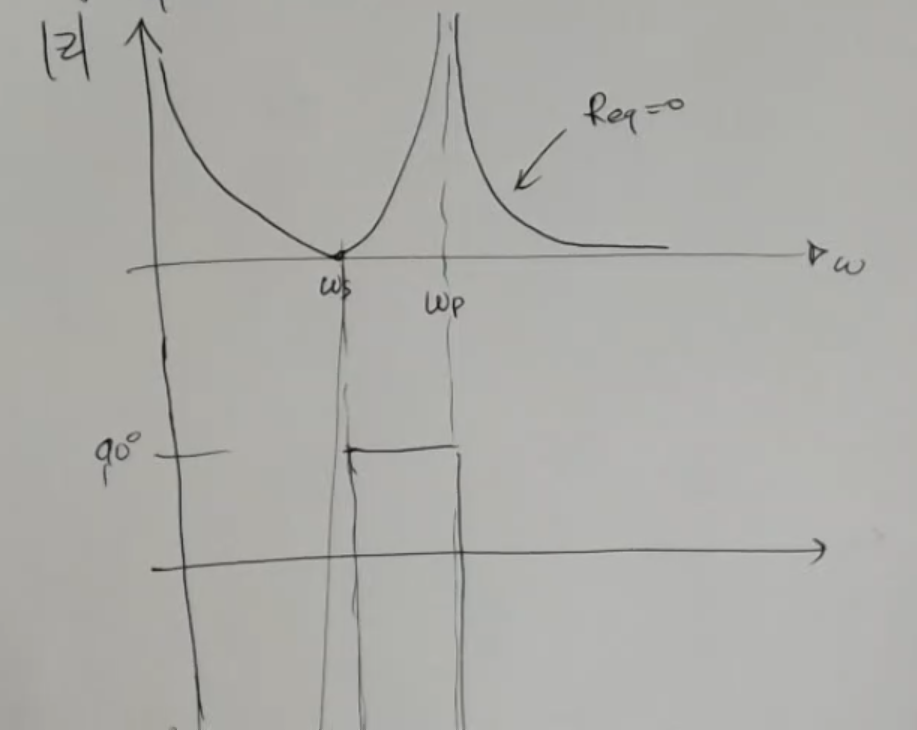
==Moreover this range is set by the physical properties of the quartz, that define and ==. - Wavelenght-thickness real world relationship:
- Plot if :
- Plot if :
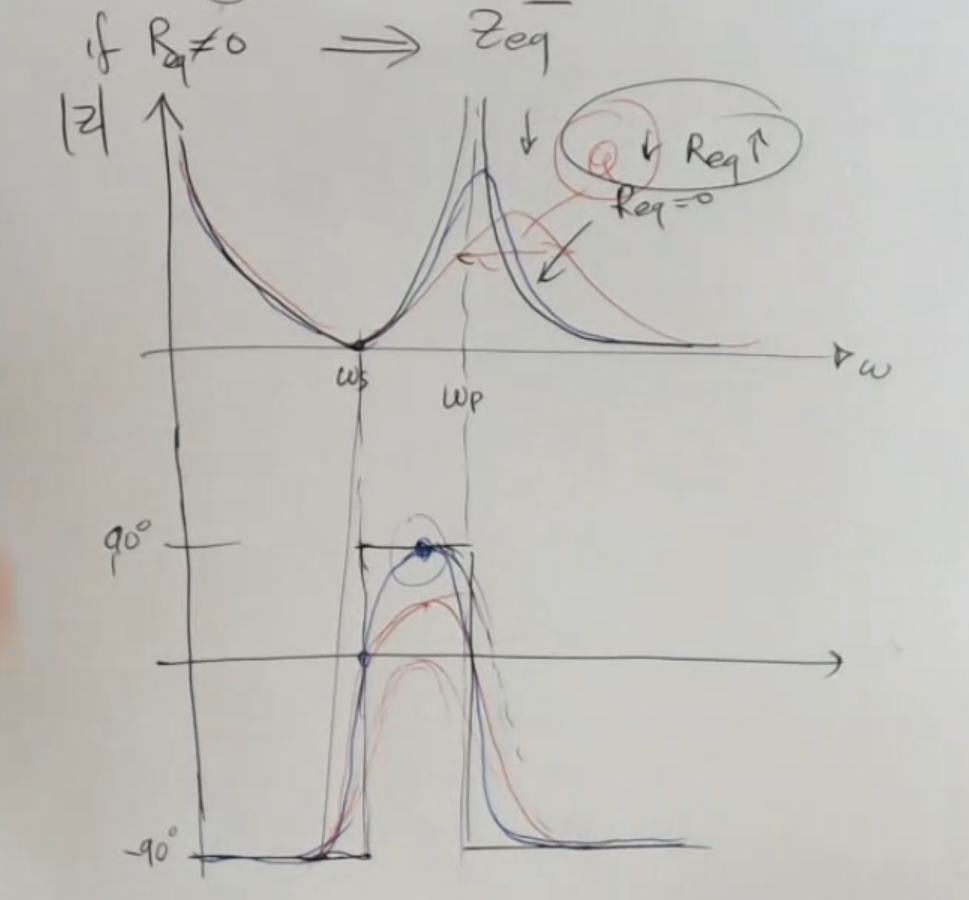
- Real world measures:
- The percentage difference (calculated like a relative error) of and is , (really small difference between and ).
- So let’s take for example then .
SaM - Crystallographic Axis
Link to original
- defines a vector.
- defines a plane .
- defines a direction .
- Typical cell for Silicon:
- Real World Measure:
- Typical surfaces: , , , used in micromachining technology
- For Silicon: (Remember : )
- Terminology
- : length of the unit cell.
/../../Notes--and--Images/Pasted-image-20230610190527.png)
SaM - Types of Cut Quartzes
- The way we cut the quartz, will relfect how it works:
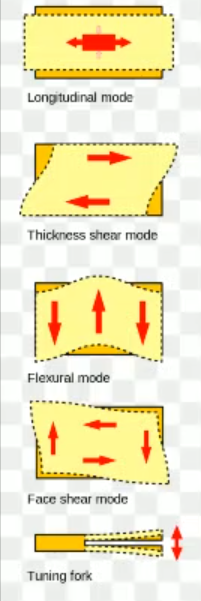
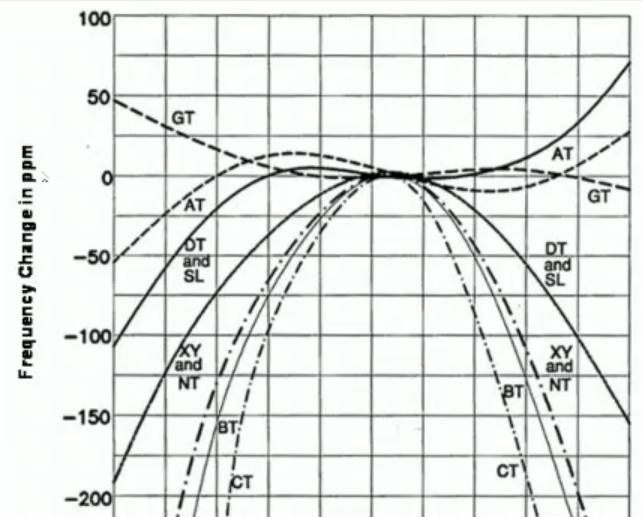
- ==Cut-Quartzes work in in frequency up to MHz==.
==The “thickness shear mode” has the highest frequency range==. - This frequency changes with temperature, and all cuts have a slope around (ambience temperature):
SaM - Quartz in a 3 Point Oscillator
- Using an AT-cut quartz in a Colpits oscillator:
(This circuit will oscillate only at frequency in which the quartz acts as an inductance, so for in the interval )- -factor value:
(Adding a capacitance in series or in parallel to our quartz, will reduce this value, not goood)- Adding a capacitance in series or in parallel to the quartz:
(Adding a capacitance in series or in parallel can reduce the frequencies and , giving us more control, good)
- No added capacitance, base graph:
- Added capacitance:
/../../Notes--and--Images/Pasted-image-20230720170240-3.png)
- In series: we increase .
- In paralle: we reduce .
- In both cases we reduce the range
Link to original
/../../Notes--and--Images/Pasted-image-20230720170240-1.png)
/../../Notes--and--Images/Pasted-image-20230720170240-2.png)
SaM - Behavior of the Quartz Ocillator at High Frequencies
- AT-cut quartz’s impedance:
- Real world values of an AT-cut quartz for :Remember: .
- AT-cut quartz special frequencies:
- AT-cut quartz reactance formula:
- Plot of :
- More precise equivalent system for an AT-cut quartz at high frequencies:
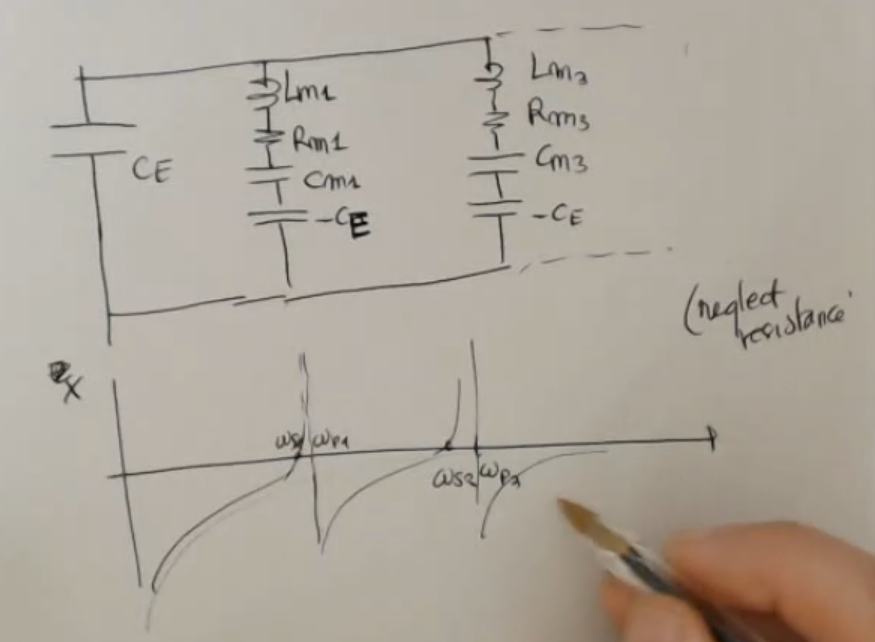
- Instead of:
- Instead of:
- Additional components formulas:And:Where:
- Real world measure:
- “Low frequency”, in this case means: .
- “High frequency”, in this case means: , or more.
SaM - Quartz as a Sensor • QCM (Quartz Crystal Microbalance)
- Structure and equivalent system:
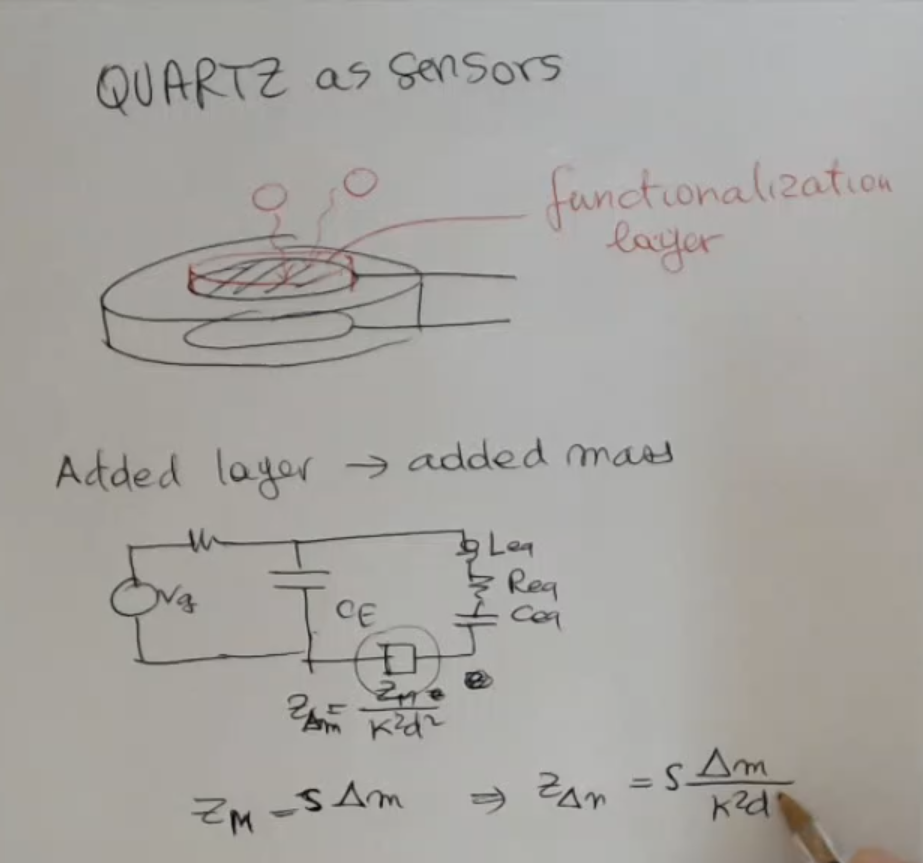
- The name of this sensor is: QCM (Quartz Crystal Microbalance).
It is based on the concentration of the target species (that gets absorbed by the functionalization layer). - Functionalization layer impedance formula:
- Changes to the equivalent components of this sensor, with respect to the normal AT-cut quartz:
- Terminology:
- : mass of the “functionalization layer”
- : cosntant defined by the geometry of the piezoelectric crystal
- : piezoelectric coefficients.
- defined previously.