Remeber:
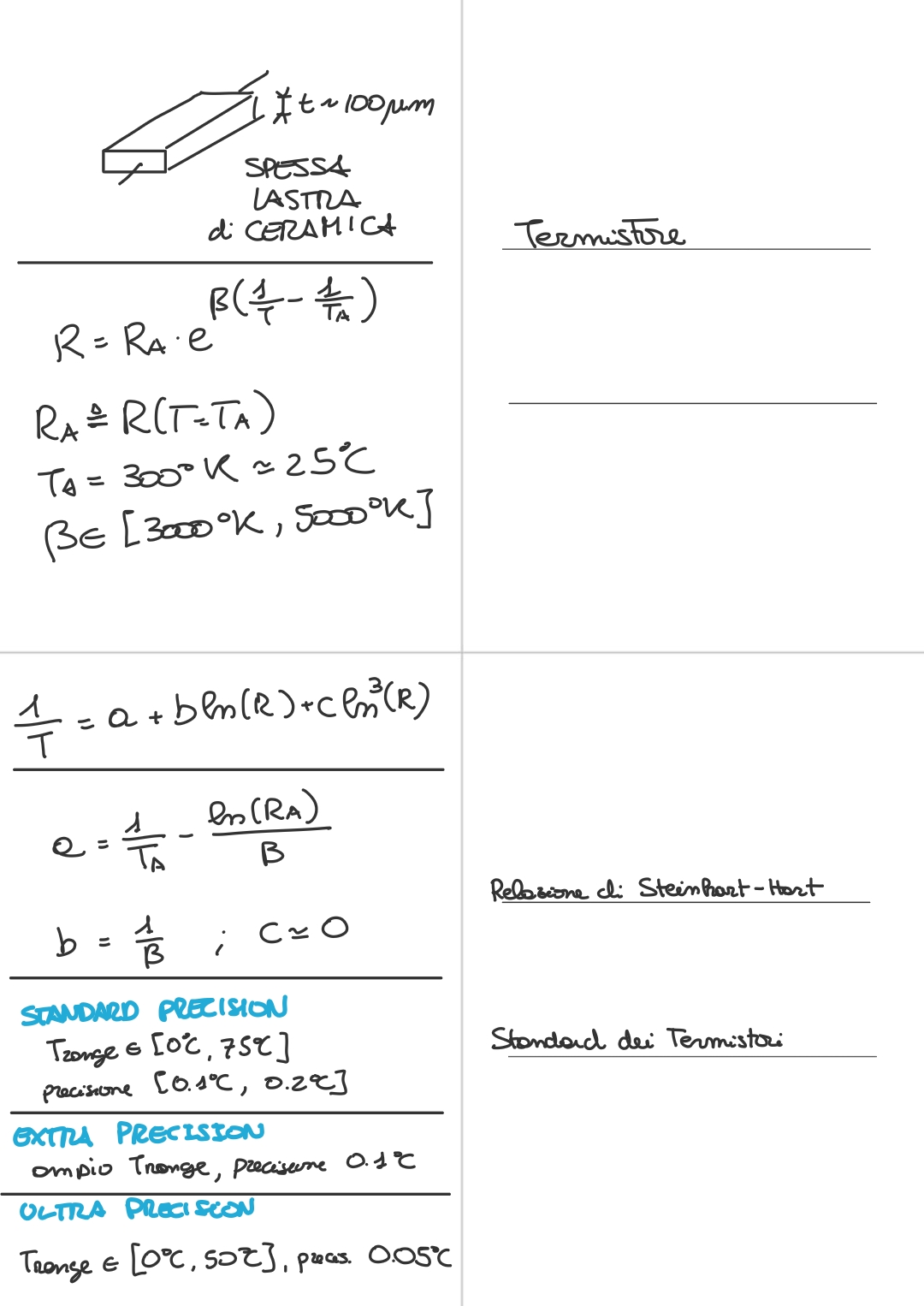
Thermistor are made of a thick layer of ceramic (semiconductor). They are very used, and cost less than RTDs:
In a thermistor we exploit the semi-conductive behavior of the ceramic material which gives us a thermally activated conductivity.
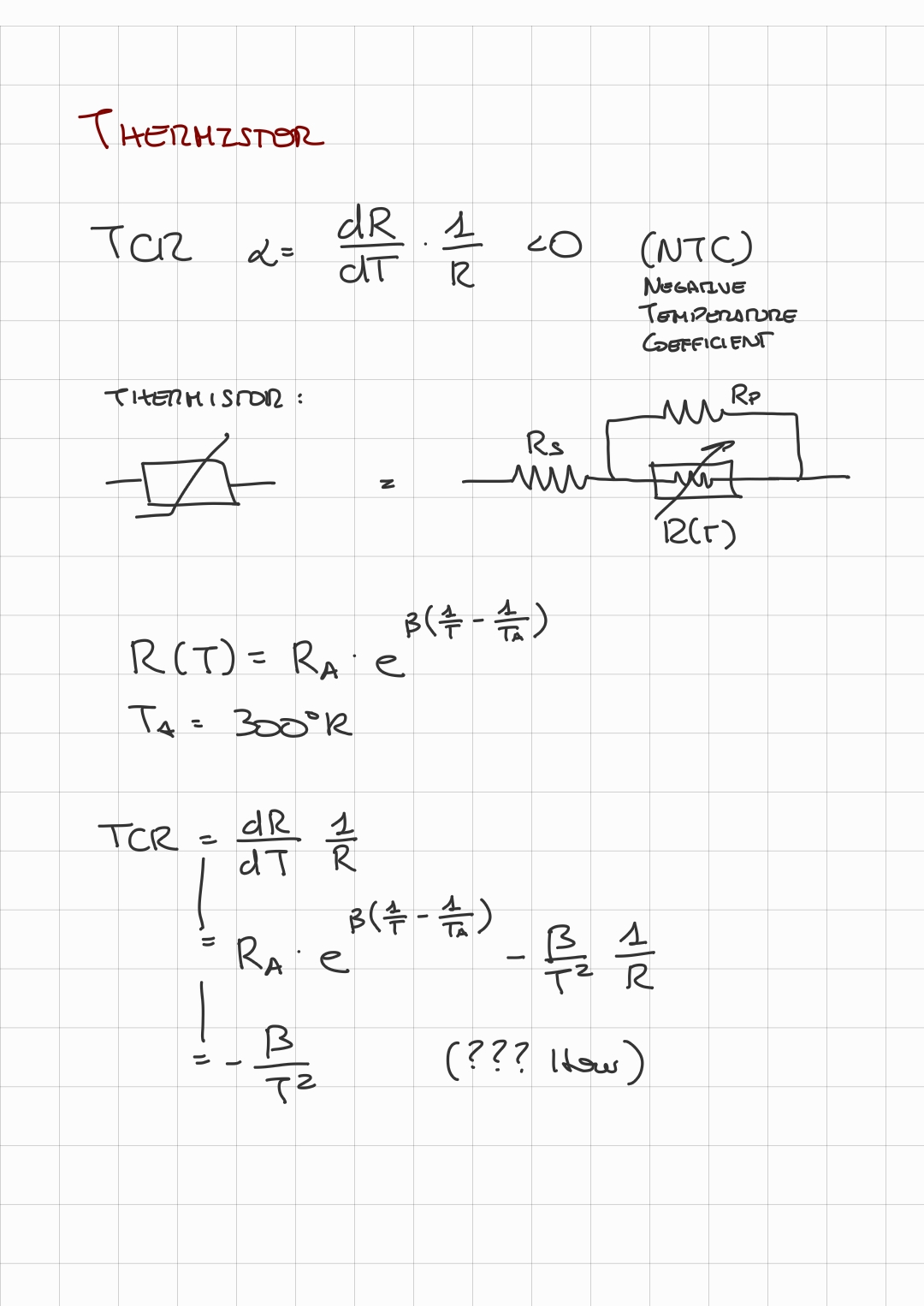
Thermistor have a Negative Temperature Coefficient (NTC or Negative TCR), which remember is defined as:Also the formula that governs thermistor is non-linear:Where:
- :
- : ambience temperature
We have also seen how we can describe the equation of a thermistor with the Steinhart-Hart Relashionship.
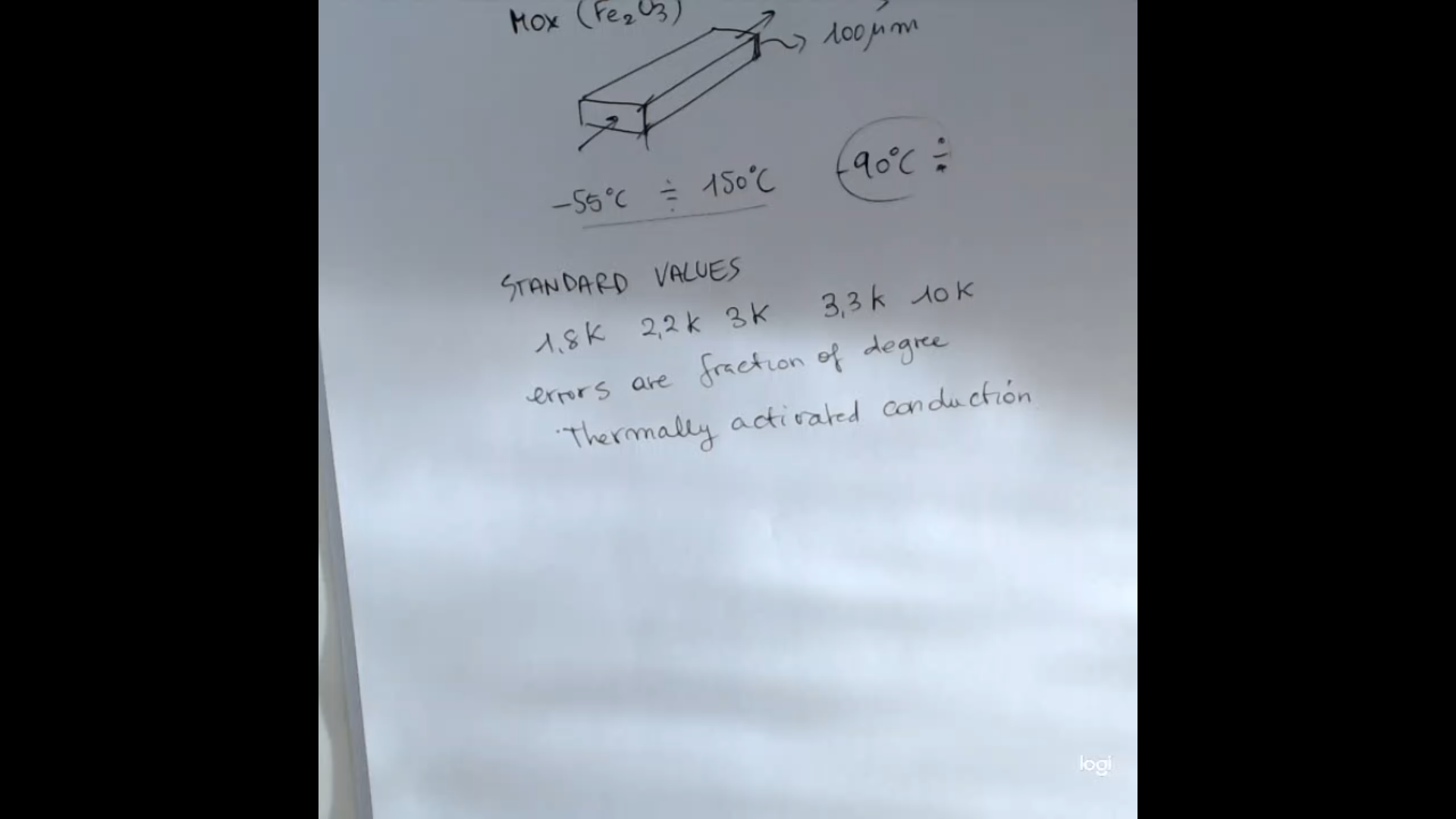
- They are of about in lenght.
- The temperature range is between .IMPORTANTE
- Some common values for the thermistor resistance are in the order of .IMPORTANTE
- Thermistor are made of a thick layer of Ceramic (semiconductor).
- They are commonly used, and ==cost less than RTDs==.
- For this material here we have we exploit the semi-conductive behavior of this material which gives us a thermally activated conduction.
- We expect resistances which decreases with temperature, because the higher is the temperature the larger is the number of carriers that becomes available or that can overcome a barrier in any case.
Something operating in the freeze out or in the intrinsic, the carriers has to be freed by the temperature, so there is a conduction which is related with an exponential function with temperature.
Memory Card
- Thermistor are made of a thick layer of Ceramic (semiconductor).
- They are very used, and cost less than RTD.
- For this material here we have we exploit the semi-conductive behavior of this material which gives us a thermally activated conduction.
- Something operating in the freeze out or in the intrinsic, the carriers has to be freed by the temperature, so there is a conduction which is related with an exponential function with temperature.
- And obviously we expect resistances which decreases with temperature, because the higher is the temperature the larger is the number of carriers that becomes available or that can overcome a barrier in any case.