Remeber:
Piezoelectricity (ChatGPT):
When mechanical stress is applied to a piezoelectric material, the material’s internal structure becomes distorted. This distortion causes a redistribution of electrical charges within the material, leading to the generation of an electric potential across its surfaces. This phenomenon is known as the direct piezoelectric effect:
- We have seen already two equations for the piezoelectric effect:Where:
- ==The first equation describes the direct piezoelectric effect==.
- ==While the second equation describes the inverse piezoelectric effect==.
==The inverse piezoelectric effect states that even if there is no stress applied to a piezoelectric material, but is present an external electrical field ⇒ then we will see a deformation, or strain of the material itself==- : Electric Displacement Field, size: .
- : Electric Permettivity, size: .
- : Electric Field, size: .
- : Piezoelectric Coefficient Matrix, size: .
- : Stress Tensor or Vector, size: , however we can reduce it to a , in collapsed notation, since by definition is a symmetrical matrix.
- : Strain Tensor or Vector, size: , however we can reduce it to a , in collapsed notation, since by definition is a symmetrical matrix.
- : Compliance Tensor, or Yieldness Tensor, size: .
NOTE: These are the sizes we have seen, but they are specific to isotropic materials.
since for anisotropic materials for example the yieldness tensor has 4 dimensions, and not only 2.
==Also typically piezoelectric materials are anisotrpic (Source: Google), take these sizes only as a reference==.- We have already seen the realtion between Stress Tensor and Strain Tensor, and we defined it as the Hooke’s Law:Where: - is the yieldness tensor. (“tensore di cedevolezza”) - is the stifness tensor, (“tensore di rigidità”) it describes the elastic constants of the material. - Also and are inverse of each other.
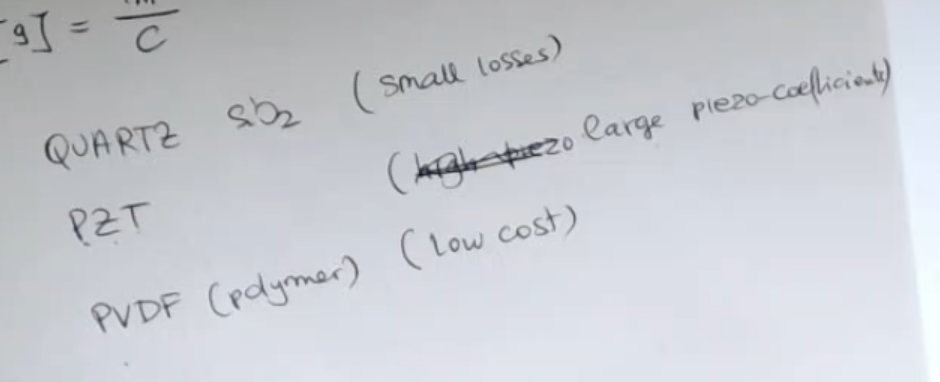
We have different materials which show piezoelectric effect:IMPORTANTE
- Quartz : small losses, almost a perfect dielectic.
- PZT (Lead Zirconate Titanate, polycrystal) : large piezo-coefficients
- PVDF (polymer) : low cost
Acutally:NOT_SURE_ABOUT_THIS (this is my reasoning)
- The quartz has: and .
- The PZT has: and .
- Their complex electric permettivity ratio is almost the same but the PZT has higher value, meaning if we take into the direct and inverse piezoelectric effect formual, it will result in a higer response given the same electric field and the same stress value .
The same is true for the capacitance value and charge output , the PZT will have higher value for both.
==So for “raw performance” the PZT is better==.- However we have studied how we can vary some characteristics of the quartz, if we cut it in a different way.
Also we have seen how the AT-cut quartz has a linear relationship between its thickness and the wavelength : .
So the quartz give us "more flexibility".
Here’s a table with some properties for quartz, PTZ and PVDF: (NOT IMPORTANT)
| Material | |||||
|---|---|---|---|---|---|
| Quartz | |||||
| PZT (Lead Zirconate Titanate, polycrystal) | |||||
| PVDF (polymer) |
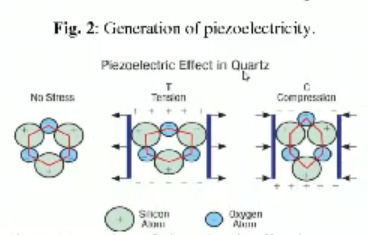
- So remember that piezoelectric effect can be seen in materials which have a crystal structure, and this crystal structure is made of ions.
- For instance, in the figure you can see the structure of a PZT material where the blue spheres are positive ions, metal ions, where has the negative spheres, negative ions, oxygen ions.
- When the crystal gets deformed, you will have a shift of the two centers of mass, such that polarization appears because the positive charge and the negative charge are “separated” in space.
therefore as a macroscopic effect, you will find a separation of charge.
The mathematical description of this effect:
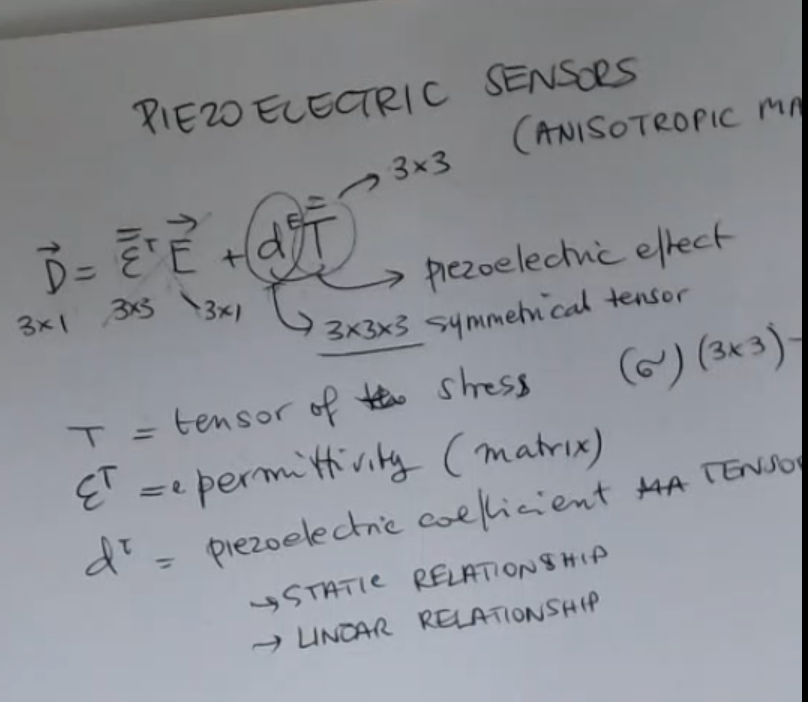
- We have two different equations that describes the direct and the inverse piezoelectric effect, this is the first one, called the “direct piezoelectric effect”.
- : field ???
- : electrical field.
- : piezoelectric effect.
- : stress tensor (previously called , i changed the name since is used for conductivity)
- it’s a symmetrical tensor.NOT_SURE_ABOUT_THIS
- So you can polarize the material either with an electrical field, or this is particular for piezoelectric effect and piezoelectric material with an applied stress.
- NOTE: this is a static relationship, and a linear relationship.
- NOTE: In this formula there is an error, if we consider the second term its resulting size is which is not the same size as which is
While the inverse piezo electric effect:
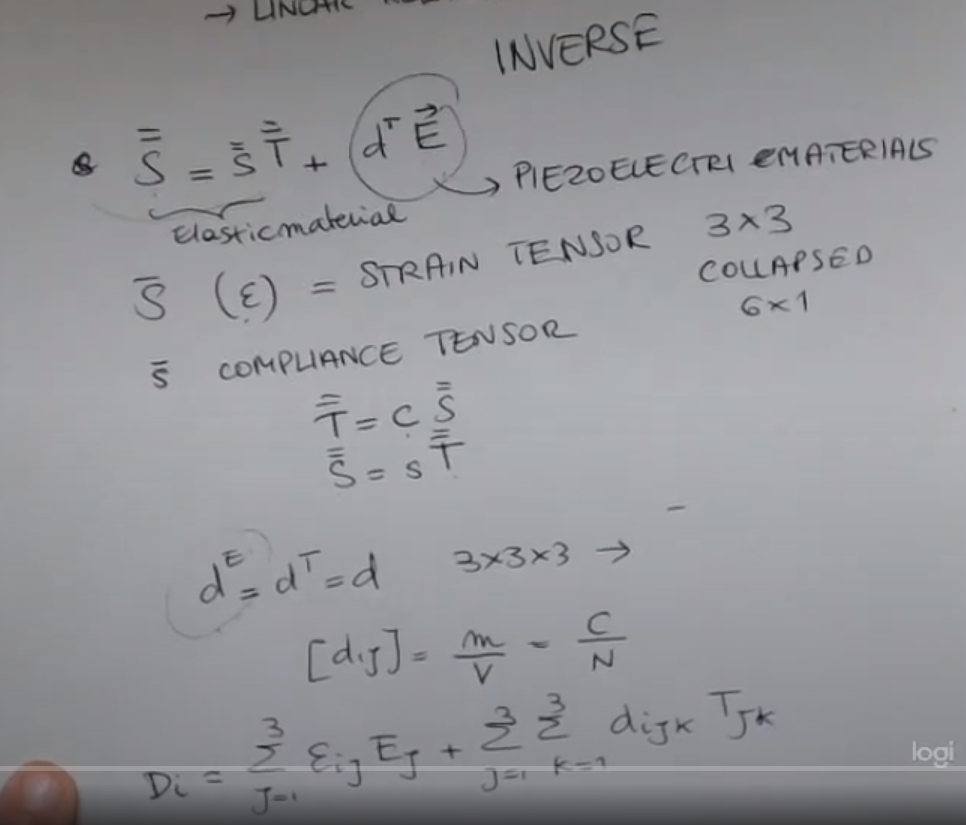
- was called before sometimes and it is the strain tensor.
Its dimension is 3 by 3 or in collapse notation can sometimes be replaced by a 6 by 1 vector. - this small here which is the inverse of the matrix of the elastic constant, this is called the compliance tensor.
- We are describing our piezoelectric material as an elastic material, it is a crystal so we know that it is true.
- The inverse piezoelectric effect and states that even if there is no stress applied to the material, but there is an external electrical then we will see a deformation, a strain of the material itself.
- I drop this and for the tensor, I put here just (it is still a 3x3x3 tensor), the measurement unit can be meter over volt or Coulomb divided by Newton.
- So now we can for instance take this equation here and write it more in a clear manner, so I have the -th component of the displacement field is equal to:
Sometimes instead of using this coefficient to describe the piezoelectric behavior, we can write this, and now I write it as if it is a scalar, so 1D:
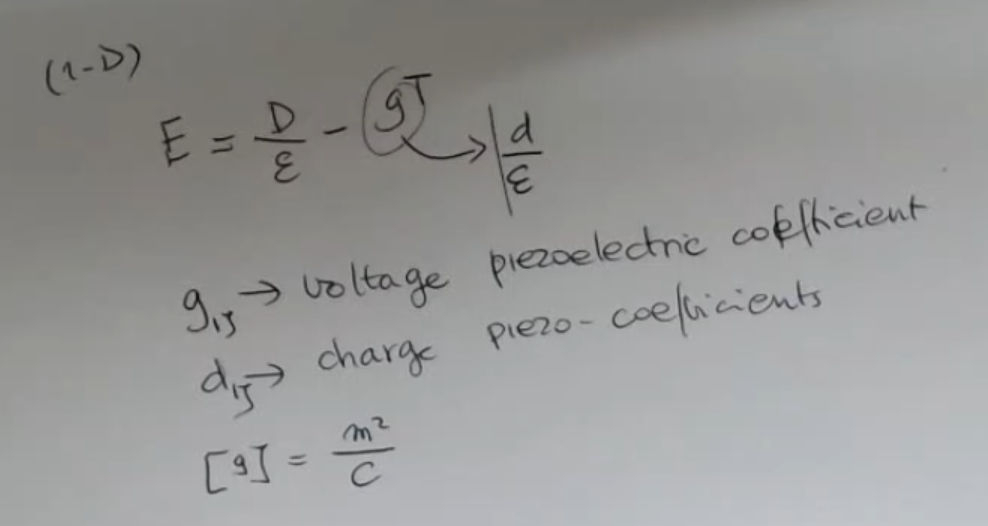
- : voltage piezoelectric coefficients.
- Originally the coefficients were called charge piezoelectric coefficients.
- For obviously you have a tensor.
I remember you that we have different materials which show piezoelectric effect: