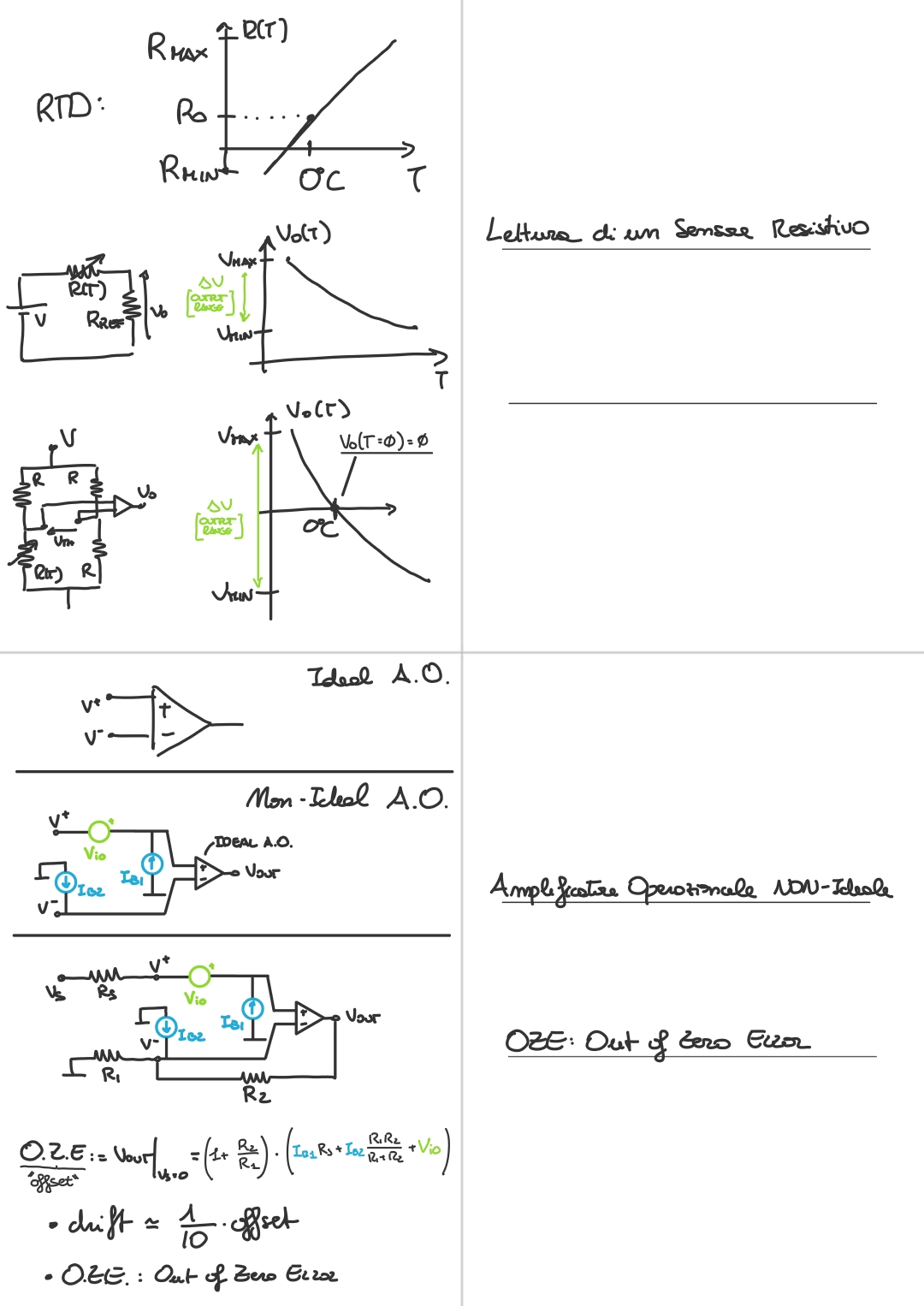
In an operational amplifier we need to consider an input offset and two bias currents , we can model it like this: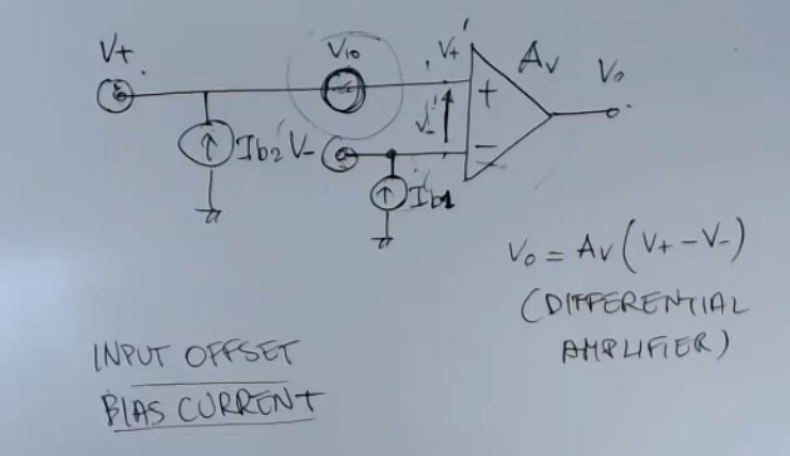
We can then model the whole measurement system, by adding the Thevenim equivalent of the measurement system as the input to the amplifier: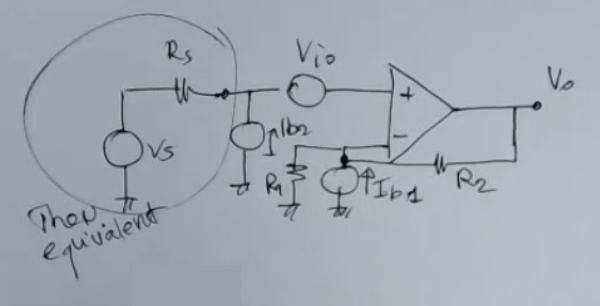
If we wish to know the effect of the non-idealities of the amplifier on the output we can calculate and the result is:IMPORTANTE And this is called OZE: Out of Zero Error.
While we can also define the IZE: Input out of Zero Error:Even if the source , since the amplifier is not ideal, we will measure an ouput like if and an having ideal operational amplifier.
By having an OZE we have a non-symmetrical dynamic range: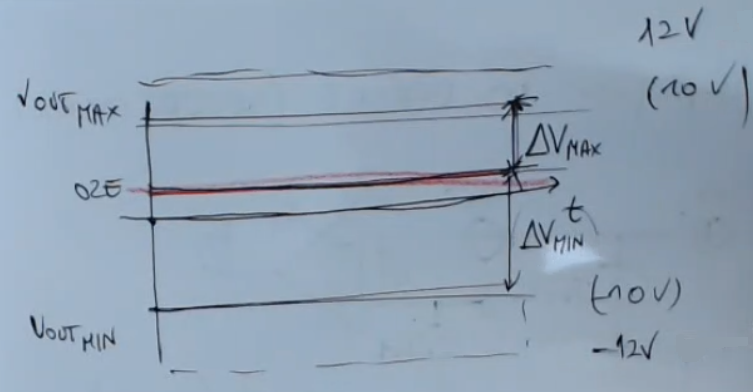 Ideally we want no OZE and a output if the input is .
Instead we have for .
==However if the OZE is constant, this is not a big problem, since it can be corrected==.
Ideally we want no OZE and a output if the input is .
Instead we have for .
==However if the OZE is constant, this is not a big problem, since it can be corrected==.
The real problem is that the OZE is not constant, instead it has a drift, due to envirement condition, aging, temperature, …, and this variation cannot be corrected : (green/blue line: real OZE)
(red line : previously calculated OZE)
(green/blue line: real OZE)
(red line : previously calculated OZE)
For this reason, if we want a high accuracy we need to select a special kind of amplifier, called ==“precision amplifier”==. These devices are often low freqeuncy device (or “narrow bandwidth devices”, it means the same thing), but with really low DC errors.
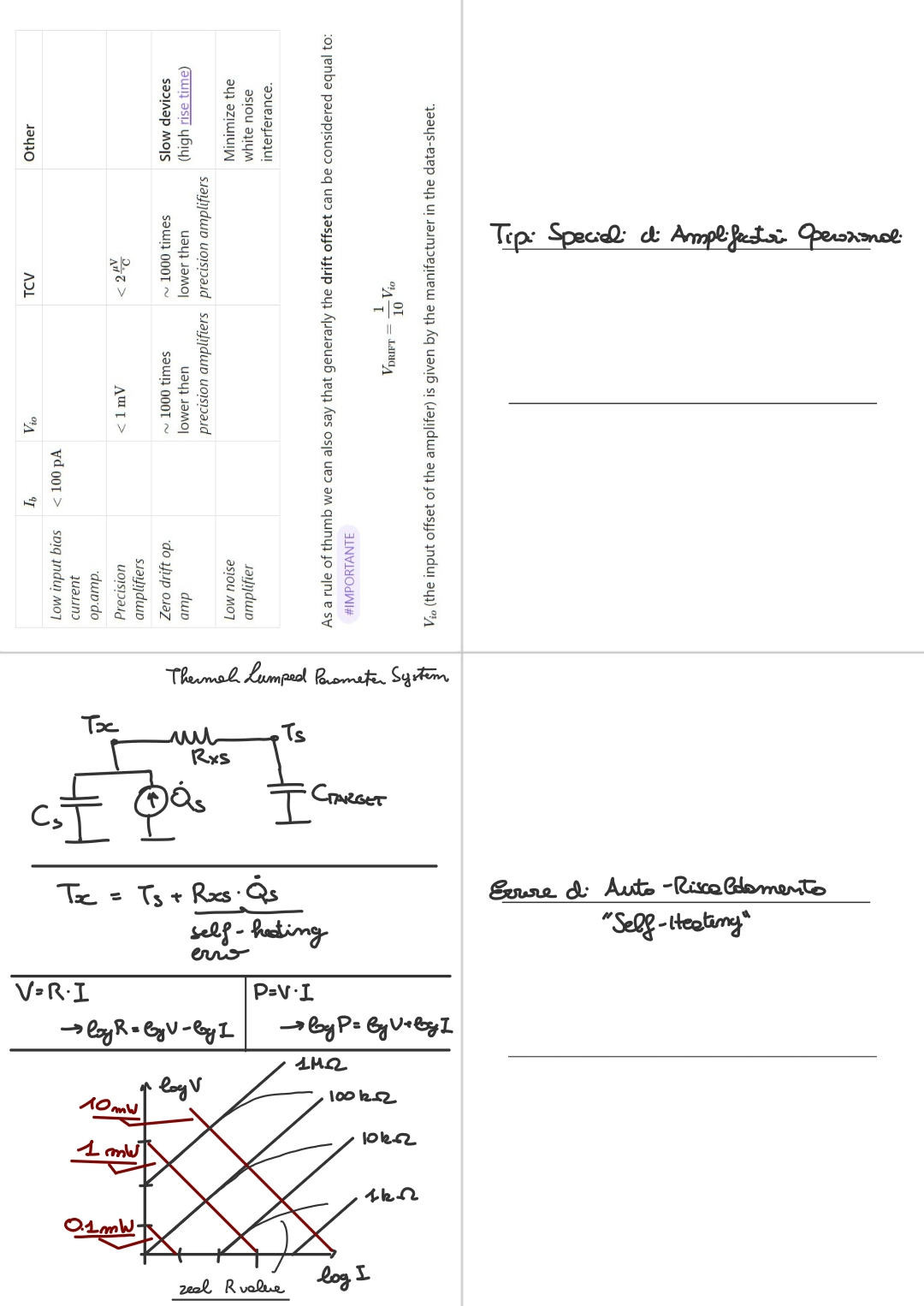
We can find different classes of precision amplifeirs:IMPORTANTE
- Low input bias current op. amp. with .
- Precision amplifiers with (can also be found with in the range of ) and with a (Temperature Coefficicent of Voltage, similar to the TCR).
- Zero drift op. amp. , , however these are slow devices, so a high rise time (or “limited slew rate”) and also have a really narrow band.
- Low noise amplifier: they minimize the white noise interferance and not the DC offset.
Here’s how we can model the input-noise in an amplifier: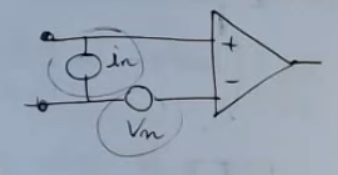
Here’s a table to better rember them:
| TCV | Other | |||
|---|---|---|---|---|
| Low input bias current op.amp. | ||||
| Precision amplifiers | ||||
| Zero drift op. amp | times lower then precision amplifiers | times lower then precision amplifiers | Slow devices (high rise time) | |
| Low noise amplifier | Minimize the white noise interferance. |
As a rule of thumb we can also say that generarly the drift offset can be considered equal to: IMPORTANTE $$V_{\small{\text{DRIFT}}} = {1 \over 10} V_{io}$$$V_{io}$ (the input offset of the amplifer) is given by the manifacturer in the data-sheet.
So to summarize for DC measurement we have that:IMPORTANTE
- DC offset: can be corrected
- Drift offset (variable offset): cannot be corrected.
- .
Memory Card