Let’s complicate the problem of calculating the CMRR of an instrumentational amplifier. We have seen previously the even if we have a non-ideal op. amp., with a finate open-loop gain , we can still have an infinite CMRR, as long as we have: .
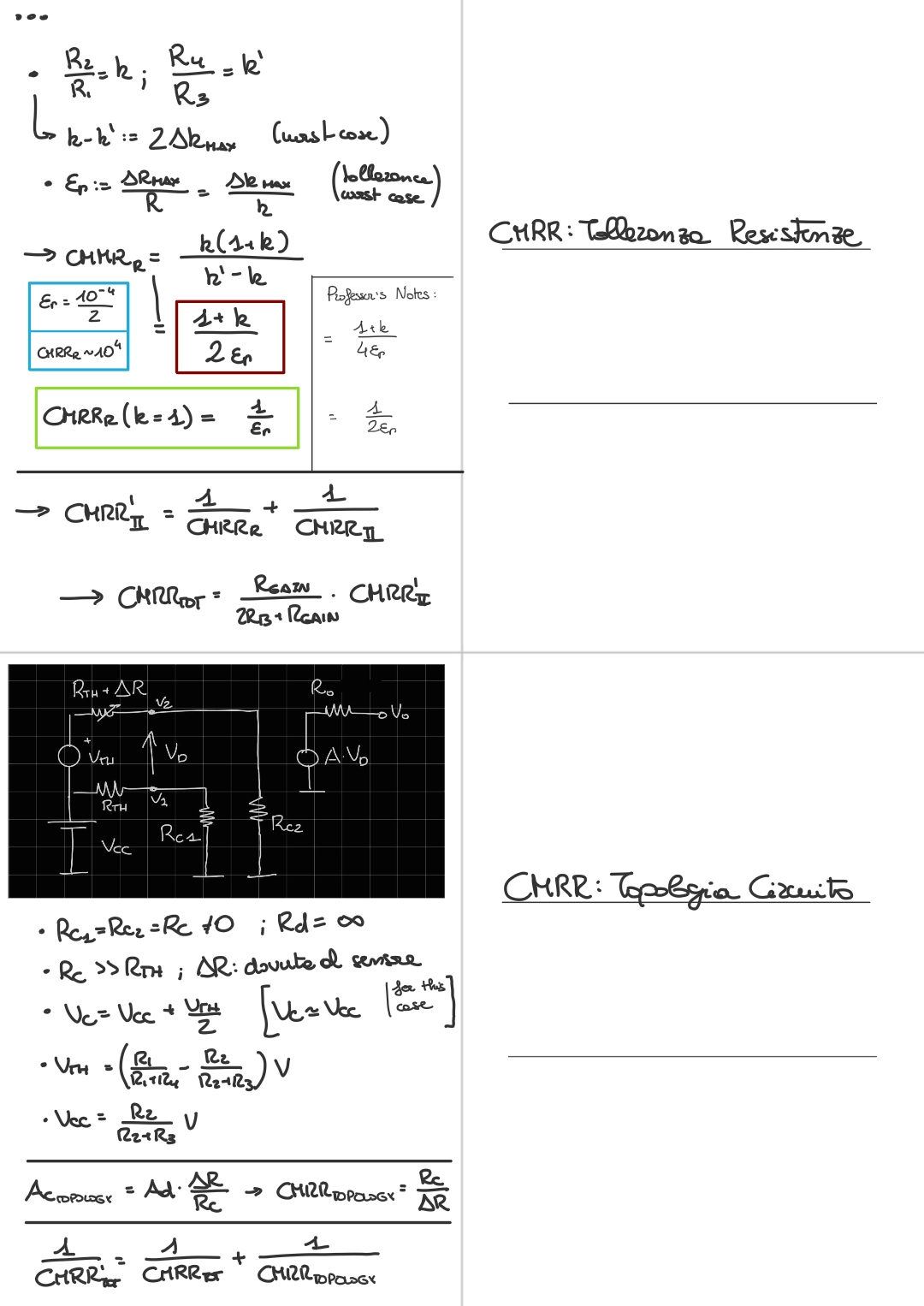
What happens, in a more realistic scenario, where we consider different resistance ratios, since having two resistence exactly equals is extreamly difficult, so:Let’s define the worst case scenario, if assumes the lowest possible value and the highest, so we’ll write it as:And define the resistance tollerance:
For semplicity we don’t consider no contribution from the operational amplifier common mode rejection ratio, so I’m accounting only for the fact that the resistances () are not precisely what I would like to have from the design, so tolerances of the resistances.
That’s why we will call it "".
Let’s calculate the CMRR based on this new rule:So:IMPORTANTE Here’s the calculations. We can the use the definition we have given for the resistance tollerance If we consieder: (so ) We obtain that the last stage of the CMRR due only to resistance tollerances is given by:
NOTE:IMPORTANTE Usually we find: So the
If these resistances are realized in an integrated circuit (IC), so with the same process, at the same moment, very close one to the other, then the matching is a parameter that could have a very high accuracy. This is the reason why we can’t build our own instrumentation amplifier we have to buy it, in an integrated form.
If we want to get the complete CMRR, also considering the contribution based on the resistances’ tollerance, we can calculate:Where:
- is the one we have just calculated, so
- was calculated here, and we found it equal to:
Then we need to calculate:Where:
- was calculated here, and we found it equal to:
Memory Card